Showing posts with label religion. Show all posts

Wednesday, July 10, 2019

China: Influenced by and Influencing the West

"Western Knowledge Flowing into the East"

Since the 16th century, with the opening of sea routes and development of sea trade, the distance between the East and the West drew closer and closer. Europeans could come into direct contact with the mysterious Orient, discovery complexity and the richness of Chinese civilization, and the Maritime Silk Road was the link of communication between the two worlds.

European merchants and missionaries unceasingly arrived to promote and market their lifestyles, religion and sense of values, while the mainstream mentality of the Chinese empire responded mostly with defense, restriction and objection. The delineation between Chinese and foreign things and the notion that "our heavenly kingdom is perfect in every way" severely hindered the rational observation and awareness of the world outside of China.

From the Ming to early Qing, foreign missionaries, while carrying out missionary work, also introduced Western science and technology to the Chinese and ultimately advanced the development of science and technology for the Ming-Qing China.

Map-making


Well-known missionary Matteo Ricci was a literati, and at the same time, affluent in astronomy, calendric systems, geography, mathematics and engineering, among other knowledge and fields of study. After coming to China, he continually presented Western sciences to Chinese governmental officials and scholars, especially the knowledge of astronomy and geography. In Zhaoqing City, Matteo Ricci re-illustrated the map of the Western world, accompanied by Chinese annotations (this is the famous Complete Map of the Earth's Mountains and Seas). In 1601, after entering Beijing, Matteo Ricci made special efforts to illustrate the Complete Map of the Myriad Countries of the World, in which he divided the earth into "five continents" and "five zones" [terms still used today unlike the Western concepts of the seven continents and the seven seas]. The five continents were Asia, Europa, Libia (Africa), Americhe and Magellanica (Antarctica); the five zones were the north frigid zone, north temperate zone, tropical zone, south temperate zone and south frigid zone. And to suit the traditional concept and custom of China [that yellow represents the emperor and since yellow is central, the emperor must be in central position], Matteo Ricci placed China at the center of the map, making Emperor Wanli quite pleased. [Typically when a country makes a map, their country is centrally located.]

Source - Jesuit missionaries, like Fr. Matteo Ricci, and Adam Schaal von Bell (above) recognized that the coherence between the teachings of Christianity and those of Confucius, made Chinese civilization receptive to Western Science.

Matteo Ricci introduced to the Chinese that the earth was round, as well as concepts of the north and south poles, the equator, longitudes and latitudes, to name a few. The new knowledge completely overthrew "the heaven is round and the earth is square" theory, and widened the horizon of many Chinese.

After Matteo Ricci, there was Didace de Pantoja (1571-1618) who was ordered by Emperor Wanli to translate the European map (a work which remained unfinished). In 1623, Giulio Aleni (1582-1649) completed the An Extra Record of Geography, a book illustrating the customs and geography of the countries in five continents, a rather complete account of world geography. In the early Qing Dynasty, missionaries including Luigi Buglio (1606-1677) and Ferdinand Verbiest together compiled the Important Accounts of the Western World, specially devoting attention on Western countries, their people and routes, a book which complemented Matteo Ricci and Giulio Aleni's works.

Source - Beijing observatory, designed and built by Fr. Ferdinand Verbiest.

The Italian Jesuit missionary Martino Martini (1607-1661) on the basis of field surveys, combined academic achievements from Chinese and foreign scholars, published the New World Map and the Map of the Chinese Empire in Augsburg in 1654. The following year he published Novus Atlas Sinensis (New Atlas of China) in Amsterdam (it's contents were detailed and precise), and Martini was considered the "father of geographical studies on China" in the West.

In 1707, Emperor Kangx ordered missionaries Joachim Bouvet (1656-1730), Jean-Baptiste Regis (1663-1738) and Pierre Jartoux (1668-1720) along with Chinese scholars He Guodong, Ming Antu and others to organize a cartography team, which then traveled to every province of China. Using longitudinal and latitudinal coordinates, they drew a detailed map of China: Complete Map of the Empire of Kangxi, a cartographic work considered very advanced.

Calendars

In 1601, Matteo Ricci had recommended the Western calendar to Emperor Wanli in Beijing, and Matteo along with scholar Li Zhizao and others finished many works, including Illustrated Explanation of the Sphere and Astrolabe, by using the Western calendar, knowledge in mathematics and in geography.

Following Ricci, other Jesuit missionaries like Didace de Pantoja, Sabbathin de Ursis (1575-1620), Nicolas Longobardi (1559-1654) Jean Terrenz (1576-1630), Johann Adam Schall von Bell arriving in China were affluent in astronomical calendars. They served the Chinese government by translating western teachings, participated in the revision of the calendar, made astronomical equipment, and contributed to the reforms of the calendric systems of the Ming and Qing dynasties, which ultimately abolished the old system of Datong Calendar and implemented the new Shixian Calendar.

Other Developments


During the Ming and Qing dynasties, missionaries introduced other Western disciplines to China, some of which included physics, agronomy, biology, medicine, architecture, music, fine arts, linguistics, philosophy, and more. There were also hands-on executions in the areas of horology, firearms, gardening, to name a few.

China Influencing Europe and America

Since the 16th century, Europeans who visited China were mostly missionaries, and they introduced a great deal of Chinese culture to the West. The missionaries studied Chinese literature and were pioneering figures in Western Sinology, and profoundly influencing modern cultural development in Europe. The Jesuits periodically reported in writing to the Church about developments in China, and these writings were the most crucial materials for informing Europe about Chinese thinking and culture.

Chinese literary works translated by missionaries included The Doctrine of the Mean, The Great Learning, and The Analects of Confucius by Prosper Intercetta (1599-1666), Confucius Sinarum Philosophus by Philippe Couplet (1624-1692), The Four Books, Book of Filial Piety, and Learnings for Children by Franciscus Noel (1651-1729), Idea Generalis Doctrinae libri Ye Kin by Joachim Bouvet, The Book of History by Antoine Gaubil (1689-1759), and more.

In the 18th century, translated by Jesuit missionaries, as many as 15 volumes of Chinese works on history, science, arts, and customs appeared in Europe. And disseminators of Chinese culture beyond missionaries were the journal logs of navigators along with adventurers and merchants to China.

Evidence of Chinese influence beyond China


18th century French ideologist Denis Diderot (1713-1784), Baron d'Holbach (1723-1789) and leaders of the French Enlightenment movement Montesquieu (1689-1775) and Voltaire (1694-1778) appreciated traditional Chinese culture and were keen to absorb its soul. Voltaire especially was an advocator of Chinese philosophy, ethics, and politics, and in his eyes, Confucius was greater than Jesus. Voltaire dreamed of finding a "rational religion" in which Confucius served as its model.

Traditional Chinese thinking with "emphasis on agriculture" profoundly impacted "physiocratic" theories of French economists Francois Quesnay (1694-1774) and Anne Robert Jacques Turgot (1727-1781). German philosopher Leibniz (1646-1716) was fascinated by the Yi Jing (The Book of Changes) and diagram of the 64 hexagrams, which influenced his Monodology and Natural Law. The great Russian author Leo Tolstoy (1828-1910) performed systematic studies on Chinese thinking and culture late in his life, particularly praising Lao Zi, whom he referred to as his "most adored philosopher".
 
 The eight trigrams and the 64 hexagrams
 
In the 1760s British classical economist Adam Smith (1723-1790) learned of Chinese physiocracy and policies through Francois Quesnay, and this knowledge became a principle ideology behind his classical masterpiece on political economy, An Inquiry into the Nature and Causes of the Wealth of Nations (Wealth of Nations).

In the 17th and 18th centuries large quantities of Chinese silk, porcelain and tea in fad proportions were shipped to Europe, along with household items like fans, sedan chairs, wallpapers, and garments, Eastern cultural additions which brought a poetic and fresh feeling to the West. 
 
Pair of large imari vases
From the 1770s to the 1780s, the pinnacle of "Chinese fashion" manifested in consumer fashion as well as in art style. The art style was a rebellion and negation against the Baroque art style that dominated Europe before the 18th century. This new style called "Rococo", originating from the French word "rocaille," which means having the characteristics of fineness, lightness, flamboyance, intricacy and dynamism. This style primarily influences landscape architecture that advocated Chinese fresco with floral patterns, home furniture with Chinese flower and bird paintings, Chinese prints, etc. Rococo art was popular in Europe for about a century until neoclassicism in the 1760s emerged and gradually became the mainstream art of Europe.
 
__________________________________________________________________________
 
Text Source:
 
This fascinating selection was taken from Li Qingxin's 2006 book "Maritime Silk Road", translated by William W. Wang, and published by China Intercontinental Press, pp. 183-189. An absolute read for the historian!

Thursday, June 8, 2017

The Zookeeper's Wife

The Zookeeper's Wife is a war story about Warsaw under siege and the Jewish holocaust. Jan Zabinski, the zookeeper, and his wife Antonina ran the Warsaw zoo, but when the animals were shot for sport by a German zookeeper Lutz Heck after selectively taking the preferred and rare animals (European bison, Przywalski horses which had only been "discovered" in 1879, and a few others) for Nazi selective breeding, Jan and Antonina stayed on at the zoo to assist in the running of a fur farm for making fur coats for the Nazis. [Under the Third Reich, animals became noble, mythic, almost angelic -- including humans, of course, but not Slavs, Gypsies, Catholics, or Jews. Therefore, breeding programs were for the selected animals and medical procedures and experiments were for the undesirably "humans". The subjects of Auschwitz's operating doctor Mengele could be operated on without painkillers, but a remarkable example of Nazi zoophilia was that a leading biologist was once punished for not giving worms enough anesthesia during an experiment.]

The zoo, despite its loss of wild animals, was a cover for hiding Jews right under the invaders' noses. In the course of the war Jan and Antonina managed to save 300 by hiding them on the zoo grounds, which were, by the way, right next to a Nazi compound. The Jews referred to as "guests" were given animal names that reflected their character and their cage of domicile. This naming method also prevented slip-of-the-tongues or prevented people who overheard their talk from guessing the truth of what really was going on at the zoo. The people who lodged in the lion's cage were, therefore, called the lions. "Pheasants" often came in the night and lodged in the pheasant house, only to fly a few days later when their trail wasn't so hot. 


During the five years of the war, 860,000 Poles were uprooted and resettled; 75,000 Germans took over their lands; 1,300,000 Poles were shipped to Germany as slave labor, and 330,000 simply shot. With ingenuity the Polish Resistance sabotaged German equipment, derailed trains, blew up bridges, printed over 1,100 periodicals, made radio broadcasts, "illegally" taught in schools and colleges (attended by 100,000 students), aided Jews in hiding, supplied arms, made bombs, assassinated Gestapo agents, rescued prisoners, staged secret plays, published books, held its own law courts, and ran couriers to and from the London-based government-in-exile. At the height of the war, 380,000 soldiers with Jan Zabinski among them comprised the military wing of the Home Army.

Jan was the leader of an Underground cell, and he used the delivery of hay and fodder for the animals as a way to bring in and pass on explosives and other counter-intelligence equipment, which Antonina never knew about until after the war. He poisoned pigs, butchered them, and then arranged the meat to be eaten by German soldiers. During one month in 1943, his cell derailed 17 trains and damaged 100 locomotives! Antonina basically knew that he was part of the resistance but not that he led parts of it so actively, often narrowly escaping capture or death. Antonina would only learn of his great exploits after the war and Jan's return from a POW camp. Jan figured that Antonina had enough stress on her plate with taking care and protecting her very young son, and of course ensuring the meals, shelter and safety of her continue flow of "guests".

In the earlier part of the war Germans established food lines for the starving people of Warsaw. They calculated a calorie-feeding system for the differing races who stood in three separate food lines based on race. The Germans received 2,613 calories of food per day, the Poles 669, and the Jews 184. German Governor Frank who controlled all matters in Warsaw declared, "I ask nothing of the Jews except that they disappear."

According to German figures, Germans shipped 316,822 people from Warsaw to concentration camps between early 1942 and January 1943. Many were shot in the ghetto so the death rate was actually much higher. Aided by friends on the Aryan side, tens of thousands escaped the ghetto, but some who stayed, such as Kalonymus Kalman Shapira, the ghetto's Hasidic rabbi, revealed a tigerish struggle with faith as was discovered after the war by his discovered diary. How could anyone reconcile the agony of the Holocaust with Hasidim, a dancing religion that teaches love, joy, and celebration? During World War II, 30-40% of the world's Jews were killed, but more specifically 80-90% of the Orthodox community was wiped out; this was the group that kept alive the ancient tradition of mysticism and meditation traced back to the Old Testament world of the prophets.

In 1941, Governor Frank decreed everyone must have an identity card complete with serial number and fingerprints. For two years, Polish offices responsible for making the cards stalled. Meanwhile, they along with Underground offices and greedy opportunists were able to set up a system for making fictitious identity cards. Hordes of people suddenly seemed to have lost their records (born in Russia, born to Muslim Poles, records burned in a church fire), so needed to reissued identity credentials. By 1943 it was commonly known that 15% of all identity cards and 25% of all working papers had been forged.

After the war and his return from the POW slave labor camp, Jan was forced to retire from zookeeping at the age of 54. Times were hard after the war and anyone who praised pre-war independence or resistance during the war (and especially for someone who fought in such a war) were judged to be dangerous. Jan retired from zookeeping but still devoted to zoology, he focused on writing and ended up writing 50 books on the lives of animals and conservationism. He also spent much time writing and researching the pedigree of the European bison that had been returned to Warsaw by Lutz Heck, which turned out to be good since Germany was bombed right afterwards killing its bison herd. Antonina, after the war, stayed in contact with the former "guests" who were spread among many countries. She and Jan never left Poland, but their hearts remained bound with all of the many people they helped save.

(Fascinating source article)
Some of the 300 "guests were Irena Mayzel, Kazio and Ludwinia Kramsztyk, Dr. Ludwig Hirszfeld (a specialist in communicable diseases), Dr. Roza Anzelowna from the National Hygiene Institute, the Lemi-Lebkowski family, Mrs. Poznanska, Dr. Lonia Tenenbaum, Mrs. Weiss (wife of a lawyer), the Keller family, Marysia Aszer, journalist Maria Aszerowna, Rachela Auerbach, the Kenigswein family, Drs. Anzelm and Kinszerbau, Eugienia "Genia" Sylkes, Magdalena Gross, Maurycy Fraenkel, and Irena Sendler, among many others. All 300 "guests" survived the war except Kazio and Ludwinia Kramsztyk (cousins of renowned painter Roman Kramsztyk), Dr. Hirszfeld (specialist in infectious diseases), and Dr. Roza Anzelowna and her mother. They were arrested by the Gestapo a few months after leaving the zoo and were summarily killed.


Tuesday, May 23, 2017

Perspective: Earth, Planets, the Sun

Seeing earth in relation to some of our nearest planet-neighbors makes us feel rather large, proud of our somewhat superior size, proud of the space we occupy in space.


Until we put our prideful size up against some of the larger planets, and even the sun, and our pride diminishes quite rapidly for we realize that we are relatively nothing ... despite us in our arrogance, not quite literally but figuratively, acting like the universe revolves around us, our desires, our needs, our goals. In size comparison, our pride can sure deflate quite rapidly. Our arrogance only can take a minute breath in space ... there's just so much more out there!


And then we put our tiny little planet with its millions of people with greatly inflated prideful ethnocentric egos next to the brightest star in the sky, Antares which is more than 1000 light years away, and we gulp as we pale at the comparison and insignificance of ourselves.


Now, to go a step further into the vastness of space and realize our less than insignificance in the grand scheme of revolutions and the organized display of brilliance above ... We look through the Hubble telescope at the ultra deep field using an infrared view and we see "countless" numbers, a vastness that our tiny eye with the aid of our most powerful scope can only manage a flickering glimpse of. There in that eyepiece are entire galaxies billions of light years away ... and we know that this is only a shadow of the vastness of the universe! In relation, we are next to nothing!


Even when we focus a look at the darkest region in space, we realize that the size there cannot possibly compare to our grain-of-sand-in-space volume. We ... are ... infinitesimal.


And yet, Someone knows how many hairs are on each of our heads, and the workings of earth are so important to Him that not a single sparrow dies apart from His will. (Matthew 10:29-31)

That makes little tiny us feel pretty darn special, and yes, very important in God's eyes!

______________________________________________

Here is a 2:33 minute YouTube clip [Star Size Comparison HD] 
of the moon, planet, and keynote stars, all in relationship to amazing size.  

Friday, September 11, 2015

King Peggy: From Secretary to King

August - September 2008:

Peggielene Bartels, secretary to Ambassador Kwame Bawuah-Edusei and divorcee of a ex-husband she was still in love with, worked virtually from sun-up to sundown as a secretary at the Ghanian embassy. She had no personal life; she dedicated it to her office job at the embassy, making sure that behind the scenes, the embassy was well-oiled and efficient. For 29 years she had worked in administrative positions in Washington DC, meeting African heads of state and US senators and planning glittering parties. Born in Ghana, she had been something of an anomaly, a female with a mouth, spirit and an attitude in the male-dominated society that just didn't fit. And then she got the strange 4 a.m. call, the call that transformed her from mere secretary to king of a city in Ghana ... if she would accept. She thought and thought and the spirits told her to accept. She knew if she did, finally her strong male-like outspoken qualities could be put to use in her home country of Ghana.

She had been raised a Christian, or at least having Christian principles, but she never totally turned her back on the spirits of her homeland for to do so would be disastrous. She poured water for her mother's spirit every night and schnapps every morning for everyone knew that the spirits were always thirsty. In the same way, Peggielene had been "chosen" to be the next king by the pouring of schnapps and the schnapps bubbling over when her name was intoned, thus the spirits informing the elders that Peggielene, the only woman on the list of 25 people suggested to be king, should be the one chosen and crowned.

Peggielene thought about the proposition but didn't readily accept. There were too many big considerations, and the biggest was that Otuam, the city she was to govern, was flat broke, the palace in total disrepair and the infrastructure for water and education almost non-existent. The task would be momentous, not to mention that she couldn't become king until the previous king, who was in refrigeration and incurring daily costs by being there, was properly buried with a big sendoff and that could only be done in the right setting - a totally refurbished palace. Where would she get that kind of money?!

After careful deliberation and the spirits seeming to speak to her constantly about accepting, she did. She flew to Otuam, Ghana and immediately missed her air-conditioned apartment, especially when she discovered that five people would be sharing her simple little hot room, because she was king and her relatives spirits would be needed in the room to protect her. She didn't think a slumber party at her age was fitting, but what could she do? She went to take a shower, and the bucket on the bathroom floor reminded her that there was no running water in Otuam. She bucket bathed.

The next day Peggy went to meet her elders, old, crafty and dishonest ... as she somewhat suspected and soon found out just how sneaky and snaky they were, for whatever money was collected in taxes went into their pockets and whatever money she gave for the restoration of her palace or anything else, never got beyond their pockets. And it was dishonorable to fire them ... they were men, and her elders and had been elders to her uncle the previous king. In time, she learned and on her second visit to Otuam, she began confronting them and voicing her strong opinion. Her favorite roar to a couple of her elders was, "You have elected a man with breasts! Maybe I don't have balls, but for all that, I am a king and I am a man! ... I am going to squeeze your balls so hard your eyes pop out!" But that was later.

On her first visit to Otuam, Peggielene evaluated what must be done to bury the king, prepare the palace for the burial ceremony and for her acceptance and crowning as king, in which her "stool" would be venerated and libations of schnapps poured daily to it. The stool in Ghana is like the metaphysical chair of enthronement. It is a decorated stool of some material that takes on spiritual qualities once a king is crowned, or rather "enstooled". And henceforth, the new king and all the king predecessors would have libations poured to them on the daily basis, and the elder pouring the libations would discuss spiritual matters with the stool ... or perhaps it would be better to say, the stools conveyed spiritual matters to the pourer of the libations and he in turn would pass the matters along to the enstooled king.

As a woman with strong opinions and which had been furthered sharpened in her years in the UK and the US, she had big ideals for her little Otuam village. She intended to end wife-beating, a chronic problem; she planned on getting medical aid for people and a midwifery clinic; the town desperately needed running water, and of course better education was a priority too. Of course getting a decent road to Accra would be needed, and then more people and statement would be inclined to visit. She continually added to the list of "needs" for her Otuam. And as a barren woman who could never have children, thus the reason for her divorce, she now had 7,000 children ... and she intended to take care of them. She might have been useless as a wife who was incapable of bearing children children, but she didn't intend to be useless as king who takes charge over "his" children.

She scrimped and scraped money, confronting dishonest elders to get money; she revised the board of elders to create a more honest arrangement, putting hard-working fishermen and even sharp-meeting women on the board, she suddenly the village started paying attention to her as king, and the money that had previously been given to the elders was now transferred to the proper hands, and thus to the coffers of the town, and so progress could start to be made!

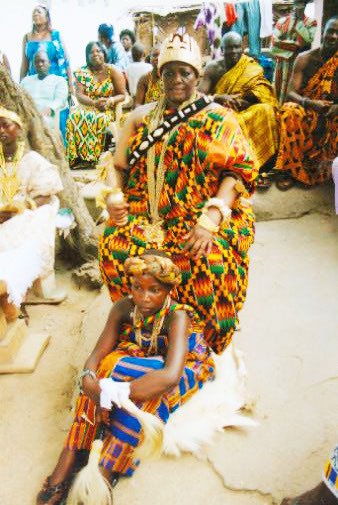
On the day of her "enstoolment" she ate her anti-urinary breakfast of boiled yams, palm oil and hard-boiled eggs (for a king must never be seen doing the basic functions of a man while holding court, which by the way could be every day). And sitting behind the Soul, a young vestal virgin girl whose own spirit would buffer that of the king's, Peggielene became king of Otuam, and finally a king-mother to 7,000.

Coronation day:  King Nana Amuah-Afenyi VI  of the Otuam people, sitting in state with her "soul," Nana Ama, twelve, the little girl whose innocence shields the new king from jealous evil spirits. Source

November 2010 - early 2011 (The book King Peggy: An American Secretary, Her Royal Destiny, and the Inspiring Story of How She Changed an African Village was published in 2012.)

After making wife-beating a punishable crime in Otuam and sinking two wells for public use and arranging for a Baptist school to be opened, King Peggy gained the respect of her people in the down-trodden poor town where the elders stole the town's tax money and spent it for themselves. Since becoming king, Peggy has been saving fishing fess and land sales to build a public latrine and create a library with Internet access for Otuam's kids. Nearby towns and city of Accra recognizes that King Peggy is building Otuam into a modern city and connecting roads are being repaired, resulting in investments in the town and the opening of shops, gas stations and other conveniences.

In October 2011, Pastor Colleton and members of Shiloh Baptist Church traveled once again to Otuam to submit a letter of intent for building a high school and meet with parents and kids to decide on scholarship awards and register them for scholarship programs. Furthermore, King Peggy and Pastor Colleton visited hospitals in Accra to determine the equipment and training needed for Otuam's nurses in order to open a medical center. Ambulances were also looked at for purchase.

The demands of Otuam are great and the income is small. All charitable efforts for the development of Otuam are to be directed through the Shiloh Baptist Church (on Facebook). Meanwhile, King Peggy continues her work as a secretary back at the Ghanian embassy in Washington DC. She is proud of her career, and the income, especially as being a king requires more income than her town at present can generate ... and she has such big goals for her town ... and so she continues to work for her 7,000 children.


Friday, September 26, 2014

"Princess" of Saudi Arabia

The book Princess by Jean P. Sasson is "an appalling indictment of the treatment of women in Saudi Arabia" and an "unforgettable ... fascinating book to move you to tears". The book is about one of over a hundred-plus princesses, the granddaughters of Abdul Asis ibn Sa'ud, who speaks out to Jean Sasson to write the conditions of women forced to hide behind the abaaya, the black veil. Women are not owners of their own bodies, their own destinies, or their even their own children. They are chattel to men, passed off after menses at early ages to become wives, sometimes second, third or fourth wives, and quite frequently these husbands are as old, if not older, than their own fathers. The women must obey their husbands implicitly, prepare their bodies to be used by their husbands upon demand, be ordered to appear or not appear, be escorted by men wherever they go. When their sons become older and the husbands cannot provide escort, then the sons are the escorts.
Sultana, the princess in the book, is fiery and wants the world to hear the conditions of the Saudi Arabian women to give the world understanding and not be afraid of the only visible parts of women - the blackness of their eyes and the blackness of their robes - and to judge that limited dark view of women. Sultana cannot escapes her gilded princess cage in Saudi Arabia. She remains the property of her husband, and sees her daughters grow up to become property themselves. Yet, to speak out even slightly would mean to denounce Saudi Arabia, the Koran, and/or her own husband, and any insult to any of them would mean her being sentenced to some punishment away from her children, and so she continued to silently exist in her gilded cage ... but with the knowledge that the book Princess would be published and begin to let the Western world have some understanding about the "freedom", or lack of it, of the Saudi Arabian women.

The Laws of Saudi Arabia


The criminal laws of Saudi Arabia adhere to strict Islamic precepts. The word Islam means "surrender to the will of God". The most important concept of Islam is the Shari'a, or the "path", which embraces the total way of life ordained by God. All peoples of the Islamic religion are expected to conduct their lives by the traditional values set by Muhammad, the Prophet of God, who was born in AD 570 and died in AD 632.

It is difficult for most Westerners to understand the complete and total submission of Muslims to the laws of the Korean in every aspect of their daily life. The Koran, along with traditions set by Muhammad, is the law of the land in Saudi Arabia.

While Jean Sasson was living in Saudi Arabia, she once asked a noted scholar of Islam who made his living as a lawyer, to describe the Saudi Arabian application of justice that stems from the teachings of the Prophet. His explanations helped dispel her misunderstandings of Saudi law.

  1. There are four main sources of the Shari'a: the Koran, which is compiled from thousands of religious verses revealed by God through his Prophet, Muhammad; the Sunna, which are the traditions the Prophet addressed that are not recorded in the Koran; the Ijma, which are the perceptions of the Ulema, or religious scholars; and the Qiyas, which is a method whereby known jurists agree upon new legal principles.
  2. The king of Saudi Arabia is not exempt from the regulations set forth by the Shari'a.
  3. The court system itself is complicated, but if a judgement is taken to appeal it is reviewed by the court of appeals. This court, usually consisting of three members, increases to five members if the sentence imposes death or mutilation. The king is the final arbitrator who serves as a final court of appeal and as a source of pardon.
  4. Crimes are classified into three divisions: Hudud, Tazir, and Qisas. Crimes of Hudud are crimes that are denounced by God; the punishment is made known in the Koran. Crimes of Tazir are given to the appropriate authority to determine punishment. Crimes of Qisas give the victim the right to retaliate.


CRIMES OF HUDUD

Crimes of Hudud included theft, drinking of alcohol, defamation of Islam, fornication and adultery.

Persons found guilty of theft are punished by payment of fines, imprisonment, or amputation of the right hand. (The left hand is amputated if the right hand has already been amputated.)

Persons found guilty of drinking, selling or buying alcohol, sniffing drugs, taking injections of drugs or stirring drugs into dough are punished by a sentence of eighty lashes.

Persons found guilty of defamation of Islam are sentences according to the circumstances. The harshness of the sentence varies depending on whether the person is a Muslim or a non-Muslim. Flogging is the general punishment for Muslims.

Persons found guilty of fornication are flogged. Men are flogged while standing and women while sitting. The faces, heads and vital organs of the guilty are protected. The usual number is forty lashes, but this number may vary according to the circumstances.

Adultery is the most serious of crimes. If the guilty party is married, her or she is sentenced to death by stoning, beheading or shooting. Stoning is the usual method of punishment. Proof of the crime must be established by confession or by four witnesses to the act.

CRIMES OF TAZIR

The crimes of Tazir are similar to misdemeanor crimes in America. There is not set punishment, but each person is judged on an individual basis, according to the seriousness of the crime and the sorrow shown by the criminal.

CRIMES OF QISAS

If a person is found guilty of crimes against an individual or a family, the aggrieved family has the right to retaliate. The sentence is decided in private by the family, and the actual punishment is carried out in private.

If murder has been committed, the family has the right to kill the murderer in the same method their loved one was murdered, or in any method they choose.

If a member of a family was accidentally killed (such as a road accident), the family of the deceased may collect "blood money". In the past, camels were used as pay for blood money; today the rate of exchange is in currency. There are set damaged according to the various circumstances: the payment can be anywhere from 120,000 to 300,000 Saudi riyals ($45,000 - $80,000). If a woman is killed, the payment is half that of a man.

If a person cuts off another person's body part, the family or the victim may commit the same act upon the guilty party.
Who may testify in criminal proceedings: 
The witness must be deemed sane, the age of an adult, and a Muslim. Non-Muslims may not testify in criminal court. Women may not testify unless it is a personal matter that did not occur in the sight of men. Actually, the testimony of a woman is not regarded  as fact but rather as presumption. The court may decide whether the testimony is valid according to the circumstances.  
Why women are forbidden to testify in criminal proceedings: 
There are four reasons given why women's testimony is not valid in a Saudi court.
  1. Women are much more emotional than men and will, as a result of their emotions, distort their testimony.
  2. Women do not participate in public life, so they will not be capable of understanding what they observe.
  3. Women are dominated completely by men, who by the grace of God are deemed superior; therefore, women will give testimony according to what the last man told them.
  4. Women are forgetful, and their testimony cannot be considered reliable.

Chronology of the book:

570         Prophet Muhammad is born in Makkah, Saudi Arabia
610         Prophet Muhammad sees a vision from God proclaiming him to be the messenger of God. Islam is born.
622         Prophet Muhammad flees an angry mob in Makkah and escapes to Madinah. This flight is forever after known as “the Hegira”, the great crisis of Muhammad’s mission on earth. The Muslim calendar begins on that date and is called Hegira in honor of the journey.
632         Prophet Muhammad died in Madinah
650         The sayings of Prophet Muhammad are collected and written down. Known as the Koran, this book, which recorded the word of God as told by Muhammad, became the holy book of Muslims.
1446       The first documented Al Sa’ud, ancestor of Sultana, leaves the nomadic life of the desert and settles in Dar’iyah (old Riyadh).
1744       Muhammad Al Sa’ud establishes a partnership with Muhammad Al Wahhab, a teacher who believes in the strictest interpretation of the Koran. Combined forces of a warrior and a teacher unleash a rigid system of punishment upon the people.
1802-6    Sons of Muhammad Al Sa’ud and Muhammad Al Wahhab, inspired by the teachings of the Koran, attack and capture Makkah and Madinah. They are ruthless, massacring the entire male population of Taif, a settlement above Makkah. With this victory, most of Arabia unites under one authority.
1846-65  The Sa’uds extend authority southwards to Oman.
1876       Sultana’s grandfather, Abdul Aziz ibn Sa’ud, founder of the kingdom, is born.
1887       The city of Riyadh is captured by the Rasheeds
1891       The Al Sa’ud clan flees Riyadh into the Empty Quarter.
1893-4    The Al Sa’ud clan marches across the desert to Kuwait.
1901       September. Abdul Aziz, now twenty-five years old, along with his warriors leaves Kuwait for Riyadh.
1902       January. Abdul Aziz and his men capture Riyadh. The new Al Sa’ud dynasty begins.
1915       Abdul Aziz Al Sa’ud enters into an agreement with the British government to receive £5,000 per month to fight the Turks.
1926       Sultana’s father is born.
1932       Unification of the dual kingdoms of Hijaz and Najd. Named the Kingdom of Saudi Arabia, it becomes the twelfth-largest country in the world.
1933       Sultana’s mother, Fadeela, is born.
1934       Saudi Arabia goes to war against Yemen; peace is established one month later. 15 May. In revenge for the Yemen war, King Abdul Aziz is attacked at the holy mosque in Makkah by three knife-wielding Yemenis. His eldest son, Sa’ud, flings himself in front of his father and is wounded instead.
1938       20 March. Oil is discovered in Dammam, Saudi Arabia.
1939       War in Europe halts oil production.
1944       Oil production in the kingdom rises to 8 million barrels a year.
1945       14 February. President Roosevelt meets King Abdul Aziz aboard USS Quincy. 17 February. Britain’s prime minister, Winston Churchill, meets King Abdul Aziz aboard USS Quincy.
1946       Oil production soars to 60 million barrels a year. December. Sultana’s parents marry in Riyadh, Saudi Arabia.
1948       Radio Makkah, the first radio station in the kingdom, is opened despite fierce opposition from the Ulema (religious men). 14 May. The state of Israel is established. The first Arab-Israeli war begins.
1952       King Abdul Aziz bans alcohol imports for non-believers.
1953       9 November. King Abdul Aziz, Sultana’s grandfather, dies at the age of seventy-seven. His eldest son, fifty-one-year-old Sa’ud, becomes king. His half-brother Faisal becomes crown prince.
1956       Sultana is born into the family of Al Sa’ud, the tenth daughter of her parents.
1958       March. With the kingdom in financial turmoil, Crown Prince Faisal takes administrative control of the government.
1960       December. King Sa’ud dismisses his brother from administrative duties and assumes control of the government.
1962       Slavery is abolished in the Kingdom of Saudi Arabia. Most slaves continue to live with the families that owned them.
1963       The first girls’ school opens; religious factions riot.
1964       3 November. King Sa’ud abdicates and leaves the kingdom for Beirut. Faisal is declared king, and his half-brother Khalid crown prince.
1965       Despite protests, the first television station is opened in Riyadh. September. Prince Khalid ibn Musa’id, nephew of King Faisal, is killed as he leads an armed protest against the opening of the television station.
1967       June. The Six-Day War begins between Israel and her Arab neighbors. Saudi Arabia sends forces.
1969       February. Deposed ex-king Sa’ud ibn Abdul Aziz dies in Athens after spending more than $15 million each year of his exile.
1973       6 October. The October 1973 war begins between Israel and her Arab neighbors. Saudi Arabia sends troops. 20 October. Furious at America’s military assistance to Israel, King Faisal announces a holy war and oil embargo against America.
1975       25 March. King Faisal is assassinated by his nephew Prince Faisal ibn Musa’id, brother of the prince who was shot and killed during a riot in 1965. Crown Prince Khalid is declared king. His half-brother Fahd is named new crown prince.
1977       King Khalid issues a government decree that forbids women from traveling outside their homes unless accompanied by a male family member. A second order follows that forbids women from traveling abroad to study. Both decrees resulted from an international incident involving Princess Misha’il, who was publicly after meeting and falling in love with another Saudi student in the American University in Lebanon. Her lover was beheaded.
1979       November. The Grand Mosque in Makkah is attacked. Protestors complain of women working outside the home in the kingdom. In the months to follow, women’s freedom is curtailed in response to government fear of increased fundamentalist unrest.
1982       June. King Khalid dies of a heart attack. Fahd, his half-brother, is declared king; his half-brother Abdullah is named new crown prince.
1990       5 August. Kuwait is invaded by Iraq. Western Allied forces gather in Saudi Arabia to join Arab armies in repelling Saddam’s army.

1991       Mutawas – the moral police of Islam – react with fear and hostility to the presence of the foreign female soldiers. Pressure increases to force the Saudi government to tighten restrictions on the female population of all nationalities as religious factions return to strict interpretation of the Koran.

Tuesday, September 9, 2014

Noah's Ark in Hong Kong

An incredible tourist attraction is in Hong Kong. Unfortunately, I didn’t take these pictures but received them along with the following information via email. Sad, but one day I will make a point of visiting the incredible modern-day version of Noah’s Ark.

The Noah's Ark Theme Park, complete with fiberglass animals exiting two-by-two, sits in front of the Tsing Ma Bridge in Hong KongThe Ark in Hong Kong measures 450ft long and 75ft wide and is built according to Biblical specifications.


The Ark also boasts less authentic Biblical touches such as double-glazed windows and a fine dining restaurant.

The billionaire brothers who built the Ark in Hong Kong claim it is the only full-scale version in the world, and the imaginative trio even attempted to give the giant boat an air of authenticity by placing 67 pairs of animals at the entrance, just like the pairs of creatures saved from the Great Flood by Noah in the Bible tale. The creationist-inspired vessel forms part of a theme park near Hong Kong, which was inspired by a young girl's scrawled drawing of the mammoth boat. Architects appear to have used some artistic license in parts of the Ark—for instance, including double-glazed windows, a fine dining restaurant and luxurious bedrooms.
 Also inside, real-life exotic animals live—including a nautilus, a toucan and reams of fish—giving the Ark credibility and some life-like authenticity.

The Noah's Ark Theme Park is now run by Christian organizations, who use it to promote peace and unity. Matthew Pine, manager of Noah's Ark Theme Park, said: “They had a vision to do something remarkable, something outstanding. They came up with many ideas. Some of them were really outrageous. But then they came across this girl's drawing, and knew it would be something do-able that captured imaginations. So they hired architects and engineers to create the replica Noah's Ark.” 

The Ark also includes a sophisticated-looking restaurant as one of its on-board attractionsGuests on board Noah's Ark can also stay on the Biblical vessel in one of its luxurious hotel-style rooms.


The Hong Kong-based Noah's Ark theme park was completed in 2009, 17 years after plans were made for the enormous structure, and it is popular among tourists. “The reason that particular moment of the Flood story was chosen from the Bible's story is," says Matthew Pine, "because this is the message
 we want to bring to Hong Kong, to China, to the world. 'In our lives we always face floods, we will face trials, we will face difficulties.
 Hopefully Noah's Ark will inspire people to pass
 through those troubles as Noah did in his day.'” 


Friday, August 8, 2014

A Fictionalized Monograph of an Aztec

The dust cover of Azteca by Gary Jennings reads:
"Once in a great while appears a book that combines the drama and immediacy of fiction with a deep knowledge and understanding of an exotic place and time — a book that excites and expands the imagination. In the last three decades, readers have been enthralled by Mika Waltari's splendid The Egyptian, Mary Renault's The King Must Die and James Clavell's Shogun. Now comes Azteca!" 
I've read Clavell's Shogun trilogy and now Jennings' Azteca, both of which were phenomenally researched and crafted with creative ethnology, so now I must go for Waltari's The Egyptian and Renault's The King Must Die, neither of which I'd ever heard of until picking up this book. When great literature is compared with other literary pieces and called similarly brilliant, the reader must listen to the erudite muse of print and ... read on!

The monograph 

And so begins the narrative of a quarrier's son, Mixtli, who was granted an ironic education, became a courier, a renowned warrior, a nobleman, an outcast, a wanderer, and a tradesman, but who ultimately died ignominiously at the hands of the "Christian" invaders who denied Mixtli his own Aztec spirituality and his own authenticity as the last keeper of ancient Aztec records. The narrative begins with him as an old gnarled and twisted man captured by the Conquistadores who want to hear and record a history of the Aztec people they have conquered and are decimating ... and who deny that Mixtli could possibly be telling the truth as Aztecs have no honor, no morals, and are on a ethnic hierarchy far below they themselves who are bringing Christianity to this uncivilized nation ... albeit in a violent bloodbath of deceit, treachery, and mercenary zeal that allows for no spiritual clemency or humanitarian act.


Mixtli, born with the Mexicatl dark spot like a bruise in the small of his back, begins his narrative by relating his abrupt entrance into the world in the Conquistadore year 1466, whereupon he was immediately plunged into a welcoming cold jar of water after which his severed navel string was wrapped around a little wooden war shield and given to the first Mexicatl warrior passing and who
was commissioned to plant the object somewhere on the next battlefield to better the boy's fate, destiny, fortune.

As a babe, his mother daily bathed his face in scalding hot lime water, as was the custom, to discourage the emergence of a beard throughout his adult life.

Mixtli tells of growing up and that lying, "speaking spittle and phlegm," was a grievous sin and punished by lower lip piercing of a thorn to curb such untoward behavior. He told of flags and tapestries made of fine feathers minus their quills — egrets for white, macaws and cardinals and parakeets for various reds, jays and herons for blue, toucans and tanagers for yellows. The colors and iridescence fluttered lively even in the softest breezes. But Mixtli intoned that the know-how for weaving these glorious flags died in the tumultuous years following the arrival of the Conquistadores and the passing of their virulent diseases (which he later related was ultimately what massacred the nation and not really the Conquistadores themselves).


He recalls wars and the need for wars even in peace time to feed the gods and keep them content. In times of peace when pestilence or a drought struck, the gods were thought to be angry and a war between alliances was arranged — not to kill on the battlefield but to take prisoners for sacrifice on temple altars. Warriors who died on the battlefield or as a temple sacrifice had a Flowery Death, that is, a death honorable to one's self and satisfying to the gods. To most effectively please the gods, alliances during the peace-time "wars" would sacrifice their captives on the same day and same hour. The god-nourishing blood of thousands of captives being sacrifices on the same day was thought to gorge the gods and make them replete so they would release their starvation caused by many (perhaps even as many as 20 or 30) warless years.

Using the term "flowers" to describe highly evocative situations was a literary motif of the Aztec. For instance, to give someone a "flower garland" was to kill them in sacrifice to the gods, "to destroy with flowers" was to seek retribution which almost certainly involved death, to have a "war of flowers" was to have a war among alliances for the purpose of taking prisoner-sacrifices to offer to the gods, and more benignly from a male's perspective, "to caress someone with flowers" was to seduce a woman.

Mixtli related that virginity of unmarried girls was required, and girls who went "astraddle the road" (prostituting) were deplored. However, some Aztec girls knew ways of proving their "virginity" on their wedding night. Pigeons fed with dark red seed of some flowers lay red-yolked eggs, so young virgins-to-be would secret an egg inside of them and would "prove" their virginity by the undetectable egg. The egg was used in conjunction with an astringent of buckthorn that would pucker the orifice to adolescent tightness. The Christian Conquistadore scribes were repulsed, insulted yet fascinated by the telling of Mixtli's tales of sexuality and war. The stories were duly documented but, though a baptized Christian of many years and his tales were of his culture or before his days as a Christian, Mixtli was thought to be repulsive to even speak such tales of blood, war and sexual appetites of himself, his people or his culture.

He told of the 5, not 4, directions of the compass — east, north, west and south, represented by the colors red, black, white and blue respectively. But green was the color to mark the center of where a person was at as well as all the space above as far as the sky and all the space below as far as the Mictlan underworld. Green, therefore, was a very important color for the Aztec, as for instance, only a child of a noble lineage could have a name reflecting a name with green in it, e.g. Jadestone Doll.

Mixtli spoke of Aztec medicine taken to the battlefield — salted honey or a healing salve of beeswax mixed with egg yolks, the juice of both adder bark and barbasco root as infection fighters. Soldiers, allies and enemies, too seriously injured in battle were knifed to death and all soldiers, friend or foe, were burned communally but each with a chip of jadestone in hand or mouth to honor their blood shed in battle and as symbols for their acceptance in the afterworld.

Just a cultural aside, the Conquistadores were culturally confused by the crosses found in the Aztec empire. To them, the crosses referenced a Christian burial, but to the Aztec the cross was a wayfarer symbol not for "reverence" but for "gladness" as it marked the presence of clear fresh water nearby.

Azteca as narrated my Mixtli tells of a nation at the height of its culture but in the depths of sacrificial depravity. He tells of the comings of the Conquistadores in the middle of his life, the deaths of all his family and friends, even his second wife who is dying of the disease "Being Eaten by the Gods" (leprosy). Finally, he tells of the overthrow of the Reverend Speaker (king) Montecuzoma and how Cortes, Alvarado and Narvaez lost the entire treasure of the dead king when they fled an uprising of the angry Mexicatl. And thus was lost the treasure now referenced as "the lost treasure of the Aztecs".


So Mixtli "kisses the earth" (swears or pledges honor) that he, as the last Rememberer of the Aztecs, has told his life tale with care and honor so that his history may be known to the conquerors, and yet he knows that before they strike him the last Rememberer down in cold-blood that the great Aztec history will similarly be chopped apart ... as the history of the Mexicatl / Aztecs is now in the hands of those who have no memories but are the usurpers of the nation.

AR (Accelerated Reading) score:   74 points, a very high score