Showing posts with label politics. Show all posts

Thursday, May 9, 2019

Human Trafficking (presentation)

Every semester I get outstanding presentations from my students, and some of those presentations touch on matters of global importance. Human Trafficking is such a presentation! Many people hear about human trafficking as an issue, typically as being in Southeast Asia and Africa, but few really realize that it is not a third world problem, but one that powerfully exists in first world countries as well! With great appreciation on the organization and research to my Public Speaking students (Roxanne Barth, Hyun Ji Choi, Min Park and Junil Lee of France, Guatemala, Guatemala, and Fiji respectively), I am able to publish this to hopefully raise wider awareness of the huge endemic social problem. Thank you my wonderful students for allowing me to share your important research!


Opening points were questions, not facts:

Are smuggling and trafficking synonymous? Definitely no! Smuggling is transportation based while trafficking is exploitation based.

Is the average age of entry into prostitution 12 - 14? No, that is a myth. No one really knows the average age. Many in the U.S. report entry into prostitution as 17 or younger, but the average age for prostitution in the U.S. (must stress that every country is markedly different) is thought to be 19.
_______________________________________________________________________

What is human trafficking?

SEX TRAFFICKING
LABOR TRAFFICKING
CHILD TRAFFICKING
DOMESTIC SERVITUDE


_____________________________________________________________

For more sites on human trafficking:

Human Trafficking Foundation (UK)
United Against Human Trafficking (Texas, USA)

And a series of 3 articles published by The Muse in one of Obama's January National Human Trafficking Awareness Months, seven worldwide organizations combating human trafficking were highlighted

Trafficking Policy and Advocacy: Polaris Project

One of the most influential groups working on the issue in the United States, the Polaris Project takes a comprehensive approach to ending modern-day slavery. The organization advocates for stronger federal and state laws, operates the National Human Trafficking Resource Center hotline, provides services and support for trafficking victims, and works with survivors to develop long-term strategies to ending human trafficking.

Second-Generation Trafficking: Prajwala

In India, children who grow up in brothels with their parents often meet the same fate. In order to counteract this dangerous legacy, social activist Dr. Sunitha Krishnan co-founded Prajwala (which means "eternal flame”). Based in Hyderbad, India, the organization rescues women from brothels and then provides them with education, mental health care, and job programs. (Check out Dr. Krishnan’s powerful talk at the 2009 TedIndia Conference.)

Statelessness and Child Trafficking: COSA

Most Hill tribes in Thailand are “stateless,” or not governed by the laws of the country—which makes their women and girls particularly vulnerable to trafficking. After recognizing this, photojournalist Mickey Choothesa and social worker Anna Choothesa created the Children’s Organization of Southeast Asia to provide education, intervention, and support in Hill tribe communities. COSA works directly within trafficking communities to provide trafficked girls with healthcare, social services, and housing in the Baan Yuu Suk Shelter—as well as to bring awareness and education to the traffickers themselves.

Trafficking of Men and Young Boys: Urban Light

A number of organizations help girls in the sex industry, but very few work to aid young men. After a service trip during which she observed the industry in Thailand firsthand, Alezandra Russel realized that boys are often excluded from the human trafficking conversation. So she created Urban Light, an organization that works to help young men break free from child prostitution and sexual exploitation. By providing food, shelter, healthcare, and support services, the group helps restore and rebuild the lives of male victims.

International Sporting Events: Student World Assembly’s Red Card Project

When a large sporting event, such as the World Cup, takes place, fears often arise that trafficking will increase to meet demand from the influx of tourists. Student World Assembly’s Red Card Project mobilizes students from around the world to stage powerful and striking condemnations of human trafficking at these events, bringing large-scale and needed public awareness to the practice.

Child Labor: GoodWeave

The handmade rug industry has one of the highest child labor rates in the world. When GoodWeave began its work in 1994, there were nearly one million children—many kidnapped or trafficked—working on the looms in South Asia, often for up to 18 hours a day. Through its efforts, the organization has not only helped bring child labor in the rug industry down 75%, it has built affiliations with retail outlets all over the U.S. to ensure that all carpets sold are free from child labor.

The Issue of Choice: The Empower Foundation

Not all who work in the sex industry do so against their will—some do so by choice. While the resources of most organizations aim to assist those exploited and hidden in the shadows, The Empower Foundation grew from a movement of sex workers and entertainers who fight for fair and sustainable standards and equal rights in the professions they have chosen. The group runs the Can Do Bar, which offers just, safe, and fair conditions for its workers.

Thursday, November 1, 2018

The Bear Wojtek: Beer-drinking World War II Hero

Every semester in my Academic English class I have a speaking contest of some kind. One semester it might be "for 4 minutes talk about your favorite book", and the students are put in 4-5 student groups to battle out the "most interesting book" of the class. They start at small group level and then verbally battle it out in a second finalist round. This semester I thought we would have the speaking contest on "weirdest of the weird" news item, and again students had to "market their story" as the "weirdest of the weird" to win the prize. Much like the major leagues, the contest isn't just one-round of story-telling, but involves two before the students can choose the class pick for the weirdest story told to them. We had some amazing stories, but the most memorable story from the class was not the weirdest-of-the-weird, "The Ear That Was Made with Van Gogh DNA", but the beer-drinking bear Wojtek of World War II who was a war hero! My history-buff student loves war stories so he scrounged for a stunner, and indeed, he won "most jaw-dropping" story in the class! Total consensus!


How an orphaned Syrian bear named Wojtek became a Polish army hero 
Wikimedia Commons
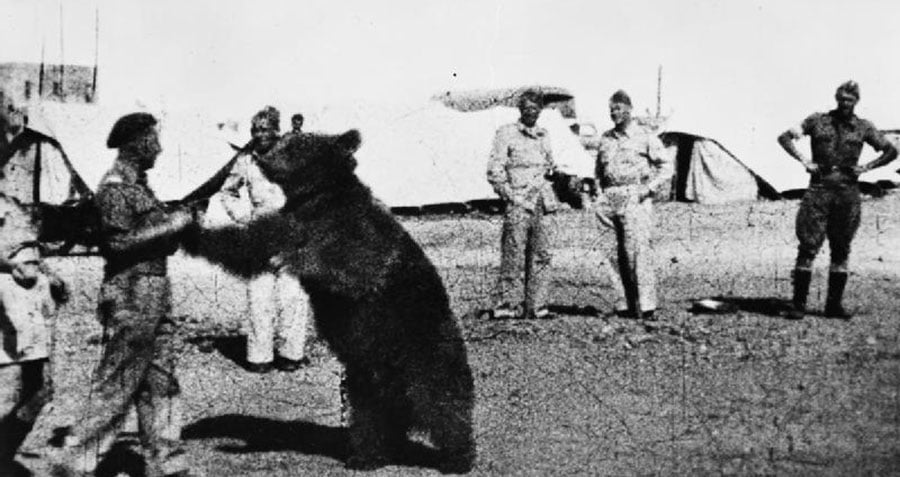
Troops of the Polish 22 Transport Artillery Company watch as one of their comrades play wrestles with Wojtek their mascot bear during the Middle Eastern campaign of World War Two, circa 1942-1943. 
Amid a long journey to join forces with the British Army in World War Two, one unit of the Polish II Corps stumbled upon an unlikely, and invaluable, comrade: A Syrian brown bear. 
A New Army And A New Mascot 

Poland bore a bulk of World War Two-related traumas. After the Nazis invaded Poland on September 1, 1939 — only to be followed by the subsequent Soviet invasion on the 17th — the country had only experienced a couple of decades of independence before it found itself under occupation once again. 
Following the invasions, Stalin and Hitler agreed to a nonaggression treaty, which effectively divided Poland in two. Hitler broke that pact on June 22, 1941, when he ordered an invasion of the USSR. 
In what came to be known as the Sikorski-Mayski Agreement, Stalin declared all previous pacts between the USSR and Poland to be null and void. Among other things, this allowed Poles to create their own army, despite technically being on Soviet soil. That they did, and the army became the Polish II Corps led by Lieutenant General Władysław Anders. 
In the spring of 1942, the newly-formed army left the USSR for Iran, along with the thousands of Polish civilians released from Soviet gulags. On the way to Tehran, the traveling Poles encountered an Iranian boy in the town of Hamadan who had found an orphaned bear cub. Irena Bokiewicz, one of the civilians, was so enamored with the cub that one of the lieutenants purchased him in exchange for a few tins of food. 
The cub became a part of the 22nd Artillery Supply Company, and soon received its own Polish name, Wojtek (pronounced voy-tek), which translates to “joyous soldier.” Wojtek traveled with the company through the Middle East, as the unit made its way to join forces with the 3rd Carpathian Division of the British Army in Palestine. 
Wojtek the Bear 
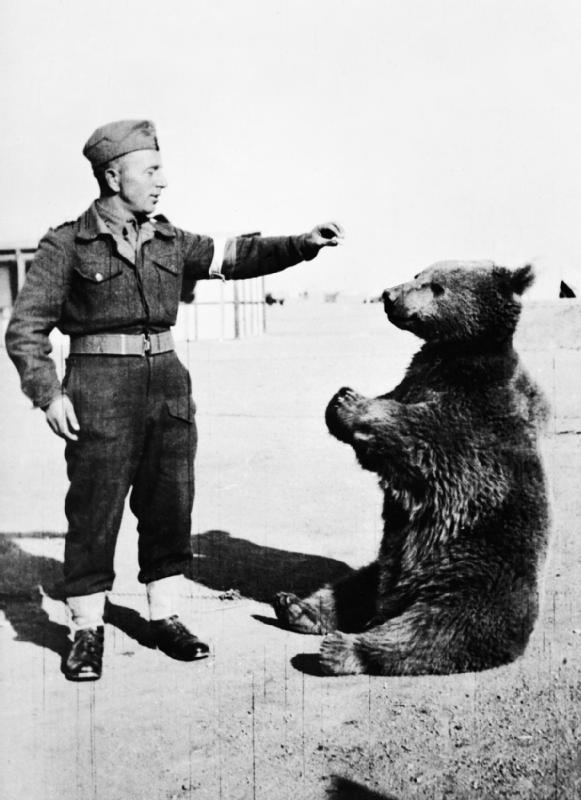
Wikimedia Commons Wojtek sits with a Polish soldier, 1942
Growing up with soldiers, Wojtek adopted some rather curious habits. Indeed, reports say that the bear would drink milk from an old vodka bottle, imbibe beer and wine, and smoke (and eat) cigarettes with his army buddies, just as any soldier would. 
Wojtek quickly became a source of light in the midst of war. He would often wrestle with his fellow fighters, and even learned to salute when greeted by his company men. 
Wojtek’s fate with the company fell on uncertain times in 1943, when the unit prepared to board a ship and join the Allied campaign against Italy in Naples. Officials at the Alexandria, Egypt port refused to let the bear on as he was not officially part of the army.
In a quick, if not bizarre, workaround, soldiers made Wojtek a private of the Polish II Corps, and gave him a rank, service number, and pay book to legitimate his status. It worked, and Wojtek joined his comrades onto the Italy-bound vessel, this time as a legal member of the army. 
By the time the unit arrived in Italy, Wojtek had grown significantly from cub to a 6 ft tall, 485 lb. adult Syrian brown bear. Making good use of his size and strength, the company taught Wojtek how to carry crates of mortar rounds, which he reportedly did without fail during the bloody battle of Monte Cassino. 
Wojtek not only survived the conflict — soon after, he achieved legendary status. Indeed, following Wojtek’s valiant performance, Polish high command made Wojtek the official emblem of the 22nd Artillery Supply Company. 
When the war came to a close in 1945, Wojtek retired from army life and traveled to Scotland with his fellow soldiers. Unlike his fellow veterans, Wojtek retired to the Edinburgh Zoo. 
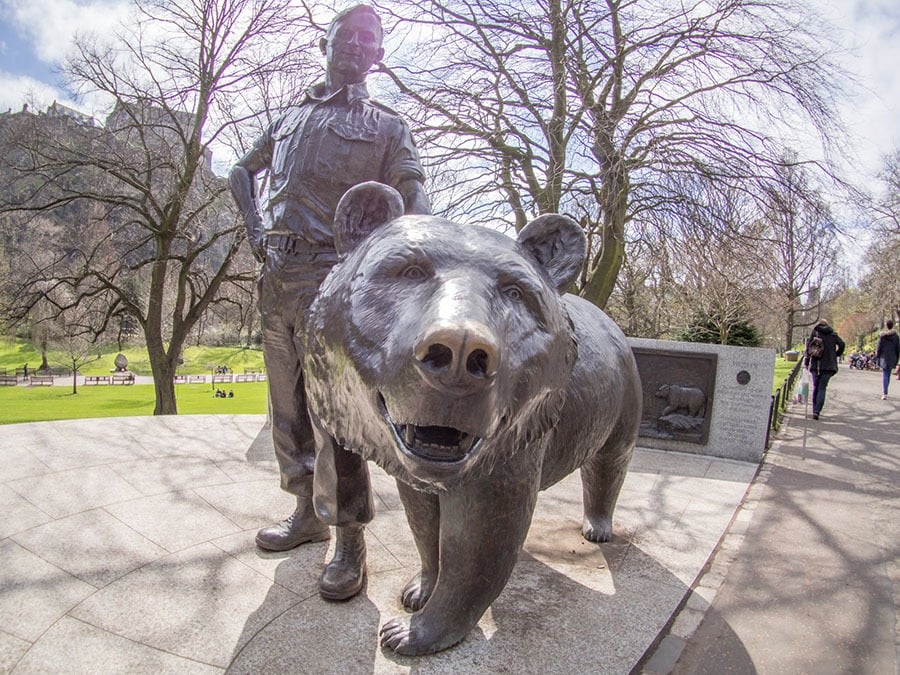
Wikimedia Commons
While 21-year-old Wojtek would die at the zoo on December 2, 1963, his memories of army life would stay with him for the rest of his days. Reports say that the bear would perk up when he heard visitors speak Polish.
__________________________________________________________________

My student did further studies on the bear for relating his story. Once curious story he found was that initially the bear, as he was sitting up with his arms out, was given ammunition for a moment. When the bear didn't drop it but accepted holding the ammunition, the soldier or officer thought of getting the bear to actually carry ammunition to the front. Wojtek willingly did it! As Wojtek became even more loved in his company, the emblem patch on the uniforms of the Twenty-Second Artillery Supply in which Wojtek belonged came to be that of a bear ... carrying ammunition!

       Wojtek, the Bear of Monte Cassino

The "wartime memoirs of Stanislaw Kroczak, an officer with the Twenty-Second Artillery Supply Company of the Polish II Corps ... [puts a lot of human-attributed behavior stories like carrying ammunition in his forepaws to the front] to rest but does note the bear’s role in helping maintain the troops’ high morale during the bloody campaign up the mountainous Italian peninsula, culminating in the capture of Monte Cassino by the Poles on May 18, 1944. After the war, Wojtek shared the lot of most of his Polish friends who chose not to return to their Soviet-dominated homeland. Many of them settled in Scotland, and Wojtek was placed in the Edinburgh Zoo, frequently visited by his old army buddies, journalists, and crowds of admiring fans. Wojtek died in Edinburgh in 1963, but his fame lives on in several Polish and English children’s books, a BBC film documentary, and commemorative plaques in the Edinburgh Zoo, Imperial War Museum in London, and the Canadian War Museum in Ottawa. His story is now also documented in the Hoover Archives." -- Hoover Institution, 21 March 2012

Tuesday, August 29, 2017

The Moon by Whale Light

The Moon by Whale Light … and Other Adventures among Bats,Penguins, Crocodilians, and Whales by Diane Ackerman. Diane Ackerman, one of my recent favorite authors, paints herself as a glorious animal-lover and –researcher. Her book The Moon by Whale Light is an insightful look at some of what I at first thought a most random selection of animals. Well, actually after reading the book I still think the animal selection is random but her deep zoological perspectives of the animals is not random but in fact astute, learned and is a wealth of behavioral comments gleaned from field research carried out with long-term professionals. Each of the four chapters dedicated to (1) bats (mammals), (2) crocodilians (reptiles), (3) whales (cetaceans), (4) penguins (aves) explores the animals’ use to man and man’s relationship with them. She also offers many intriguing and little known behaviors and knowledgeably creates the animals in their own highly structured and functional society, a perspective that few humans consider possible for “the lower species”.


So I have collected just a few thoughts on each of the animals, but this book is a jewel for animal-lovers. I so very highly recommend it!

On Bats

Merlin Tuttle, the world’s authority on bats, says, “Bats are among the gentlest of animals. They’re really shy and winsome creatures who have just had bad press.”

Bats are a natural pesticide. They eat 150 tons of insects every night. (Bracken Cave, San Antonio, TX) In fact, bats eat so much food in one evening of foraging that they weigh 50% heavier after one night of dining. An example of their insect gluttony, little brown bats of a common North American species catch as many as 600 insects in an hour.

Bats fly with their mouths open so they can echolocate, but which people mistakenly attribute to a snarling demeanor. They are not snarling, they are not mean, they’re just trying to not bump into anything.

Big brown bat
Picture taken from "The Why Files: The Science behind the News" in its feature "Stopping the Slaughter of Bats"
Bats are extremely tidy, comb themselves thoroughly, and do not gather a mess of nesting materials for their homes like birds. They provide excellent tender care of their young as well.

Cave walls are typically around 57F, but bat babies need to maintain body temperature of around 102F as they are born hairless (these cave conditions are the equivalent of a human lying naked on a cement floor). Therefore, caves chambers that have little moisture and shaped to retain heat become nurseries and babies cling from the ceiling packed with hundreds of other babies waiting for their mothers to return from their hunts and wrap their wings around the young. If bat nurseries are disturbed, the bats must move further back in the cave, where it is likely colder and many babies die. Only one young is raised per year so bats are at risk of not maintaining colony numbers if disturbed.

Even a person passing near a bat which is hibernating causes the bat to raise its body temperature in order to make a retreat if necessary, but this seemingly harmless elevation costs the bat 10-30 days of stored fat.

Bats are rapidly declining due to people not understanding them and killing them off. They have been victims of bat shoots, poison, attacked by flame throwers, napalm-bombed from the air, and dynamited. They have ultra-sensitive hearing and even the blast of a cherry bomb in a cave could kill their ultra-sensitive hearing and confuse a whole cavern of bats so that they can no longer use echolocation, and thus die.

Bats were once as numerous as the passenger pigeon. Old-timers remember when gray bats filled the night sky and now officially they are on the endangered list. The free-tailed bat has declined as much as 99.9% in some places. Its biggest colony went from 30 million to 30 thousand in just six years!

What people don’t realize is that bats are ESSENTIAL for maintaining the balance of nature! They fertilize bananas and maintain the wild strain which is disease-resistant. They plant the rain forest. Of the 3000 or so strains of peaches, which all started in China, bats were the seed dispensers and the pollinators. Bats pollinate many fruits, and bats and bees the the world’s greatest pollinators. Without them, earth would struggle to exist.

On Crocodilians

All crocodilians have a third transparent eyelid (or nictitating membrane), or goggles of a sort, so they can swim underwater. Their pupils are football-shaped and stay vertical to the horizon no matter what angle the head turns. Even if the gator tilts its head straight up, the pupil floats like a gyroscope, so vision isn’t distorted.

While mammals are extravagant with their energy, reptiles are extremely energy efficient and don’t expend energy unless they have to as they take their energy from external sources. Their inferno must be stoked carefully and kept at a precise temperature. If the temperature is incorrect, they cannot digest their food, but their efficiency is shown in their need for only three or four good meals a year.

Alligators have about 80 teeth (and crocodiles 70) and loose teeth throughout their lifespan. New teeth push up through the socket to replace old ones and an alligator, whose lifespan parallels a human’s, might have as many as 3,000 teeth. [Fun trivia: colonials used to fill up alligator’s teeth, which are hollow, with gun powder.]


A large gator, swinging its tail to counterweight the enormous head, stretches its head out of the water, gulps air then lowers itself in the water to make a sub-sonic boom when it bellows, making the water dance high around its body. Researchers note that alligators are responsive to the pitch of b-flat; when hearing b-flat tones, they go nuts with bellowing.

A mother alligator lays 35 or so porcelain eggs, which are incubated for about 65 days. Crocodilians do not have sex chromosomes; their gender is determined by the temperature at which they develop, and 2-3 weeks after the egg being laid, ambient air temperature determines the gender: 94+F produces males, 86-F produces females. Most often an entire nest is one gender, but in some cases, the top 2-3 eggs might be different based on their exposure to a different air temperature.

The first year is tough for an alligator. Yearlings are about 2 feet long and three-quarters of them die because they are eaten by fish, frogs, wading birds, to name a few. As they gain size, this risk is minimized, but then two- to three-year-olds are chased by adult alligators to protect territories and families, and a three-year-old which is about three and a half feet becomes a wanderer. In most reptiles, especially crocodilians, reproduction depends on size, not age, and some crocodilians might reproduce at 6 years of age while others at 15 for some males or 18 for females who develop later. By 30, a male alligator in the wild shows signs of senility, loses its teeth which aren’t replaced, becomes mottled and rough-skinned, and may even go blind. However, a male in captivity may grow as old as 90.

On Whales

If you ask someone to draw a picture of a whale, he/she will likely draw a sperm whale with its bulbous head made famous by Melville’s Moby Dick, but whales come in many shapes, sizes and colors … with 77 species of whales and dolphins inhabiting earth.


Whales are divided into two groups—toothed whales (Odontoceti from the Latin for “tooth” and “whale”) and baleen whales (Mysticeti, from Latinized Greek for “whale”). Toothed whales include sperm whales, dolphins, and orcas/killer whales. They have a single blowhole, echolocate like bats, have teeth for holding prey like fish, squid and shrimp but despite teeth, swallow their food whole. Baleen whales have paired blowholes—nostrils in fact. They graze with their mouths wide open, and the baleen with smooth outer edges and bristly inners catches the krill, plankton, and schools of fish while water passes on through. Other species with baleen have throat pleats and open their mouths even wider to swallow prey when the water is pressed to the top of the mouth and wrung out.

The Right whale, a Mysticeti, got its name from the age of whaling when a whaler would see a whale and ask if it were “the right one”. The Right whale floated when killed instead of sinking, didn’t struggle in battle, and was extremely valuable for its baleen. Now the Right whale is one of the rarest whale species (only 3,500 remaining) due to human greed. Never have humans caused an animal with widespread distribution across the globe to come to extinction, but they sure have come close in the case of the Right whale.

The Gray whale of the North Atlantic became extinct by the end of the 1700s because of Basque whalers, but the Grays in the North Pacific were “discovered” in the 19th C and called devilfish; they were furiously hunted and in self-defense killed several men and smashing boats in the hunt. Now they are known for “the friendly whale phenomenon” which started in 1977 when a friendly whale near Baja California allowed itself to be patted by passengers on a whale watching boat. Since then, friendly whales have sought out boats, and on occasion rammed them and then rolled over to beg for belly rubs.

Blue whales make loud, low-frequency “songs” that can travel up to 500 miles in deep sound channels before disappearing into background noise.

A Humpback has paddle-like flippers and a huge tail with markings as unique as fingerprints, but its most arresting feature is it sings complicated, beautiful songs and varies them as it continuously sings.

When a whale exercises in warm equatorial waters, it can die of overheating. A whale is like a house with a too-large furnace and too few radiators. If it races too much for its food, it can become hot and can virtually blow up. Even after a whale is killed in the Antarctic, it must quickly be hauled aboard and cut up, for if it takes too long to drag the whale back to the ship for evisceration or is left in the water too long, its bones will be charred by the heat of its internal decay.

Most sperm whales live close to the equator and so dive to unimaginable depths to get to freezing water to cool off. They feed on squid and large fish, sometimes swallowing a whole shark. In the depths of the ocean and swimming under extreme pressure among luminescent fish, no wonder the sperm whales seems magical.

A mother whale is virtually 97% water, lives in water, sounds in water which travel through water and ultimately to her unborn who hears her, but because there is no air in the womb, the baby cannot speak back until it is born one year later.

On Penguins, those feathered dinosaurs

Penguins have no land predators, so they do not fear people. Just the opposite, they are curious and alert and allow their babies to waddle around and freely explore.

Penguins do NOT live at the South Pole, which is about 800 miles from the closest body of water and an altitude of almost 10,000 feet. Nor do they live with Eskimos and polar bears in the Arctic.

There are 17 types of penguins on earth, and while all penguins are essentially black and white, their head markings are what make them most easily identifiable.
·      Adelie penguins (named after Adelie Land near the Antarctic coast of Australia that was named after the wife of a 19th C French explorer) have black heads with chalk-white eye rings—like little men in tuxedo suits.
·      Rock-hoppers have lively red eyes, long yellow and black head feathers resembling an outgrown crew cut, and thick yellow satanic eyebrows that slant upwards.
·      Chinstraps get their name from the thin black “strap” across their throats; their amber eyes are outlined in thick black and look Egyptian.
·      Emperors have black heads, a tawny stripe on their bill, and a bib of egg-yolk yellow around their necks and cheeks.
·      King penguins, the most flamboyant of all, display a large velvety-orange comma on each cheek, which melts to a radiant yellow, and on either side of their bills, a comet of apricot or lavender darts toward their mouth.
·      Fairy penguins are tiny and blue-headed.


Click to enlarge
Photos taken at Sea World just outside of Honolulu, Hawaii (a horrible place to visit -- the focus is on making money, e.g. $140 to kiss a dolphin and $18 a photo (and you can't take a camera in with you to get your own photo))
The black and white of penguins has very specific purposes. First, for protection—black backs make them less visible from above and white breasts make them appear like a reflection of water from below. For heat—if the penguin is cold, they turn the black towards the sun and warm up but turn white towards the sun if they are hot. An interesting study showed that when penguins were tagged with silver, they were quickly eaten by leopard seals which were attracted to the flash of the silver, so black tags were then used and the penguins were no longer at a disadvantage for becoming a targeted lunch.

Only 4 penguin types live in the Antarctic and only 2 live there exclusively. Most live in slightly balmier climates—on sub-Antarctic islands like South Georgia or the Falklands, along the coast of South America, South Africa, Australia, and New Zealand, and one species even lives in the Galapagos near the equator, but penguins do not and have never lived north of the equator. The ocean currents aren’t favorable for carrying them that far north.

Penguins come in a broad range of sizes. The Emperor penguin is the tallest and stands over five feet tall, weighing as much as 100 pounds while in contrast the smallest penguin, the fairy, weighs only 2 ½ pounds and stands a mere 12 inches tall.

Penguins waddle around and are believed by many to be flightless birds, but they do fly—they fly through water, and gracefully too, at speeds up to 15 miles per hour. They porpoise to breathe in just enough air to keep the lungs from collapsing and dive to great depths, with their pulse going from 100 beats per minute to only 20, and because they take only one shallow breath in their porpoise-move, they don't get the bends.

Penguins don’t have binocular vision like humans do, so they turn one eye to an object and then the other. Although they see well underwater, long vision on land isn’t necessary.

Thursday, June 8, 2017

The Zookeeper's Wife

The Zookeeper's Wife is a war story about Warsaw under siege and the Jewish holocaust. Jan Zabinski, the zookeeper, and his wife Antonina ran the Warsaw zoo, but when the animals were shot for sport by a German zookeeper Lutz Heck after selectively taking the preferred and rare animals (European bison, Przywalski horses which had only been "discovered" in 1879, and a few others) for Nazi selective breeding, Jan and Antonina stayed on at the zoo to assist in the running of a fur farm for making fur coats for the Nazis. [Under the Third Reich, animals became noble, mythic, almost angelic -- including humans, of course, but not Slavs, Gypsies, Catholics, or Jews. Therefore, breeding programs were for the selected animals and medical procedures and experiments were for the undesirably "humans". The subjects of Auschwitz's operating doctor Mengele could be operated on without painkillers, but a remarkable example of Nazi zoophilia was that a leading biologist was once punished for not giving worms enough anesthesia during an experiment.]

The zoo, despite its loss of wild animals, was a cover for hiding Jews right under the invaders' noses. In the course of the war Jan and Antonina managed to save 300 by hiding them on the zoo grounds, which were, by the way, right next to a Nazi compound. The Jews referred to as "guests" were given animal names that reflected their character and their cage of domicile. This naming method also prevented slip-of-the-tongues or prevented people who overheard their talk from guessing the truth of what really was going on at the zoo. The people who lodged in the lion's cage were, therefore, called the lions. "Pheasants" often came in the night and lodged in the pheasant house, only to fly a few days later when their trail wasn't so hot. 


During the five years of the war, 860,000 Poles were uprooted and resettled; 75,000 Germans took over their lands; 1,300,000 Poles were shipped to Germany as slave labor, and 330,000 simply shot. With ingenuity the Polish Resistance sabotaged German equipment, derailed trains, blew up bridges, printed over 1,100 periodicals, made radio broadcasts, "illegally" taught in schools and colleges (attended by 100,000 students), aided Jews in hiding, supplied arms, made bombs, assassinated Gestapo agents, rescued prisoners, staged secret plays, published books, held its own law courts, and ran couriers to and from the London-based government-in-exile. At the height of the war, 380,000 soldiers with Jan Zabinski among them comprised the military wing of the Home Army.

Jan was the leader of an Underground cell, and he used the delivery of hay and fodder for the animals as a way to bring in and pass on explosives and other counter-intelligence equipment, which Antonina never knew about until after the war. He poisoned pigs, butchered them, and then arranged the meat to be eaten by German soldiers. During one month in 1943, his cell derailed 17 trains and damaged 100 locomotives! Antonina basically knew that he was part of the resistance but not that he led parts of it so actively, often narrowly escaping capture or death. Antonina would only learn of his great exploits after the war and Jan's return from a POW camp. Jan figured that Antonina had enough stress on her plate with taking care and protecting her very young son, and of course ensuring the meals, shelter and safety of her continue flow of "guests".

In the earlier part of the war Germans established food lines for the starving people of Warsaw. They calculated a calorie-feeding system for the differing races who stood in three separate food lines based on race. The Germans received 2,613 calories of food per day, the Poles 669, and the Jews 184. German Governor Frank who controlled all matters in Warsaw declared, "I ask nothing of the Jews except that they disappear."

According to German figures, Germans shipped 316,822 people from Warsaw to concentration camps between early 1942 and January 1943. Many were shot in the ghetto so the death rate was actually much higher. Aided by friends on the Aryan side, tens of thousands escaped the ghetto, but some who stayed, such as Kalonymus Kalman Shapira, the ghetto's Hasidic rabbi, revealed a tigerish struggle with faith as was discovered after the war by his discovered diary. How could anyone reconcile the agony of the Holocaust with Hasidim, a dancing religion that teaches love, joy, and celebration? During World War II, 30-40% of the world's Jews were killed, but more specifically 80-90% of the Orthodox community was wiped out; this was the group that kept alive the ancient tradition of mysticism and meditation traced back to the Old Testament world of the prophets.

In 1941, Governor Frank decreed everyone must have an identity card complete with serial number and fingerprints. For two years, Polish offices responsible for making the cards stalled. Meanwhile, they along with Underground offices and greedy opportunists were able to set up a system for making fictitious identity cards. Hordes of people suddenly seemed to have lost their records (born in Russia, born to Muslim Poles, records burned in a church fire), so needed to reissued identity credentials. By 1943 it was commonly known that 15% of all identity cards and 25% of all working papers had been forged.

After the war and his return from the POW slave labor camp, Jan was forced to retire from zookeeping at the age of 54. Times were hard after the war and anyone who praised pre-war independence or resistance during the war (and especially for someone who fought in such a war) were judged to be dangerous. Jan retired from zookeeping but still devoted to zoology, he focused on writing and ended up writing 50 books on the lives of animals and conservationism. He also spent much time writing and researching the pedigree of the European bison that had been returned to Warsaw by Lutz Heck, which turned out to be good since Germany was bombed right afterwards killing its bison herd. Antonina, after the war, stayed in contact with the former "guests" who were spread among many countries. She and Jan never left Poland, but their hearts remained bound with all of the many people they helped save.

(Fascinating source article)
Some of the 300 "guests were Irena Mayzel, Kazio and Ludwinia Kramsztyk, Dr. Ludwig Hirszfeld (a specialist in communicable diseases), Dr. Roza Anzelowna from the National Hygiene Institute, the Lemi-Lebkowski family, Mrs. Poznanska, Dr. Lonia Tenenbaum, Mrs. Weiss (wife of a lawyer), the Keller family, Marysia Aszer, journalist Maria Aszerowna, Rachela Auerbach, the Kenigswein family, Drs. Anzelm and Kinszerbau, Eugienia "Genia" Sylkes, Magdalena Gross, Maurycy Fraenkel, and Irena Sendler, among many others. All 300 "guests" survived the war except Kazio and Ludwinia Kramsztyk (cousins of renowned painter Roman Kramsztyk), Dr. Hirszfeld (specialist in infectious diseases), and Dr. Roza Anzelowna and her mother. They were arrested by the Gestapo a few months after leaving the zoo and were summarily killed.


Monday, April 24, 2017

Unbowed: Wangari Maathai (1940 - 2011)

Wangari Muta Maathai, born in Nyeri, Kenya (1940) ultimately became the first woman in East and Central Africa to earn a PhD (1971). She also became the first woman in her region to be a chair of the Department of Veterinarian Anatomy and to be an associate professor (1976). Seeing a political deficit and unmet needs by politicians, she entered politics and became an active member of the National Council of Women of Africa (1976-1987), which was where her idea of empowering women while rehabbing the environment was conceived, the birthchild of The Green Belt Movement. Over the years, she assisted women in planting more than 20 million trees on farms and schools and church compounds, and by 1986 the Movement had become a Pan African Green Belt Network. 

She became internationally recognized for her persistent struggle for democracy, human rights and environmental conservation. On several occasions she addressed the UN on behalf of women. She authored articles, books, served on boards of several organizations, and in 2002 was elected to parliament with an overwhelming 98% of the vote. Subsequently she was appointed by the president as Assistant Minister for Environment, Natural Resources and Wildlife in Kenya's 9th parliament. 

In 2004 the Nobel Peace Prize was awarded to Wangari Maathai "for her contribution to sustainable development, democracy and peace."

Her book Unbowed: A Memoir (2006, 2007) documents some moments that gave her a solid foundation of family and nature and which were fundamental in raising her awareness of a large escalating environmental problem ripping across the environment that had been so untroubled in her youth.

As the story goes, the name of Kenya was named by the explorers Johan Ludwig Krapf and Johannes Rebmann, when they encountered the awe-inspiring 17,000-foot-high mountain known today as Mount Kenya. "What do you call that?" they asked of their guide, and thinking the two were asking about the gourds he had in his hand, the guide answered, "Kii-nyaa", and thus the name of the mountain and the country became known by the colonial name and not the Kikuyus indigenous name of Kirinyaga, or Place of Brightness. Today the country of Kenya still feels the tug of conflict in their development and concept of self caused by the colonial and the indigenous ideas.

Before Wangari went to school, in her area the colonial government decided to establish commercial plantations of non-native trees. She remembers huge bonfires as the native fig trees went up in smoke. By the mid-1940s the British had introduced many exotic tree species to Kenya—pine in the north and eucalyptus and black wattle in the south. These trees grew fast and strong and contributed to the newly emerging timber business, but they eliminated local plants and destroyed the natural ecosystem. While the old trees had pierced deeply into the earth and allowed other trees and shrubs to thrive in their shadows, the new trees eliminated local plants and didn't retain the rainwater. Eventually, rivers and streams either dried up or were greatly reduced.

The native fig trees were strong trees, burrowing deeply into the ground, breaking through rock and into depressions and ultimately hitting water. It was known that wherever a fig grew, water would be found. Communities had great reverence for these trees and they were never used for fire wood. These trees held the soil together, reduced erosion and landslides. These trees brought life-sustaining water. 

In the early 1970s Wangari realized that many ticks were affecting livestock. While gathering ticks from many places and going out in the rural areas, she noticed the people did not have good food but were eating the colonial flours and processed foods and because there was not enough firewood for cooking and preparing food, the crops were in drought because of loss of trees, the cattle were not well watered and certainly not the land. After looking at the people and the environment, she came up with the idea to give women jobs by planting trees, which would bind the soil, retain and collect water, be a home to birds and provided fruit and food for the people. Trees would heal the land and regenerate the vitality of the earth.

And thus began her journey of planting trees ... to foster a strong relationship between people and their land once again.

"I'm doing the best I can."

Wangari Maathai closed her book with a story she heart from a Professor Suji in Japan. One day a massive fire broke out in a forest and the animals, with flames coming closer, fled the forest, all of the animals except one, a tiny hummingbird who said, "I'm going to do something about the fire!" And she flew to the nearest stream and in her tiny beak scooped up a drop of water and flew to the conflagration, dropping her water droplet, and then flying back to the stream. The other animals watched in horror and dismay, "Why are you doing this? You cannot begin to put out the fire!" And the little hummingbird turned briefly to them and said, "I'm doing the best that I can!" 

Wangari Maathai encourages everyone to work towards a better and greener world. She encourages everyone to plant, even if it's just one tree, just one tree at a time.

Tuesday, June 7, 2016

The Corpse Walker: Glimpses of Society

Liao Yiwu—poet, novelist, screenwriter, free-lance journalist—published an epic poem “Massacre” that condemned the Tiananmen Square killings. He portrayed the stark reality of the killings of innocent students and residences by reciting “Massacre” using Chinese ritualistic chanting and howling to invoke the spirits of the dead. The audiotape widely circulated via underground channels in China, and eventually caught the attention of the Chinese security police. He spent four years in prison for “speaking out”.

Since his release, Liao has remained on a permanent government blacklist and most of his works are still banned in China, where he lives. Finding a job as a blacklisted person is very hard and he must remain mobile to escape the ever-watchful eye of the government. To do so and because his resident registration, which allows him to get legal work, has been cancelled, he is a street performer. He has been detained numerous times for conducting “illegal interviews” and exposing the dark-side of the communist society, particularly in his documentary-style book Interviews with People from the Bottom Rung of Society. The 27 chapters in his book The Corpse Walker are a collection of voices of people, who, like himself, were flung to the bottom rung of society resulting from the tumultuous changes and political purges of the Maoist era and the radically changing Chinese society.


Originally he compiled over 60 interviews with people who were flung to the diceng, “bottom rung of society”, a word he coined and which is an anathema notion to the supporters of Mao’s communistic movement, which is supposed to create an egalitarian society free of prostitutes, beggars, triad gangsters, drug abusers, homosexuals, street musicians and magicians, dissidents, and more. The displaced people—the marginalized—are mostly those who have been stripped of their residential registration and thus rendered unemployable and subject to expulsion to the countryside. Laio gives voice to the marginalized in his book The Corpse Walker: Real-Life Stories, China from the Bottom Up (2008). The book is a loud condemnation of the deprivation of people’s rights to speak out as well as being an excellent portrayal of a group of unique individuals that heavily populate China. The manuscript had to be smuggled out of China otherwise it would never have reached a reading public.

The 27 chapters in this book are on the voiceless and virtually “unseen” people of China, people that the government doesn’t acknowledge and does not want others to acknowledge as well. Laio as a flute street performer and as a marginalized was able to get their stories:


The professional murderer
The neighborhood committee director
The human trafficker
The former red guard
The public restroom manager
The counterrevolutionary
The corpse walkers
The Tiananmen father
The leper
The falun gong practitioner
The peasant emperor
The illegal border crosser
The feng shui master
The grave robber
The abbot
The safecracker
The composer
The blind erhu player
The rightist
The street singer
The retired official
The sleepwalker
The Yi district chief’s wife
The migrant worker
The village teacher
The survivor
The mortician

Literary expressions:

Many people use the phrase “covering the sky with one palm” to describe the government power over religion as the Communist-spawned Religious Affairs Bureau takes charge of all Buddhist, Taoist, Muslim temples as well as Christian churches. The abbot being interviewed astutely said, “Throughout ancient history, no matter how incompetent the emperors were, or how corrupt and decadent the royal courts became, one never heard about officials blackmailing and harassing monks.” [p87]

Liao described the safecracker with the Chinese cliché, the safecracker “had a tiger’s back and a bear’s waist” as apparently he was a strong man and even though it was a cold winter the man was wearing only a shirt and summer pants. [p267]

Street shoeshine women shoeshine “yellow shoes”, the code name for prostitution. When men stop and show interest, a shoeshine woman will start polishing his shoes first, reach up to fondle his ankle, while haggling over the price. 50 yuan [US$6.40] is a typical full service price. Full-breasted young women find transactions easier, while women almost 30 and with kids and sagging boobs might get lucky to get 20 yuan. “Smart” girls from the countryside get to the city, drop their accents, powder their faces and swing their butts, and even pay money to buy fake college degrees so they can hook the more educated guys by saying that after they earn more money, they can change to a new career to match their college degree. [p313-4]

Outcomes of the Great Leap Forward (1958-1961):

The Great Leap Forward resulted in ordering people in the Dongyang Commune to hasten farm production and discard traditional farming practices. Peasants of fertile fields famous for rice, wheat, corn, beans and sweet potatoes were instructed in the new farming method of “reasonable density” invented by Soviet scientists. That is, make deep furrows and plant seedlings densely. The Party claimed a 10-fold increase of crop production, so crops were duly planted with packed seedlings … which of course failed. The peasants knew better but dared not disobey or voice their more "educated opinion" in the matter. [p123]

Families were starving and couldn’t subsist on the poor communal food kitchens which had thin soups and no fat and no nutrition. Cannibalism became a terrible scandal, and of particular note in the Fifth Production Division which comprised 82 families and a population of 491. Between December 1959 and November 1960, parents there had killed and eaten 48 female children under age seven, which represented 90% of the female children in that age group. About 80% of the families were involved in cannibalism. [p127]

Doctors and nurses were allocated more food than ordinary peasants because there was a social need for them to perform in society. Yet, they too didn’t get meat and the sleepwalker’s wife who worked at the hospital was able to supplement her and her sick husband’s diet by picking up placenta—their only source of protein—from a hospital. Locals didn’t want to touch the stuff for superstitious reasons. [p305-6]

In the Dongyang Commune, a rural area of Sichuan, peasants ate a type of white clay called Guanyin Mud. The mud—mildly sweet and metallic—was considered precious because it helped soothe the sense of extreme hunger. Eating too much, a frequent problem, caused stomach cramps and extremely constipated the intestines. Raw veggies and castor oil would have relieved this but these were not to be found. [p130]

Teachers, as members of the educated class, were condemned as Rightists and if they didn’t lose their lives were sent to the countryside. One teacher of Chinese and math was soon only permitted, as all other teachers were permitted, to teach the chairman’s Little Red Book. Its quotes were treated like words from God. Three times a day people read from the book and all daily behavior was to be a reflection of its teachings. Math could not be taught from the "text" and was struck from the curriculum. Ironically, a well known general, who had written the essay “The Admiring Qualities of a Pine Tree”, also part of the carefully culled curriculum, lost favor with Mao, and teachers who had been ordered to teach his book were labeled as counterrevolutionary and were dealt with "appropriately". [p163]

The street singer came from a family of blind street musicians, a pre-Cultural Revolution trade open to the blind. His illiterate father took his stories from Chinese classical literature, such as “The Warrior Conquered the Tiger”, filling his stories with suspense, colorful description to the beat of his now extinct traditional instrument, the daoqin—a meter-long bamboo cylinder covered on one end with pigskin and much like a drum. With the start of the Cultural Revolution, the government banned him from performing his stories because they were considered feudalistic and anti-revolutionary, so he and his blind wife were assigned to work in a remote sausage factory for 27 yuan [$3.50] a month, barely enough to feed the family of five. After 1966, all street performances were declared illegal and local opera troupes were only allowed to stage the “Eight Revolutionary Model Operas” mandated by Mao’s wife. Apart from that, people spent their evenings attending communist meetings, witnessing public executions of counterrevolutionaries, murderers and rapists, and being bored to tears. [p285]

Social outcomes following the Great Leap Forward:

The neighborhood committee director was interviewed  in his tiny home and on the wall were big pictures of Karl Marx, Friedrich Engels, Vladimir Lenin, Joseph Stalin, and Mao Zedong—the world’s well-known communist leaders. When asked if the committee director worshiped the leaders, he replied, “Well, I can’t do that. If we want to set up an altar for them, there are specific rules. You cannot treat the pictures of these great men the same way you do pictures of movie stars. You cannot tilt them, or put them in separate places. There are five equally great men, and they have to line up on the same wall. Otherwise it would be a political mistake.” [p191]

Falun Gong practitioners in 1999 stages a silent protest in Beijing against unfair treatment. The communist party leadership saw the group suddenly as a threat to communistic rule, declared it an evil cult, and launched a massive campaign to eliminate Falun Gong in China. [The on-going campaign against Falun Gong practitioners is unclear as the “cult” seems harmless enough: Falun Gong combines Buddhist and Taoist meditation and exercises and was founded by Li Hongzhi, referred to as Teacher Li by practitioners. Teacher Li’s book is said to cultivate the mind and teach a person to be a good person, and teaches the principles of truth, benevolence and tolerance.] [p230]


In recent years, millions of peasants have migrated from the poverty-stricken rural areas to big cities in search of better job opportunities. Many end up working on construction sites or at clothing and toy factories. According to a Chinese government statistic, about 114 million rural laborers—known as min gong, “peasant workers”—swarmed into China’s major cities in 2003. [p308]

The American version of The Corpse Walker:

The United States has a similar book of lesser-known voices, those on the lives of ordinary Americans in the States. The book by Studs Terkel Working: People Talk about What They Do All Day and How They Feel about What They Do (1997) is a book filled with colloquial American English. It is also a book used as a textbook in China with the Chinese translated version being Americans Talk about Lives in America.