Many are familiar with the popular novel, The Horse Whisperer (1995) which was later made into The Horse Whisperer (1998), the movie directed by and starring Robert Redford. To write his incredible book that populated best seller lists, Nicholas Evans, author of The Horse Whisperer (1995), met
Monty Roberts and heavily interviewed him among other knowledgeable horse
trainers and owners before writing.
But while The Horse Whisperer is a
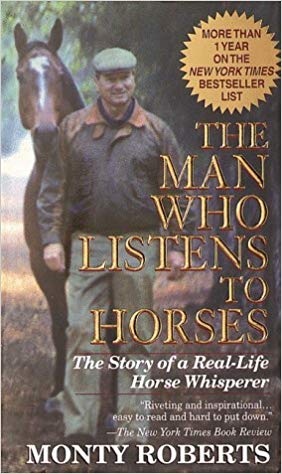
work of fiction, what appeared on library shelves two years later, The Man Who Listens to Horses (1997), is the autobiography of Monty
Roberts, a real-life horse whisperer. In his own book, Monty tells his
remarkable journey with horses and how his horse training-methods have
revolutionized horse training, from the violence and exercise of force and mastery previously used to the gentling
methods of those today. Horses are not to be "broken" anymore but to be "gentled".
Here is a postage-stamp version of the Monty Roberts story.
 |
| Source |
Monty Roberts, born 14 May 1935, as a babe was held in the
saddle in front of his mother as she trained neighborhood youngsters in the family riding
school. By age 4 Monty was riding in shows and winning prizes. At age 7 he made
a precocious and controversial discovery—the realization that horses have their
own language, what he came to regard as “the language of Equus”, an extremely
controversial thought at the time!
His father, a mean and violent horse trainer, also mean and
violent with Monty, wouldn’t allow such a thought, and tried to beat (yes,
physically) the thought out of Monty’s brain. Monty hated violence and despite
the beatings, continued his observations on how horses communicate. By age 11
Monty was in the family rail car and riding across the country with typically 6
horses, a groom-trainer, and a school teacher. By this time he was known to be
“professional” as his competitors were kids who actually attended school and
merely rode on weekends, he swooped up the highest prizes rather consistently
whenever and wherever he competed.
By age 13 he was taking summer trips to the Nevada desert to
do mustang round-ups, and this was where he got the biggest epiphany on horse
communication—from interactions at night between a young misbehaving stallion
and the leading herd mare who was “punishing” the wayward youth! To be able to
see these night interactions between the herd animals, Monty realized his rare
achromatopic (complete colorblind) condition was actually a blessing, as it
gave him ability to distinguish the textures of the night desert and not feel
the loss of the colors!
On this earliest mustang roundup he observed a mare chasing a
young rambunctious stallion 300 yards away from the herd and not allowing him
to return. This ostracism is critical as it prevents group protection from the
coyotes, wolves, mountain lions and other predators, and it is unnatural to be
excluded as horses are herd animals and thrive in socializing family herds. The
young stallion was chased out and the lead mare kept him ostracized by directly
facing him, eyes riveted into him, with no letup on reprimanding stance or
breaking of eye contact. After some minutes the young stallion started moving
his mouth, and then sticking out his tongue a bit at times, actions that Monty later
learned was his beginning to admit his submission to her authority. Following this, his head would drop to just inches off the ground while he continued with the
mouth action. The mare was waiting for this submissive act and then would break
eye contact and look a few inches in front of him. As he continued with his
submissive movements and turning his body more and more laterally to her, an overt act
of vulnerability and submission, her eyes would drift further in distance ahead
of him, and she too would gradually turn laterally. The more she turned, the
closer he approached. What was utterly astonishing to Monty, however, was how
she showed her forgiveness to him after allowing him back into the herd,
provided he continued expressing his submission and not misbehaving again. She
would curry his mane, withers and around his tail gently with her lips and
teeth and give him lots of attention as she welcomed him back, and forgave him.
If he misbehaved, out he was chased again, and the process would be repeated.
For Monty, this was revolutionary! Horses had rules, meted
out punishment, expressed forgiveness and caring love, and were in fact master
trainers for raising “model” communities! Monty’s father used aggression,
violent submission, force and cruelty in his horse-breaking methods, and Monty
was quick to note the huge differences in both process and outcome. Monty
developed training methods he gained from this mustang experience, and his
horses were “broken” to saddle and bridle in an average of 30 minutes after
meeting. His father’s violent method took 6 weeks, and the horse was forever damaged.
Monty’s method was based on speaking the “language of Equus” with the horse and
gaining its trust so that he could just quietly place the saddle on the horse,
reassure the horse that it wasn’t a bad thing, and then slip the bridle on the
horse with the same reassurance. Monty knew his father’s method of domination
was inherently wrong, and Monty’s ultimate philosophy was that the horse is an
honest soul and will tell you its story, if you but take the time to listen, as
“the horse is always right”!
Monty’s Training Method
According to Monty, to break a horse in 30 minutes is not difficult if one
speaks the “language of Equus”. The ideal method is to use a 50-foot arena,
preferably without a lot of activity around it. The horse would be put in the
arena for a time before Monty entered it in order for the horse to become
familiar with the space rather than have too much unfamiliar stimuli at once
during the initial gentling session. Then Monty would enter the arena with a
rope, not to beat the horse at all, but to just flick the rope behind the horse
to keep the horse circling at a nice pace. Monty, like the lead mare who was
ostracizing the fractious youth, would squarely face the horse with eyes fixed
on it and the horse would be running because he was realizing Monty spoke
“Equus” and he, the horse, was being punished for something.
Once the horse started moving his mouth, and then lowering
his head to just above ground level while moving his mouth and still making
revolutions around Monty, Monty would adjust his eye focus to just in front of
the horse. The horse would slow immediately, offer more submissive mouth
movements with lowered head and the further Monty adjust his eye focus in front
the horse, the slower the horse circled. Finally when Monty was no longer looking
at the horse and his (Monty’s body) was turned laterally in the position of
little awareness and in trusting vulnerability, the horse would gaze at Monty.
Monty would then turn his back on the horse, being careful to never cut his
eyes in any way to see how the horse was reacting, and just slowly walk away.
The horse, the herd animal, would naturally approach Monty and with its muzzle
over Monty’s shoulder, follow Monty trustingly around the arena.
After a couple minutes of “round-up”, Monty would turn and
touch the spots of vulnerability—the spots where for example a mountain lion
would grab if it attacked, many of the same spots that the mare had curried
when she welcomed the fractious stallion back into the herd. Monty was saying
with these touches, “You can trust me. I would never hurt you.” Monty would
touch the vulnerability points, along the muzzle, the top of the head, along
the mane, the throat, the flank, and as he developed his methods, he would even
lift one hoof after another, an act that demanded ultimate trust as it denied
the horse the ability to run when one of its hooves was lifted. With these acts
allowed, the horse was acquiescent for allowing more acts of vulnerability, the
adding of the saddle, and then the bridle. After each each piece of equipment was added,
Monty would reassure the horse with appropriate touches, conveying his high
regard and respect to the horse for the horse putting such trust in him. And so
Monty could walk into an arena, and about 30 minutes later have a “green” horse
introduced to a saddle and bridle and have a rider on his back for a few spins
around the arena. Of course this was just the beginning of the training, but
Monty did the initial horse “breaking”, a term that is actually a misnomer. The term
in regard to Monty’s method should be more like “horse gentling”.
 |
| KNYSNA-PLETT HERALD |
This book is the amazing journey of Monty from a small boy
who never had a childhood or owned a toy to a grown man who, living and
breathing with horses all of his life, learned a method of “horse breaking”
that gained the horses trust and didn’t destroy its spirit. When Monty was into
his 40s, Queen Elizabeth, quite the horsewoman herself, heard about Monty and
invited him to Buckingham to see for herself his methods. She was amazed and
she and Monty struck up quite the friendship which lasted for years, and
developed further during many more visits. Until meeting Queen Elizabeth, Monty
had learned to remain silent about his controversial gentling methods of
training horses. After meeting such a renowned horse advocate, Monty started
giving public demonstrations and instructions on his methods, and because of
Queen Elizabeth’s keen passion for humanitarian treatment of horses and her
passionate approval of Monty’s gentling methods, Monty’s ways became widely
known … and even was the catalyst for this book!
Monty, beaten from ages 7 to 15, and often with a chain,
refused to continue with the violence that he underwent growing up. His methods
gentled the training methods of horses, and he and his wife with their big
hearts and passion to help even youths at risk, over the years took in 47
foster kids (typically aged 12-14) who had a lot of baggage. They used the same
methods of “herd mentality”, stern looks and welcoming touches as the mare had
used. None of their kids were ever beaten, communication and love were the
ingredients for a strong “family” tie. And Monty says that despite the heavy
baggage that his 47 foster kids had, 40 of them were “successfully taught to
fly”!
Definitely this book is a high recommend!


