Showing posts with label Mediterranean. Show all posts

Friday, April 20, 2018

Salt in the World - Salt in the Food

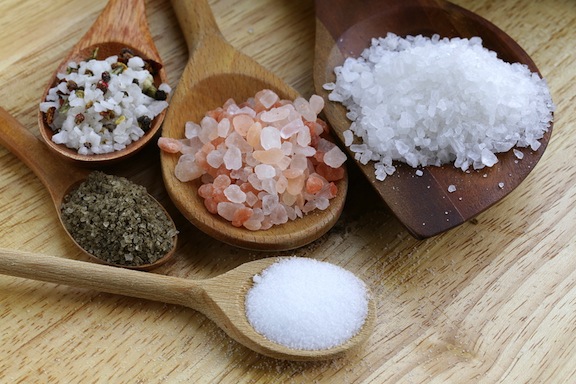
This article taken from Guide to Salt Varieties by VegKitchen: Salt comes in all colors, shapes and sizes; as well as pure white, salt may be pink, grey, black or green. Salt truly is a rainbow-hued rock. Here’s a guide to many of the salt varieties available.

Fleur de sel

What is it? Fleur de sel, the “flower of the salt,” is the name used for salt that has been raked by hand from salt ponds surrounding certain villages in France, predominately those around Brittany, on the Atlantic coast, and in the Camargue, on the Mediterranean.

It is harvested from May to September, when artisan paludiers patiently wait as the shallow pools of water in the salt ponds evaporate, creating the prized salt crystals. It is a delicate art: excessive movement will cause the “flower” to sink to the bottom, so salt can only be collected when the weather is warm and winds are light. The ponds are the same ones where the coarser sel gris is harvested, but for every 40 kilograms of sel gris produced, only around 1½ kilograms of fleur de sel is harvested. Each day a new layer of salt rises to the top of the pond, crystallizing in delicate flakes that are scooped up by the paludier using a wide, flat board on the end of a long pole. Each day’s harvest comprises one batch of fleur de sel.
Properties: The salt itself is white, although it can acquire a pinkish hue, and has long been prized by chefs and gourmets for its high quality. 
Uses: Light, flaky, and with a pure, slightly mineral taste, fleur de sel is perfect for finishing dishes, either in the kitchen or at the table.
Sea Salt

What is it? Sea salt is the generic term for unrefined or minimally refined salt, usually containing many of the trace minerals found in sea water as it has been naturally evaporated from a living ocean, sea or bay. Some of the more common sources for sea salt are the North Sea, the Mediterranean Sea and the Atlantic Ocean, particularly in France on the coast of Brittany, although sea salt can be made from the waters of any ocean, large or small.
Properties: Sea salt is typically unrefined, so the minerals it contains may include iron, calcium, magnesium, potassium, manganese, zinc and iodine. These contribute to its bright, pure, clean flavor, which many consider carries the tang of the ocean.
Uses: Less delicate —and less expensive—than fleur de sel, sea salt is perhaps the ideal general-purpose salt, suitable for nearly all uses in the kitchen, particularly if you keep both a coarse and a fine-grained variety on hand. Suitable for both seasoning and finishing at the table.
Rock Salt

What is it? The term rock salt applies to any salt that has been mined from salt deposits on or under the ground. This definition may also apply to salt which has been extracted from underground deposits by dissolving it in water, pumping the brine to the surface and then precipitating the liquid back into salt.
Properties: Rock salt comes in a variety of sizes and is generally very cheap. 
Uses: As it is cheap, it can be used for anything that requires salt in large quantities, such as baking anything in a bed of salt.
Table Salt

What is it? Table salt is highly refined salt—usually between 95% and 99% pure sodium chloride—which has been created to a uniform size by mechanical evaporators. It is often iodized, and usually contains an anti-caking agent to allow it to flow freely.
Uses: For much of the twentieth century, most homes had iodized table salt in their kitchen and nothing else. There remains a place for iodized table salt, mainly where it will not be used directly on food—the salting of cooking water, for example—or in baking, where its uniform size makes for accurate measuring (although a fine sea salt is preferable). The strong, sharp taste of table salt means that, given the wealth of alternatives, it should never be used at the table or as a finishing salt.
Grey Salt

What is it? Sel gris, grey salt, usually refers to the grey French sea salt that is hand harvested with wooden rakes in the traditional method. A moist, unrefined sea salt produced along most coastal areas of France, it is typified by a light grey, slightly purple tinge, which comes from the clay found in the salt flats.
Properties: Because it comes from France, sel gris is a little more expensive than local salt, but it is still an ideal all-purpose salt. It is unrefined, so it contains a range of minerals, and the evaporation process leaves it slightly moist, meaning it can be easily handled with your fingers. Learning to judge the amount of salt you are adding by how it feels is an essential skill in cooking, one that professional chefs learn early in their training. 
Uses: For maximum flavor, sprinkle this salt by hand over foods just before serving to draw out the full flavors of the other ingredients. This is a natural compliment to fresh salads and vegetable dishes. An excellent all-round seasoning.
*A cheaper alternative to sel gris is Korean grey salt, which is available at many Asian supermarkets. It is similar in texture, color, and taste, though it will generally be drier than sel gris.

Pink Salt

What is it? Of all the colors that salt comes in, pink is definitely the most popular. Or at least the most common.

The color comes either from the minerals that are bound in with the salt crystals, or from a salt-loving bacteria that produces a red carotenoid pigment, providing a valuable source of beta-carotene. Pink salts come most frequently from inland areas, where deposits have been left by the evaporation of prehistoric seas. Himalayan pink salt, Peruvian pink salt and Australia’s Murray River pink salt are perhaps the three most popular varieties.

Himalayan and the Peruvian salts are mined from pure salt deposits that lie high in the mountains, and they both possess the rich, mineral flavor that is common to pink salt.
Properties: Because they are mined rather than evaporated, the crystals are substantial, and contribute a definite ‘crunch’ to dishes on which they are used. 
Uses: This is a gentle salt with a subtle, crunchy texture. Try with barbecued or highly-spiced food.
Murray River pink salt is sourced from an underground aquifer near Mildura, Victoria, which is pumped to the surface through the mineral-rich soil, absorbing nutrients as it goes. The brine is evaporated first by the sun, then mechanically, producing a uniform flake salt that is now used by chefs around the world.
Uses: Murray River pink salt has a mild flavor without harshness. Justin North, of Becasse, favors the salt for its “beautifully balanced clean finish” and its “delicate crunch.” Good with vegetables such as mushrooms and potatoes.
Expat Foodie; It's Not Just White Stuff
Red, Black and Blue Salt

As we have seen, salt comes in most colors of the rainbow, and from all corners of the globe. Because pure salt is pure white or even translucent, the colors they gain are from natural elements incorporated into the salt crystals as they are produced.

Hawaiian ‘Alaea salt is almost red; these salts take their name from the iron oxide-rich red volcanic clay, called ‘Alaea, which gives them color.
Properties: Harvested on the Hawaiian island of Kauai, which is their only source, these are claimed to have the highest concentration of trace minerals and elements of all salt. 
Uses: Authentic ‘Alaea red clay will cause a fizzing reaction when added to a liquid, and imparts a subtle, mellow flavor to the salt. However, because clay and salt will separate in water, ‘Alaea salt should be mainly used as a finishing salt.
Persian Blue salt harvested from Iran, is a natural rock salt that is mineral rich with a hint of sweetness. It is dotted with blue crystals which are in fact salt crystals that have been highly compressed, causing them to turn blue.

Kala Namak, also known as black salt or sanchal, is an unrefined volcanic table salt with a strong sulphuric flavor. Despite its name, kala namak, which is mined in Central India, is actually light pink in color when ground.
Properties and Uses: It is rich in minerals and most often used to flavor Indian dishes like chaats, and vegetable and fruit salads.
Smoked Salt

What is it? The effects of smoke on salt are quite remarkable: the smoke clings to the surface of the salt crystals, coating them with a rich, woody color and imparting a strong, smoky flavor. And when the salt dissolves, that flavor goes straight into the food.

People have been smoking their salt since at least the time of the Vikings, who produced salt by evaporating seawater in a big vessel over an open, smoky fire containing juniper, cherry, elm, beech and oak woods.

In modern times, the salt is often produced first, then subsequently smoked.
Uses: Both Maldon from England and Halen Môn in Wales produce a salt that has been smoked over oak wood. The type of wood used has a distinct effect on the flavor: salt smoked over chardonnay oak wine barrels, for example, will achieve a gentle smoke flavor with a savory hint of wine.
Similar in concept to smoked salt is jook yeom, a Korean salt made by roasting sea salt in bamboo cylinders plugged with yellow mud. The salt absorbs minerals from the bamboo and mud, which in turn leach the salt of impurities. Many Koreans use bamboo salt for its nutritional value and as an aid for indigestion.

Flavored Salt

There are many flavored salts on the market now, but the best ones to buy are those that you would be unable to make yourself.

Truffle salt – The black truffle is one of the most sought-after foods in the world; it is also one of the most expensive. An ideal way to add the taste of black truffle to food is to add it to salt, which is an ideal medium for carrying both the strong aroma and the delicate flavor of the truffle.
Properties: Perhaps the best of these is Tetsuya’s Truffle salt – a delicate and aromatic blend of ground black truffle and sea salt, sourced from Italy, which brings the unique aroma of truffle to everyday dishes, turning them into something exotic and exciting.
Vanilla salt is also very useful to have in the cupboard: you will be surprised how many things it will enliven, from fruit to seafood. And many salt companies sell prepared combinations of salt, herbs and spices to use as the basis of rubs and marinades. Just be aware that, unlike ordinary salt, these flavored salts will not last forever, so buy them in quantities you know that you will use.

The Himalayan Salt Block

Cut from slabs of solid crystal salt, the Himalayan salt block is an innovative way to add salt to the cooking (or curing) process. The salt block may be chilled to freezing point or heated up to 32 degrees F (230˚C), making it ideal for serving a range of hot or cold foods.
Properties: The blocks are carved from slabs of pure salt that is estimated to be up to 250 million years old. They look a little like pink marble, but one touch with the tongue confirms that they are indeed made of salt. 
Uses: They can be used as serving platters, to cure food and to cook it—and not just savory dishes: a chilled block can be used for tempering chocolate, setting caramel, or even for creating a dramatic fruit flambé to present at the table.
Tips: Although salt blocks will sustain temperatures from –18˚C to over 450˚C, it is best to reserve one block for each purpose. Those that have been subject to heat will change their appearance as a result, becoming more tempered and less suitable for presentation. The salt block must also be heated SLOWLY. This can be done in the oven or on the stove top, but care should be taken to avoid it touching electric elements. The salt block should also be carried very carefully when hot, particularly if it has developed any cracks.

Excerpted and adapted from The Salt Book* by Fritz Gubler and David Glynn, reprinted with permission of Arbon Publishing.

__________________________________________________________________________
__________________________________________________________________________


Choosing Salt for Recipes

edited by Ruth Reichl 
1056 pages -- following info from page 54

Table salt, kosher salt, and rock salt all come from salt mines, whereas sea salt is obtained by evaporating seawater. Some manufacturers add iodine to salt, for nutritional reasons, as well as free-flowing agents to prevent the crystals from clumping together.

TABLE SALT has small crystals. When iodine has been added, it's called iodized salt. In our recipes, when we call for just "salt", we mean table salt.

KOSHER SALT is preferred by many chefs because it's easy to grab when making a dish and doesn't dissolve on the fingers. It may or may not have additives, depending on the brand. When applied to salt, the word "kosher" doesn't mean kosher in the usual sense of conforming to Jewish dietary laws. (All salt, coarse or fine, is considered pareve -- neither animal nor diary). Rather, it means that the salt is a coarseness suitable for koshering meat and poultry. (One part of the koshering process is salting the meat to remove as much blood as possible. If the salt is too fine, it dissolves on the surface; if it is too coarse, the flakes or pellets won't draw out enough blood.)

ROCK SALT usually found in hardware stores and used for melting snow, is very coarse grayish salt. Because it isn't manufactured under the same standards as table, kosher and sea salts, it isn't FDA-approved for culinary use.

SEA SALT, available in coarse or fine crystals, comes from seawater that has been allowed to evaporate naturally. Depending on the brand, iodine and free-flowing agents may have been added. Most of the sea salt sold in the United States is imported. The most famous kind is from France's Brittany region. According to Mark Kurlansky, the author of Salt: A World History, Brittany's sel gris acquires its distinctive color when salt crystals sink to the gray earth at the bottom of the salt ponds. Fleur de sel is not sel gris washed white; it's lightweight crystals that float to the ponds' surface and are skimmed off. Other sea salts include Maldon, harvested in England since the Middle Ages; Anglesey from Wales; Sicilian salt from the huge salt flats at Trapani; Korean salt, which is roasted in bamboo cylinders; pink Hawaiian salt harvested from clay salt pools; and black Hawaiian salt from lava-lined pools.

Sea salt can add not just flavor but a spike crunch to food, so it is best used as a garnish or condiment. Big, almost shardlike crystals of Maldon salt are delicious, for example, sprinkled on a tomato sandwish or a grilled fish. If you do want to cook with sea salt (for some reason, greens seem especially delicious when cooked with fleur de sel), be aware that you can't substitute measure for measure (particularly in baking) if a recipe calls for table or kosher salt, so err on the cautious side.

Thursday, December 21, 2017

Tim Severin's "The Jason Voyage"

A historian friend introduced Tim Severin to me a few years ago when I told him a favorite book (at the time) was Thor Heyerdahl's Kon Tiki. Heyerdahl (1914 - 2002) was a Norwegian adventurer and ethnographer. Probably his most famous work was his book Kon Tiki, which was a raft made following ancient craft-building traditions with vines for binding balsa logs and bamboo canisters for storing water. Thor and a five others sailed their raft from the Peruvian coast to the island reefs of Raroia in the Tuamotus 4,300 miles distant. No one died, the 1947 adventure was a success and his subsequent book of his endeavor -- from building the raft to the difficulties of sailing without contact to the rest of the world to being cast on an island and feared as spirits of the original Kon Tiki -- was publicly well received. He proved the hypothesis that ancient peoples could have followed sea routes to navigate the globe, particularly to relocate to the Polynesian Islands. He made subsequent voyages and in 2011, a few years after his death, the Thor Heyerdahl Archives were added to UNESCO's "Memory of the World" Register.

Tim Severin (1940 - present) made similar grand voyages of adventure. He is a historian, a navigator, and fortunately a writer, as he combines these three pleasures with grand adventure writing after research-based adventure seeking. As a navigator, he reads ancient texts and ponders on sea routes taken, e.g. Seeking Robinson Crusoe (2002), the Sinbad Voyage (1980-1981), In Search of Moby Dick (1999). He also did motorcycle and camel explorations when retracing the route of Marco Polo. He has been quite diverse in his explorations; his routes have been almost uniformly based on ancient ones documented in literature, e.g. The Jason Voyage (1986), or the non-fiction historical texts.

The Jason Voyage
The Jason Voyage: The Quest for the Golden Fleece (1986)

Since Wikipedia already wrote a brief summary of the voyage, there's no need to reinvent the wheel and summarize the book myself:
The epic poem Argonautica, first written down by Apollonius of Rhodes in Alexandria in the late 3rd century BC, became the basis for Severin's next expedition. He began his research into ancient Greek ships and the details of the text in 1981. Master shipwright Vasilis Delimitros of Spetses hand built a 54-foot (16.5 m) replica of a Bronze Age galley based on a detailed scale model of the Argo. In 1984, with twenty volunteer oarsmen, Severin rowed and sailed from northern Greece through the Dardanelles, crossed the Marmara Sea, and passed through the Straits of Bosphorus to the Black Sea—a voyage of 1,500 miles (2,400 km). Along the way they identified many of the landmarks visited by Jason and his Argonauts, and found a likely explanation for the legend of the Golden Fleece. Severin recounted the expedition in The Jason Voyage (1985).
Though historians have questioned the veracity that anyone like Jason could have existed, or at least existed but doubted whether the golden fleece existed, they have also questioned the navigability of the Argonauts' route from Athens to Georgia. With his commissioning of a boat as identical to the original Argos as possible, and with an equal number of men (minus the mythologically great Heracles, Castor and Polux, etc) Severin proved that a sea-route could done. En route to Georgia following the original argonaut route he made stops on islets and recorded tides; he experienced brutal storms like Jason had experienced in literature, and Severin identified the appearance of rocks, hills, and island formations that matched those on the route of the original Argonauts. 

While in Greece, no self-respecting girl would want the evil name of Medea, but in Georgia it is a very popular name. Medea had been a princess, daring, brave; she had chosen her own destiny, and the name of Medea is not twisted with subterfuge like it is further to the west. In Georgia it is a name of pride. Quick-witted princess Medea, to help Jason, had told Jason the solution to circumventing the sacred bulls. Then she had charmed the guardian snake that protected the golden fleece, and together with their golden possession the lovers had fled. Medea was a temptress but a beauty, the bulls are still part of temple worship, snakes are apparent in archaeological diggings and were cult objects. Evidence in the present-day points to the symbols of the past.

The voyage that Tim Severin embarked on was to demonstrate that the route could be taken, but he also was able to prove that the old literature isn't just dusty words but geographical, topographical and archaeological evidence supporting the veracity of the "tale". One of his final sentences in The Jason Voyage is "What had seemed as a far-fetched yarn when we began the Jason Voyage had found its solution in Georgia, 1500 miles away from its starting point in Iolcos" Greece. 

No more spoilers. The book is a travelogue entwining the historical and the present, a great journey!

Thursday, May 30, 2013

Foreign Food Mart, an International Experience

International Grocery Store Project: Foreign Food Mart

(identifying 5 import items and giving a historical background in addition to dietary needs/interests, religious interests, import/export standards, etc)
 

             Foreign Food Mart in Itaewon, the area in Seoul historically known for foreign housing and foreign food restaurants catering to the foreign residences, is my favorite place to shop. For my interests, it offers a wide variety of beans, legumes, spices, as well as a few fresh vegetables and fresh herbs that just can’t be found on the Korean market. As a gluten-free near vegan, here I can find quite the food variety to extend my diet, but even if I’m not extending the diet, I’m very curious to know what’s new on the shelf, especially as the shop, which opened in 2006, has expanded several times. The store most recently expanded around New Year’s, at which time they added another 30-40% floor space, and the imports now appearing on the shelves are getting even more interesting.


One of my old standby purchases is Rotary® Onion Crackers, a product of Indonesia. Its four ingredients are incredibly simple—tapioca flour, garlic, salt and coconut oil. The product carries the seal of Majelis Ulama Indonesia which has halal in both English and Arabic at its center. Majelis Ulama Indonesia was established in 1975 and is Indonesia’s top Muslim clerical body for producing fatwā, the giving of legal judgment according to Islamic law, and for advising the Muslim community on contemporary issues. With the Indonesian Ulema Council’s seal, this product is approved for religious dietary consumption by the 1.62 billion global Muslims, that is, 23% of the world’s population and with the largest population living in the country of the products manufacture. As the entire simple packaging is written in English with the exception of the dual-lingual ingredients and the seal itself, this product targets English speaking countries. It also meets USA market standards with a clearly labeled product, the ingredients easy to read, the manufacturer’s name, address and contact provided, and the nutrition facts label present. Although this product will attract the eyes of Muslims in foreign countries, it by its simplicity and a cracker with a flavor, onion, well-liked by Americans, will be well received in the US or by people with savory proclivities, and particularly so by the more health conscience label readers and those wishing to be gluten-free, not an issue in a country where gluten crops aren’t grown and so the need for gluten-free labeling isn’t regarded as necessary or economically gainful yet.


            Crown Farms Vegetable Samosa is a product I’ve tried in the past, and is indeed very tasty and very spicy, as are most foods associated with Bangladesh, where it is manufactured. Eurasia Food Processing in Bangladesh manufactures the product but Euro Foods Group of England imports and distributes it, by all accounts for reasons of providing exotic food items to the more northern United Kingdom and also for boosting the growing Bangladeshi economy. This is definitely an export item, and not for sale in Bangladesh as the only Arabic word on the box is halal. The product is marketed toward Muslims or, more specifically, people in English, French or Italian speaking countries, as the ingredient list and preparation instructions are in those languages. The ingredients are whole foods with the filling containing mixed vegetables, salt, sugar, spices (onion, garlic, ginger, cumin powder, coriander powder, turmeric powder), vegetable oil and water, and the pastry is a composition of wheat flour, water, vegetable oil and salt. I couldn’t find evidence of this product being sold in the US which makes sense as, according to the FDA, all ingredients must be labeled in their descending order as based on weight, and this product doesn’t seem in compliance with that regulation, e.g. salt couldn’t possibly be the ingredient second in weight; the product would be sodium saturated and would far exceed the labeled sodium amount of less than 2,600 mg per serving, the single samosa. As for what the Food Standards Agency (FSA) of the UK requires on their labels, I wasn’t able to locate specifics but a FSA website did state that Scotland, Wales and Northern Ireland had different standards than England. In any regard, samosas, a name of Persian origin, have become widespread across the southern regions of Asia, the Arabian Peninsula, the Mediterranean, and in various parts of Africa, not to mention the large ethnic groups who have migrated from these countries or the many people previously exposed to these countries. Samosas have great global popularity and their popularity is further growing, putting this product as high on the well-to-be-received list in a number of countries.


            One item in the mart that reminds me somewhat of baklava is Mo’pleez Soan Papdi, a product of India where it is a traditional dessert. Unlike Greek and Turkish baklava with the main ingredients being honey and/or sugar, wheat flour, cloves, cinnamon, frequently walnuts and typically phyllo, soan papdi typically contains sugar, gram flour, perhaps wheat flour, ghee, cardamom and often pistachios. Influences between the desserts may exist, but obvious regionalism from accessible ingredients influence the overall products. Although soan papdi also is a dessert, it is more savory than baklava. This particular soan papdi is packaged in three languages (English, Arabic and French) and is apparently for export. The packaging cites the ingredients sugar, refined peanut oil, chick pea flour, wheat flour, cardamom, almonds, pistachios and gluten. No preservatives or additives are included in this label, and by including the batch number, manufacturing date and expiration date, there seems careful concern in ensuring a quality product to a discriminating market. Though India homes the third largest population of Muslims in the world, no halal label is present on the packaging which perhaps unwittingly marginalizes the 177,291 Indian Muslims, or perhaps the target group, if the product is to be sold within country, is the vegetarian, the group (actually the majority of India) which traces its history back to 500 BC when India saw a rise in Buddhism and Jainism, the religions that practices ahimsa or “non-violence”. This product bears the symbol for “vegetarian”, a word only in existence since about 1847 and which was derived from the Latin vegetari, meaning “to enliven”; it was coined by Brits in reference to Britain’s colonial Indian vassals. Two other symbols include a recycling awareness, a larger concern in Western societies than in India, and a European Snack Association symbol, which is an organization that promotes savory snacks to the UK. Commerce between the England and India, England’s former colony, is expected to double by 2015, and this product will likely be included in promoting the trade connection.

             Lemnos Mediterranean Lifestyle Sun-dried Tomatoes were in refrigeration and were a product of, surprisingly, Australia. The concept of the Lemnos brand was conceived on an island in the Aegean Sea and now manufactures “premium quality Mediterranean style cheeses and dairy products” to about 40 countries. It even declares itself the number one dairy company in the world, and holds certifications for halal, Hazard Analysis and Critical Control Point (HACCP), Safe Quality Food (SQF), Dairy Safe, and organic. This particular product has no dairy which seems to be the focus of the brand, but the two kilogram pail is marketed towards the Muslim community within Australia and worldwide by its English and Arabic label of halal. No claims to this product being organic exist, nor does it seem to be aimed for the US market as measurements are limited to kilograms, unlike the onion crackers, samosas, and soan papdi already discussed. However, there is awareness of a growing population with gluten allergies, and included in the nutrition facts label is a label for gluten, a listing that is not typically seen and certainly not required on such labels. Certainly the FDA does not require it.
 

            The item at the Foreign Food Mart which most surprised me was the Tropiway™ Plantain Fufu Flour. Fufu flour is an African food, and yes, of late there is a very mixed African population in Korea, so there is a market here. Yet, this product is out of place. First of all, this mart seems to cater to Indians, Middle-Easterners of which the owner is one being from Bangladesh, to Thai, Filipinos, Vietnamese, among others, which include the very large and diverse English speaking expats in education and business. This item is the only identifiable African food in the mart; however, it’s only African by name when, in fact, it is an American manufacture. As Sudanese political refugees relocating to the US stated concerning the American packaged and processed food they encountered on the flight, “American food is not food”. They were used to whole and unprocessed foods, not highly processed pseudo-foods with flavor enhancers and chemical attributes. This fufu flour lists on its ingredients—plaintain, granular potato, cassava, mono and diglycerides, BHT (to protect flavor), sulphites (as preservatives), FD&C yellow #5. This list of non-food items might be accepted by Americans used to such ingredients, but why would this item be in this store? And, it must be asked, who would the market even be back in South Carolina where the 28.1% black population seems to be black Americans, not African Americans craving food memories from their mother country?

Bibliography

Compare Infobase Ltd. 24 Dec 2012. Top ten countries with largest Muslim population. Maps of the World. Retrieved from http://www.mapsofworld.com/world-top-ten/world-top-ten-countries-with-largest-muslim-populations-map.html.

Eurofoods Group Blog. 13 Jan 2011. Bangladesh: The new frontier in Eurofoods Group Blog. Retrieved from http://eurofoods.wordpress.com/2011/01/13/bangladesh-the-new-frontier/.

European Snacks Association. 2004. European Snacks Association. Retrieved from http://www.esa.org.uk/europe_statistics.php.

Food Standards Agency. 20 Dec 2005. Imports and food labeling. Food Standards Agency. Retrieved from http://www.food.gov.uk/business-industry/imports/importers/labelling.

IndiaChild. 2000. Vegetarianism in India. Retrieved from http://www.indianchild.com/vegetarianism_in_india.htm.

Lemnos. N.d. The lemnos story. Retrieved from http://www.lemnosfoods.com/the-lemnos-story/.

National Geographic. N.d God grew tired of us: Cultural differences. http://video.nationalgeographic.com/video/movies/god-grew-tired/cultural-differences-ggtu/.

Price, Rabbi Gavriel. 2013. Food ingredients labels: A primer on regulations. Kashrut.com. Retrieved from http://www.kashrut.com/articles/LabelingLaw/.

PTI. 21 Feb 2013. Trade volume between UK, India set to double by 2015. Zee News Limited. Retrieved from http://zeenews.india.com/business/news/economy/trade-volume-between-uk-india-set-to-double-by-2015_70694.html.

US Census Bureau. 2011. South Carolina in State & County Quick Facts. US Department of Commerce. Retrieved from http://quickfacts.census.gov/qfd/states/45000.html.

US Food and Drug Administration. 30 Apr 2009. Inspections, Compliance, Enforcement, and Criminal Investigations. US Department of Health & Human Services. Retrieved from http://www.fda.gov/ICECI/Inspections/InspectionGuides/ucm074948.htm.

US Food and Drug Administration. 1 Mar 2013. General food labeling requirements in Food. US Department of Health & Human Services. Retrieved from http://www.fda.gov/Food/GuidanceRegulation/GuidanceDocumentsRegulatoryInformation/LabelingNutrition/ucm064866.htm.

Wikipedia (8 May 2013). Fatwā in Wikipedia. Retrieved from http://en.wikipedia.org/wiki/Fatw%C4%81.

Wikipedia (10 Mar 2013). Indonesian Ulema Counsil in Wikipedia. Retrieved from http://en.wikipedia.org/wiki/Indonesian_Ulema_Council.

Wikipedia (20 May 2013). Samosas in Wikipedia. Retrieved from http://en.wikipedia.org/wiki/Samosa.