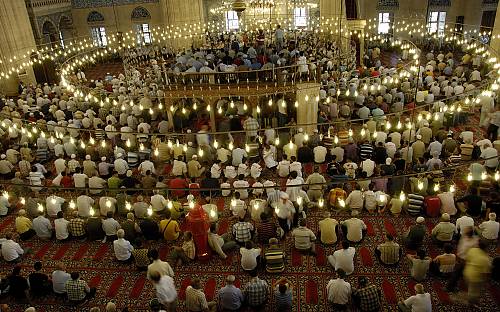
The sum total of all ideas, dreams, legends, rituals brought into the world by the mankind since the dawn of our time—this is our ‘ethnosphere’. This is humanity’s great legacy.
As
Wade Davis, author of Dreams from Endangered Cultures and National Geographic explorer, describes, some of this legacy is expressed in physical objects or impressive constructions, for example the
man-made wonders of the world. However, other aspects can be less tangible living cultural expressions that have been passed down through generations and contribute to our collective sense of identity and community. Whether these expressions take the form of rituals, festivities, skills, dance or knowledge—they elicit certain emotions within us or make us feel a sense of belonging. It is an unavoidable truth of modernity that, along with many of the benefits that globalization has brought to society, it is also causing some of our gloriously diverse cultural heritage to be lost.
The legendary anthropologist Margaret Mead said before she passed away that her greatest fear was that as we headed towards this blandly amorphous generic worldview, not only would we see the entire range of the human imagination reduced to a more narrow modality of thought, but that we would wake from a dream one day having forgotten there were even other possibilities.
“In the end, then, it really comes down to a choice: do we want to live in a monochromatic world of monotony or do we want to embrace a polychromatic world of diversity?— Wade Davis
UNESCO is currently safeguarding and attempting to preserve 298 traditions that the organization has listed as ‘intangible cultural heritage’. Below are eleven illustrations of very intriguing and delightful traditions from this endangered extravagant ethnographic record. Illustrating them here is a gentle reminder that there are an infinite number of ways of thinking and orientating one's self on this
pale blue dot we call home.
1 | Vanuatu Sand Drawing
Long before Snapchat existed, the artists from the Vanuatu archipelago in the South Pacific were creating ephemeral messages—traced by a single finger along a continuous meandering line of an imagined grid to produce a graceful set of geometric patterns in the cooled ash of cooking fires over the volcanic black soil. Not only are they beautiful, these sand drawings possess several layers of meaning: they can be repositories of information, illustrations for stories, signatures, or simply messages and objects of contemplation. (
source)
2 | Generational Vietnamese Gongs
Originating from the appropriately named ancient ‘Dong Son’ civilization, the belief systems of the communities form a mystical world where gongs produce a privileged language between men, gods and the supernatural world. Behind every gong there is a god or goddess, that grows more powerful as the gong ages. In the central Vietnamese highlands, gongs are a symbol of a family’s wealth and prestige; every family owns at least one to pass down through generations. In fact, no rite of passage in their lives, from sacrificing bullocks to victory celebrations, is complete without them. (
source)
3 | The Hopping Procession of Echternach
If hopping alongside 13,000 people sounds like fun, head down to the medieval town of Echternach in Luxembourg on the Tuesday of Pentecost (a Christian religious festival) and join in the fun! It is a thoroughly light-hearted occasion, yet also served as a gesture of defiance in days gone by when foreigners threatened Luxembourg’s survival as a country. The secret to the harmonious hopping lies in the folded cloth held by the dancers in each row. Watch closely to notice subtle differences in the dancing styles, German pilgrims being more energetic in contrast to the relaxed steps of the Belgians. (
source)
4 | Chinese Shadow Puppetry
A form of theatre in which the colorful silhouette figures, many of which have between 12-24 movable joints, are manipulated by puppeteers who are often also masters of improv singing and falsetto. The puppetry show isn’t purely for entertainment either, since it passes on cultural history, social beliefs and unique local customs. (
source)
5 | Chinese Wooden Movable-Type Printing
One of the world’s oldest printing techniques, wooden movable-type printing, takes place in Rui’an County, Zhejiang Province. The men who draw and hand-engrave the characters by hand require intensive training—at present only 11 people over 50 years of age have mastered all of the techniques. (
source)
6 | Croatian Gingerbread Making
Gingerbread has become a symbol of Croatian identity—not only is the process of making the gingerbread difficult, each craftsman will also decorate the gingerbread in a specific way with small pictures, messages, motifs and mirrors—no Croatian festival or wedding is complete without an ample supply of gingery deliciousness. (
source)
7 | Turkish Oil Wrestling Festival
Since 1346, that is, for the past seven centuries (making it the longest-standing annual sporting event in the history of the world) ‘pehlivan’ wrestlers have travelled to Edirne in Turkey for Kirkpinar—a competitive oil wrestling festival. Each one-on-one oily battle is decided by the ‘pehlivan’ who can pin the other for long enough. When this happens, the winner will kiss the defeated as is the custom, and not unlike in a gladiator’s ring in ancient Spartacus, the testosterone-fuelled audience goes wild. (
source)
8 | Tsiattista Poetic Duelling
Picture an epic rap battle... now imagine it’s in Greek-Cypriot poetry and performed with violin or lute in the background. The ‘Tsiattista’ performers improvise rhyming couplets on specific themes within strict time constraints and attempt to outwit their opponents to win over the crowd. (
source)
9 | Tibetan Opera
Tibetan Opera has roots in Tibet’s pre-Buddhist era (the Bön religion), which in turn goes back even longer and incorporates elements from the pre-Bön era—when a shamanistic, animist-oriented religion was practiced. For this reason Tibetan Opera has been dubbed a ‘living fossil of traditional Tibetan culture’ and remains an integral part of the cultural identity of the Tibetan people. The opera itself requires a skillful combination of martial arts, singing, dancing, comedy and precise elocution, woven gracefully together into a story that shares everyday scenes from daily lives of ordinary people, all of which transform into nothing less than a universal statement about people's hopes, aspirations and the human condition. (
source)
“Today, we are going through a critical period in time… protecting an ancient culture like this is the responsibility not only of the concerned nation, but also of the world community as a whole.— His Holiness the 14th Dalai Lama
10 | Yamahoko Moving Museums
On July 17 every year, the Gion Festival in Kyoto in central Japan culminates with a grand procession of
yamahoko—floats known as ‘moving museums’, with gorgeous drape decorations. The floats are paraded through the main streets of central Kyoto, and were originally intended to summon the plague god, so that he could be transformed into a protective spirit through music, dance, and worship. (
source)
11 | Catalonian Human Towers
Every year in Catalonia, Spain, there are festivals in which people come together to build colorful—and ridiculously tall—human towers called
castells, meaning ‘castles’ in Catalan. These
castells can be anywhere between six to ten levels high and consist of about 100-500 men, women and children—supported by nothing other than sheer strength and courage. (
source)
Local Catalan photographer David Oliete is fascinated by these human towers and their capacity for evoking human emotion. He begun photographing the
castells eight years ago and hasn’t stopped since. Explore the gloriously kaleidoscopic shots of human towers in David’s Maptia story:
‘The Human Towers of Catalunya’.