Showing posts with label missionaries. Show all posts

Wednesday, July 10, 2019

China: Influenced by and Influencing the West

"Western Knowledge Flowing into the East"

Since the 16th century, with the opening of sea routes and development of sea trade, the distance between the East and the West drew closer and closer. Europeans could come into direct contact with the mysterious Orient, discovery complexity and the richness of Chinese civilization, and the Maritime Silk Road was the link of communication between the two worlds.

European merchants and missionaries unceasingly arrived to promote and market their lifestyles, religion and sense of values, while the mainstream mentality of the Chinese empire responded mostly with defense, restriction and objection. The delineation between Chinese and foreign things and the notion that "our heavenly kingdom is perfect in every way" severely hindered the rational observation and awareness of the world outside of China.

From the Ming to early Qing, foreign missionaries, while carrying out missionary work, also introduced Western science and technology to the Chinese and ultimately advanced the development of science and technology for the Ming-Qing China.

Map-making


Well-known missionary Matteo Ricci was a literati, and at the same time, affluent in astronomy, calendric systems, geography, mathematics and engineering, among other knowledge and fields of study. After coming to China, he continually presented Western sciences to Chinese governmental officials and scholars, especially the knowledge of astronomy and geography. In Zhaoqing City, Matteo Ricci re-illustrated the map of the Western world, accompanied by Chinese annotations (this is the famous Complete Map of the Earth's Mountains and Seas). In 1601, after entering Beijing, Matteo Ricci made special efforts to illustrate the Complete Map of the Myriad Countries of the World, in which he divided the earth into "five continents" and "five zones" [terms still used today unlike the Western concepts of the seven continents and the seven seas]. The five continents were Asia, Europa, Libia (Africa), Americhe and Magellanica (Antarctica); the five zones were the north frigid zone, north temperate zone, tropical zone, south temperate zone and south frigid zone. And to suit the traditional concept and custom of China [that yellow represents the emperor and since yellow is central, the emperor must be in central position], Matteo Ricci placed China at the center of the map, making Emperor Wanli quite pleased. [Typically when a country makes a map, their country is centrally located.]

Source - Jesuit missionaries, like Fr. Matteo Ricci, and Adam Schaal von Bell (above) recognized that the coherence between the teachings of Christianity and those of Confucius, made Chinese civilization receptive to Western Science.

Matteo Ricci introduced to the Chinese that the earth was round, as well as concepts of the north and south poles, the equator, longitudes and latitudes, to name a few. The new knowledge completely overthrew "the heaven is round and the earth is square" theory, and widened the horizon of many Chinese.

After Matteo Ricci, there was Didace de Pantoja (1571-1618) who was ordered by Emperor Wanli to translate the European map (a work which remained unfinished). In 1623, Giulio Aleni (1582-1649) completed the An Extra Record of Geography, a book illustrating the customs and geography of the countries in five continents, a rather complete account of world geography. In the early Qing Dynasty, missionaries including Luigi Buglio (1606-1677) and Ferdinand Verbiest together compiled the Important Accounts of the Western World, specially devoting attention on Western countries, their people and routes, a book which complemented Matteo Ricci and Giulio Aleni's works.

Source - Beijing observatory, designed and built by Fr. Ferdinand Verbiest.

The Italian Jesuit missionary Martino Martini (1607-1661) on the basis of field surveys, combined academic achievements from Chinese and foreign scholars, published the New World Map and the Map of the Chinese Empire in Augsburg in 1654. The following year he published Novus Atlas Sinensis (New Atlas of China) in Amsterdam (it's contents were detailed and precise), and Martini was considered the "father of geographical studies on China" in the West.

In 1707, Emperor Kangx ordered missionaries Joachim Bouvet (1656-1730), Jean-Baptiste Regis (1663-1738) and Pierre Jartoux (1668-1720) along with Chinese scholars He Guodong, Ming Antu and others to organize a cartography team, which then traveled to every province of China. Using longitudinal and latitudinal coordinates, they drew a detailed map of China: Complete Map of the Empire of Kangxi, a cartographic work considered very advanced.

Calendars

In 1601, Matteo Ricci had recommended the Western calendar to Emperor Wanli in Beijing, and Matteo along with scholar Li Zhizao and others finished many works, including Illustrated Explanation of the Sphere and Astrolabe, by using the Western calendar, knowledge in mathematics and in geography.

Following Ricci, other Jesuit missionaries like Didace de Pantoja, Sabbathin de Ursis (1575-1620), Nicolas Longobardi (1559-1654) Jean Terrenz (1576-1630), Johann Adam Schall von Bell arriving in China were affluent in astronomical calendars. They served the Chinese government by translating western teachings, participated in the revision of the calendar, made astronomical equipment, and contributed to the reforms of the calendric systems of the Ming and Qing dynasties, which ultimately abolished the old system of Datong Calendar and implemented the new Shixian Calendar.

Other Developments


During the Ming and Qing dynasties, missionaries introduced other Western disciplines to China, some of which included physics, agronomy, biology, medicine, architecture, music, fine arts, linguistics, philosophy, and more. There were also hands-on executions in the areas of horology, firearms, gardening, to name a few.

China Influencing Europe and America

Since the 16th century, Europeans who visited China were mostly missionaries, and they introduced a great deal of Chinese culture to the West. The missionaries studied Chinese literature and were pioneering figures in Western Sinology, and profoundly influencing modern cultural development in Europe. The Jesuits periodically reported in writing to the Church about developments in China, and these writings were the most crucial materials for informing Europe about Chinese thinking and culture.

Chinese literary works translated by missionaries included The Doctrine of the Mean, The Great Learning, and The Analects of Confucius by Prosper Intercetta (1599-1666), Confucius Sinarum Philosophus by Philippe Couplet (1624-1692), The Four Books, Book of Filial Piety, and Learnings for Children by Franciscus Noel (1651-1729), Idea Generalis Doctrinae libri Ye Kin by Joachim Bouvet, The Book of History by Antoine Gaubil (1689-1759), and more.

In the 18th century, translated by Jesuit missionaries, as many as 15 volumes of Chinese works on history, science, arts, and customs appeared in Europe. And disseminators of Chinese culture beyond missionaries were the journal logs of navigators along with adventurers and merchants to China.

Evidence of Chinese influence beyond China


18th century French ideologist Denis Diderot (1713-1784), Baron d'Holbach (1723-1789) and leaders of the French Enlightenment movement Montesquieu (1689-1775) and Voltaire (1694-1778) appreciated traditional Chinese culture and were keen to absorb its soul. Voltaire especially was an advocator of Chinese philosophy, ethics, and politics, and in his eyes, Confucius was greater than Jesus. Voltaire dreamed of finding a "rational religion" in which Confucius served as its model.

Traditional Chinese thinking with "emphasis on agriculture" profoundly impacted "physiocratic" theories of French economists Francois Quesnay (1694-1774) and Anne Robert Jacques Turgot (1727-1781). German philosopher Leibniz (1646-1716) was fascinated by the Yi Jing (The Book of Changes) and diagram of the 64 hexagrams, which influenced his Monodology and Natural Law. The great Russian author Leo Tolstoy (1828-1910) performed systematic studies on Chinese thinking and culture late in his life, particularly praising Lao Zi, whom he referred to as his "most adored philosopher".
 
 The eight trigrams and the 64 hexagrams
 
In the 1760s British classical economist Adam Smith (1723-1790) learned of Chinese physiocracy and policies through Francois Quesnay, and this knowledge became a principle ideology behind his classical masterpiece on political economy, An Inquiry into the Nature and Causes of the Wealth of Nations (Wealth of Nations).

In the 17th and 18th centuries large quantities of Chinese silk, porcelain and tea in fad proportions were shipped to Europe, along with household items like fans, sedan chairs, wallpapers, and garments, Eastern cultural additions which brought a poetic and fresh feeling to the West. 
 
Pair of large imari vases
From the 1770s to the 1780s, the pinnacle of "Chinese fashion" manifested in consumer fashion as well as in art style. The art style was a rebellion and negation against the Baroque art style that dominated Europe before the 18th century. This new style called "Rococo", originating from the French word "rocaille," which means having the characteristics of fineness, lightness, flamboyance, intricacy and dynamism. This style primarily influences landscape architecture that advocated Chinese fresco with floral patterns, home furniture with Chinese flower and bird paintings, Chinese prints, etc. Rococo art was popular in Europe for about a century until neoclassicism in the 1760s emerged and gradually became the mainstream art of Europe.
 
__________________________________________________________________________
 
Text Source:
 
This fascinating selection was taken from Li Qingxin's 2006 book "Maritime Silk Road", translated by William W. Wang, and published by China Intercontinental Press, pp. 183-189. An absolute read for the historian!

Wednesday, July 13, 2016

Don't Sleep, There Are Snakes

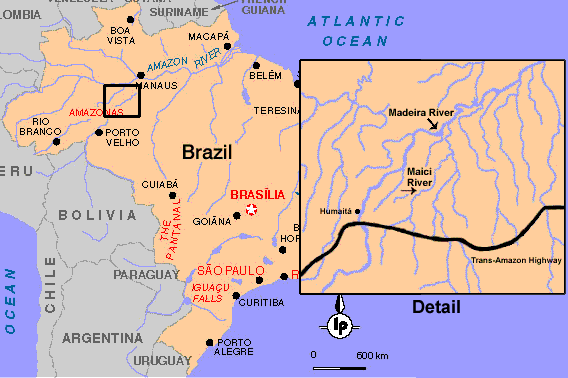
Language is a reflection of culture and in 1979 when Daniel Everett with his wife and three young kids went to Brazil to live among one of the most remote tribes in the world, Dan was forever discovering differences rather than similarities between the cultures. Initially, Dan went as a missionary to the Pirahã with intentions to convert the natives to Christianity, but living among the tribe that had no word or concept for war, shared equally with all members of the village, was non-materialistic, he began to see that his "lifestyle" was inferior to the one he sought to convert, so he gave up mission work and refocused his energies on learning the Pirahã language and culture, both of which were hugely different from his own or any other he had studied.

Even the name of his book Don't Sleep, There Are Snakes: Life and Language in the Amazonian Jungle is a reflection of that difference. The expression "Don't sleep, there are snakes" is actually a way of saying 'good night' but the difference comes with the intent in saying 'good night'. To the Pirahã, they believe that sound sleeping puts one in danger, drops one's defenses, and so they must "harden themselves" into nocturnal awareness to ward off predators. In fact, the Pirahã laugh and talk much of the night, and don't sleep much at any one time, perhaps 20 minutes to at most two hours at any time throughout each 24 hour period.


Euphemisms therefore seem common in the language. When visiting someone's house, the traditional way of approaching a house is to call out, "Hey, tell the dogs not to be mad at me!" Also, if someone gives you food, the person asks, "Do you already know how to eat this?" and if you want to politely refuse, you simply answer, "I already know how to eat this."

Similarly, phatic communication -- communication that primarily functions to maintain social and interpersonal channels like hello, goodbye, how are you?, I'm sorry, you're welcome and thank you -- do not exist as Pirahã sentences are either for requests for information (questions), assertions of new information (declarations), or for the most part commands. Their expressions are primarily limited to immediate experience, so they talk about what they have experienced or someone still living has experienced. Sentences are all simple sentences -- compound and complex sentences are structurally not possible and language structure is limited to simple present, past and future tenses; there are no perfect tenses, and certainly no embedded clauses. In application, translating the Bible, the Koran, or Buddhist Vedas would be impossible as these stories are outside of experienced immediacy and no eye witness could make assertions to their existence. Such stories would therefore, even if they could be translated, have no impact on the tribe. In fact, no known missionaries have had any impact on the Pirahãs for nearly 300 years.

The Pirahã's contact with the "outside" is virtually limited to the Caboclos, descendants of an Amazonian indigenous people living in close proximics to the Pirahã. The Pirahã call them xaobi-gii (authentic foreigners); Americans, Brazilians, etc are simply xaobi (foreigners), because the Pirahã view the Caboclos as more acceptable to interact with, partly because their two different tribes are still more alike than the Pirahã and "other" foreigners who the Pirahã have little social contact with and virtually no understanding of, which ultimately means no interest in.

The Pirahã have no counting system, no fixed expressions for color, no sense of tribal history, creation myth or folklore. Kinship terms are simple and limited to the lifespan, that is, with mortality at around 45, great-grandparents could not be known and so there is no term for such an imaginary relationship. There are no property terms and body-oriented directions are non-existent, e.g. 'turn left' or 'go straight ahead' are not spoken but rather directions for the Pirahã are focused on the directional path and flow of the river, which forces speakers to think of the overall world differently.

Their language has one of the smallest sets of speech sounds and phonemes in the world, with only three vowels (i, a, o) and just eight consonants (p, t, k, s, h, b, g, and the glottal stop x) for men and for women three vowels and seven consonants (women replace the masculine s sound with the h). Surprisingly the consonants are frequently interchangeable, but what is important is the tone, accent, and weight of the syllables which can ultimately be whistled, hummed, yelled or sung. Pirahã is very much a tonal language and cannot be whispered as voicing is necessary for completing communication. Pioneering work by the sociolinguist Dell Hymes noted that there are five pitch channels in Pirahã: whistle speech, hum speech, musical speech, yell speech, and normal speech, the latter using consonants and vowels.

One fascinating conversation Daniel had concerning food involved lettuce. A plane delivered lettuce, tomatoes and cabbage and Daniel was delighted to eat something besides rice, beans, fish and wild game smothered in tabasco sauce. A Pirahã was puzzled when he saw Daniel eating, and enjoying, the salad, and asked, "Why do you eat leaves? Don't you have any meat?" When assured that meat was available, the Pirahã made the "obvious" conclusion to the affair, "Pirahãs don't eat leaves. That is why you don't speak our language well. We Pirahãs speak our language well and we don't eat leaves." The statement confused Daniel but he was to finally come to the conclusion that to speak their language is to live their culture.


The Pirahãs were a hard to define tribe. Unlike other Amazonian groups, they did not wear feathers, enact elaborate rituals, paint their bodies, or have other outward exotic cultural manifestations. They don't display wealth because all Pirahã are equal, they don't need houses for privacy as privacy is not a strong value. They produce few tools, almost no art, and very few artifacts. Perhaps their most outstanding tools are their large, powerful bows (over two yards in length) and arrows (2-3 yards long). If a basket is needed, they quickly weave one on the spot out of wet palm leaves, of course not using the more durable wicker fibers but something for quickly completing what is immediately necessary. The women do wear necklaces made from seeds and homespun cotton string, decorated with feathers, beads, beer-tabs, and other objects, but their purpose is for warding off spirits, not to be artistic, show symmetry or reflect tribal colors or design, which don't exist. Neither do they have any method for food preservation. In death, Pirahã are buried in a prone position with their belongings alongside, but these amount to very little as Pirahã have relatively no material culture.

Marriage ties are for life but invariably men (maybe even women) cheat. The next day a woman will have the man with his head on her lap and she will be rapping his head repeatedly for hours. The woman can express her anger tangibly and the man by allowing her to rap expresses his remorse. The conflict is over by the end of the day, but this isn't to say that it won't happen again.

One anthropology student went to the Pirahã in order to collect data. Lacking Pirahã language, he attempted to conduct his research in Portuguese, which some the Pirahã had limited working knowledge of. When the Pirahã realized that the recording could go to their friend Daniel Everett (having long experienced tape recorders from Daniel's extended stays in the village), the researcher's questions were totally disregarded and they began talking about village affairs to Daniel. The researcher gave up trying, probably intuitively knowing that if he had been speaking "straight head" (Pirahã) instead of "crooked head" (Portuguese) his language constraints would have been lowered and his communication conventions would have been more in line with experiential immediacy.

Tuesday, October 27, 2015

Samurai William: Character for Clavell's Shogun

I stuffed the book Samurai William: The Adventurer Who Unlocked Japan in my purse and headed off to a lecture at the Royal Asiatic Society Korea Branch. I knew I would arrive a bit early so plunked myself down on a lobby couch and opened the book. The story immediately gave me the impression that I was reading a less-racy, well-researched, little-romance version of James Clavell's well-embroidered tale, Shogun. Whipped out my smartphone and sure enough, John Blackthorne in Clavell's novel is modeled after the first British sailor (on a Dutch ship) to Japan, William Adams, or Samurai William as dubbed by Giles Milton in his semi-biography of the British navigator-pilot turned confidant to the shogun and intercessory buffer for the later arriving British, Dutch and other nationalities of traders. As soon as I confirmed the link, two other scholar-friends passed by, saw the book and immediately made the link between Clavell's Shogun and Samurai William. So the question is, which is better - documentary-style history or a juicy detailed novel? I vote for Samurai William, but I wouldn't have understood it as well without having read Clavell's Shogun, so they both have their place in writing the historical record.

______________________________________________________________

In 1598 when he was 34 and bored with being just a pilot of English woolens to Barbary, William Adams heard rumors of a fleet setting sail to the fabled Spice Islands and rushed off to the Netherlands to join the fleet, which was suspiciously silent on its true intended destination. Yet, he and his brother got employment and set sail aboard the Hoop (Hope) and later transferred to the Liefde (Love). They were accompanied by three other ships as well - Geloof (Faith),  Trouw (Fidelity) and Blijde Boodschop (Merry Messenger),

Through hostilities from indigenous people, shortage of food and water, the Liefde (the only ship to make it so far) finally floated into a Japanese harbor, with just 26 men and Adams among them barely alive and unable to even row the boat or defend themselves. They were sick from starvation, scurvy, dysentery and on the verge of death. A band of silken-robed and oil-scented warriors boarded the derelict ship and, ignoring the sick and dying men, stripped the ship of anything valuable and good. No men were bothered, all were systemically ignored. Fortunate for Adams and his men, the local brigand who controlled the strip of land their ship was floating near, heard of the pillaging and with curiosity of the other-worldly appearance of such a strange sea-faring vessel, ordered the goods be returned, and thus began the slow opening of the wharves of Japan to the outside world.

Already the Jesuits were well established in the land, and they had the ear of the shogun. They were not there as traders but as religious adherents spreading their religious fervor. However, it wasn't to the Jesuits' advantage for the protestant Englishmen and Dutch to be entering into the land of Japan for then the shogun would learn that things were not as presented by the Jesuits. In becoming accepted and entrenched into the Japanese society, Father Valignano had ordered that all Jesuits become as Japanese as possible - being robed in silks, eating three grains of rice at a time and sitting back on one's heals while dining, and he even wrote a handbook on decorum to meet that end, Advertimentos. The Jesuits were therefore by this time well in-tuned with the language and had attained a high level of decorum. And Father Valignano was a confidant and advisor to the shogun. No, the Jesuits didn't want the British and Dutch ruining any of their connections or letting Japan know that other religions outside of Catholicism existed, and especially one(s) so contested by the Papacy.

William Adams, however, had the fortune to be listened to by the local authority, who sent him off to the shogun for a hearing. The shogun was interested in Adams sea-faring stories and his documentations for charting the seas and navigating. Father Valignano was the translator but quickly Adams realized Valignano's subtle treachery in undermining the good vibes between him and the shogun and determined to learn the Japanese language. He seemed to have a prowess for languages as he quickly made himself communicable and almost as quickly replaced Father Valignano as confidante and advisor to the shogun. Adams was duly honored with the title hatamoto or bannerman, a prestigious position that made him a great retainer to the shogun's court. This linked him to the great warrior class that had dominated Japanese history for centuries, for his fellow hatamoto were all samurai -- battle-hardened warriors -- whose role was akin to an elite officer corps, or a military bureaucracy.

And the for the next several years, Adams served the shogun, marrying a local Japanese woman and having two more children, (one baby daughter and his wife remained clueless of his life and desire but inability to return to them in England). It was not until July 1613, 13 years later when the Clove anchored in Japan that he next saw any fellow Englishmen. He had romanticized about meeting his countrymen but when they arrived, reeking of body sweat and dressed like animals, (eating that way to) and having low manners and big egos did he realize that he had gone native. The sailors were likewise delighted to see a fellow Englishmen in such distant, forbidden waters but they were even more shocked by his "going native". Neither could they understand the propriety of patience and gift-giving to garner respect before slowly introducing the "business" of opening trade. Adams became an invaluable advisor for them and a go-between them and the shogun, who was interested in cultivating foreign trade.

Years passed. At 55 William Adams (1564-1620) was no longer youthful. He had suffered the ravages of diseases as a sailor and more recently picked up a kind of debilitating malaria in Cochinchina on a voyage he made for the shogun. Never returning to his family back in England, Adams died among the British sailors/traders he was helping. (His son was soon afterwards given the titles and lands that Adams had held, continuing and honoring the legacy of the man who had helped Japan in many more ways than just opening the ports for foreign trade.)

Adams survived Ieyasu (1543-1616), his patron and shogun, by four years. In those four years, Ieyasu's son, Hidetada, had ruled which established that the shogunate was to be a hereditary title. Hidetada didn't have the same brilliance and acumen for business, control (war), and organization as his father and he was soon replaced by his sadistic son, Iemitsu, who had a keen hatred for foreigners and proceeded to hound them out of his territory. However, the British, due to the more and more restrictions placed on their trade and being reduced only to one port, withdrew from England in 1622, a few short years before Iemitsu became shogun.

After Iemitsu became Shogun, foreigners were no longer welcomed. The Jesuits and their converts were the first to feel the barbarity of Iemitsu, soon followed by the expulsion of the Portuguese traders in 1637. The Dutch were quickly limited to a Deshima Island in Nagasaki bay and not allowed to have contact with Japanese. And so, the Land of the Rising Sun entered a period known as sakoku, the closed country. After a century of contact with foreigners, Japan closed her windows to the outside world and denied traders, and in upcoming years, the few mariners unlucky enough to be blown onto her shores were arrested, tortured and killed.

Not until some 200 years later could the Englishmen and other foreigners reestablish trade with the eastern realm. However, when they did, they were astonished to discover that William Adam's name was still famous throughout the land. They listened to marvelous stories of Adam's rise at court, his role as a spokesperson, advisor, tutor and oracle. His title, estate and extraordinary friendship with the shogun had left a deep and lasting impression on the Japanese. As a mark of their respect, they had named an area of Tokyo, Anjin-cho, in this honor. They also kept his name alive in prayers at the Jodoji temple, said to have been where Adams made his devotions and close to where Adams once had a townhouse. A crowd of believers gather in his honorable memory once a year, and amidst air thickened with incense and the clanging of bells, the pilgrims to the temple pray annually for the soul of Anjin Adams.


Proof that Japan remembers: Anjin Festival - August 8-10

Anjin Festival commemorates the launching of the first western-style Japanese ships by sending festival lanterns down the Matsukawa River, and culminates in a splendid display of fireworks over the sea. The ships were designed and built by William Adams, and the shogun was so impressed with Adams that he gave him a house in Tokyo, two swords, and a badge of rank and authority. The English pilot became Samurai Miura Anjin and had a fief in Hemi (today, Yokosuka) as well as an appreciable salary.

Source
Today, a monument marks the foundation of Anjin's townhouse in Anjin-cho, and his grave is marked with his Japanese name in Hirado, Nagasaki prefecture. Source

Sunday, May 13, 2012

Wooden Fish Songs

"Wooden fish songs" are laments sung by Chinese women who were left behind by husbands, sons and brothers in the 19th century when Chinese men were seeking new opportunities in the Golden Mountain (America). This novel Wooden Fish Songs is actually a historical novel told about Lue Gim Gong, an actual person who left China as a young boy, worked in various menial positions in the United States and though perhaps returning to China for a time, spent much of his youth and adult life in the United States where he developed a hardy grapefruit tree that bore succulently sweet grapefruits. He was ripped off by a marketer and his years of hard work only perhaps brought him satisfaction as he never got monetary rewards for his studies and labor. Little is known about Lue Gim Gong (188?~1925), but his obituaries estimate his work was honored in the Florida Pavilion at the 1933 Chicago World's Fair and the 1940 New York World's Fair. His extensive library was sold, his personal papers largely destroyed, and in the 1980s the author was able to trace down a single volume diary but only to discover it had been burned as it was deemed "valueless". This novel, therefore, is the greatest contribution perhaps that exists for the man who sacrificed his country, his labor and his health ... for the Lue Gim Gong grapefruit.

This book needs to read for itself, so my commentary is limited to the cultural reactions of Chinese when they were confronted by white foreigners, most likely Americans, for the first time.

In the years of drought, many Chinese were forced to attend the white ghost's worship center because those who attended were given a bowl of rice, which eased their raging hunger. Lue Gim Gong's mother was one such person. When she went to the center, the foreign ghosts were ugly and their behavior was barbaric. Mounting a raised platform, the ghost man called for silence, then shouted and howled, flinging his arms and twisting his body so furiously that his unhealthy white skin soon blotched red. Sweat poured off him but he lacked the sense to take off his jacket or loosen the sash tied peculiarly around his neck instead of his waist. The mother was not surprised as from the ghost's broken Chinese, he was denouncing her gods, the tender-hearted goddess of mercy, praising the foreign-ghost God, the one who'd murdered his own son. Clearly the man had lost his reason, and Gim Gong had gone to live among the foreign ghosts. Had he lost his reasoning too?

Going to the white ghost's worship place was like going to the theater. The white ghost woman would make strange music by pounding and pumping a large box with her fingers and feet. Her lips moved but Gim Gong's mother couldn't hear well, but understood the problem when the lady beside her snorted and said, "How can she sing louder? She's bound her waist so tight it's a wonder she can breathe, let alone sing!" Another person chimed in, "And she's carried everywhere like a bound-foot woman, but her husband speaks out against foot binding!"

Gim Gong's mother feared also the bread given by the white ghost for the white ghost had said that the bread would become meat and spurt blood if bitten down on. This would not be good because Gim Gong's mother had taken vows to never eat meat so she put the bread in her grandson's mouth, but she was convinced the white ghost was up to more trickery when the bread neither became meat nor spurted blood. She, like other mothers, hid her grandson's face from the look of the foreign white ghosts to perhaps protect him ... but how could she protect her young son Gim Gong who was separated by a sea and many mountains?

The mother indeed thought something was amiss when Gim Gong sent a picture of himself with a ridiculous sash hanging around his neck and his hand resting on his female white teacher's shoulder. The mother was deeply troubled. What kind of woman could teach a man? And worse, could this white ghost, a female though twice his age, have entrapped her son in sexual behavior and was treating her son like the husband she lacked?

In America Lue Gim Gong was learning the language and the culture, which means he was also learning about Christianity but he wasn't readily accepting. When someone rebuked a fellow Chinese for bowing to pagan idols for ritual ancestry worship, Gim Gong defended the man saying that the ancestral tablet was no different from tombstones in the white people's cemetery, the incense his fellow lit before it had the same significance as the flowers white's lay on graves, the deep bows made reflected nothing more than respect, like the bows gentlemen made to ladies. Gim Gong refused to accept the white people's religion as superior to his own when they were so obviously similar, and he was made more stubborn when his white associates told him he would burn in hell forever for his beliefs.

When Lue Gim Gong returned to China, he was a Christian who advocated change in his very traditional isolated hometown filled to overflowing with superstitions and the ever-pressing desire to live in peace with or to placate the restless spirit world. Gim Gong preached Christianity, and was condemned for reading out of a white spirit book with a devil cross on it. He preached change. When people shouted for reverting more strongly to their traditional roots to fight against the coming of the white ghosts and their powers, Gim Gong said no. "We not only can change, we must. We must take the money from surplus harvests, the money you now borrow for funerals and weddings, and spend it on fertilizers, better seed, and improved tools that will bring advancement." His words were not well received ... for who would listen to a younger brother when the older brother and father and sages of the village still lived and freely gave their counsel and wisdom based on their years of learning. And so according to the historical novel, Lue Gim Gong returned to America where he pursued his passion of studying horticulture, the soil and grafting of plants to created his sublime, heavenly perfumed grapefruit.