Showing posts with label globalization. Show all posts

Wednesday, July 10, 2019

China: Influenced by and Influencing the West

"Western Knowledge Flowing into the East"

Since the 16th century, with the opening of sea routes and development of sea trade, the distance between the East and the West drew closer and closer. Europeans could come into direct contact with the mysterious Orient, discovery complexity and the richness of Chinese civilization, and the Maritime Silk Road was the link of communication between the two worlds.

European merchants and missionaries unceasingly arrived to promote and market their lifestyles, religion and sense of values, while the mainstream mentality of the Chinese empire responded mostly with defense, restriction and objection. The delineation between Chinese and foreign things and the notion that "our heavenly kingdom is perfect in every way" severely hindered the rational observation and awareness of the world outside of China.

From the Ming to early Qing, foreign missionaries, while carrying out missionary work, also introduced Western science and technology to the Chinese and ultimately advanced the development of science and technology for the Ming-Qing China.

Map-making


Well-known missionary Matteo Ricci was a literati, and at the same time, affluent in astronomy, calendric systems, geography, mathematics and engineering, among other knowledge and fields of study. After coming to China, he continually presented Western sciences to Chinese governmental officials and scholars, especially the knowledge of astronomy and geography. In Zhaoqing City, Matteo Ricci re-illustrated the map of the Western world, accompanied by Chinese annotations (this is the famous Complete Map of the Earth's Mountains and Seas). In 1601, after entering Beijing, Matteo Ricci made special efforts to illustrate the Complete Map of the Myriad Countries of the World, in which he divided the earth into "five continents" and "five zones" [terms still used today unlike the Western concepts of the seven continents and the seven seas]. The five continents were Asia, Europa, Libia (Africa), Americhe and Magellanica (Antarctica); the five zones were the north frigid zone, north temperate zone, tropical zone, south temperate zone and south frigid zone. And to suit the traditional concept and custom of China [that yellow represents the emperor and since yellow is central, the emperor must be in central position], Matteo Ricci placed China at the center of the map, making Emperor Wanli quite pleased. [Typically when a country makes a map, their country is centrally located.]

Source - Jesuit missionaries, like Fr. Matteo Ricci, and Adam Schaal von Bell (above) recognized that the coherence between the teachings of Christianity and those of Confucius, made Chinese civilization receptive to Western Science.

Matteo Ricci introduced to the Chinese that the earth was round, as well as concepts of the north and south poles, the equator, longitudes and latitudes, to name a few. The new knowledge completely overthrew "the heaven is round and the earth is square" theory, and widened the horizon of many Chinese.

After Matteo Ricci, there was Didace de Pantoja (1571-1618) who was ordered by Emperor Wanli to translate the European map (a work which remained unfinished). In 1623, Giulio Aleni (1582-1649) completed the An Extra Record of Geography, a book illustrating the customs and geography of the countries in five continents, a rather complete account of world geography. In the early Qing Dynasty, missionaries including Luigi Buglio (1606-1677) and Ferdinand Verbiest together compiled the Important Accounts of the Western World, specially devoting attention on Western countries, their people and routes, a book which complemented Matteo Ricci and Giulio Aleni's works.

Source - Beijing observatory, designed and built by Fr. Ferdinand Verbiest.

The Italian Jesuit missionary Martino Martini (1607-1661) on the basis of field surveys, combined academic achievements from Chinese and foreign scholars, published the New World Map and the Map of the Chinese Empire in Augsburg in 1654. The following year he published Novus Atlas Sinensis (New Atlas of China) in Amsterdam (it's contents were detailed and precise), and Martini was considered the "father of geographical studies on China" in the West.

In 1707, Emperor Kangx ordered missionaries Joachim Bouvet (1656-1730), Jean-Baptiste Regis (1663-1738) and Pierre Jartoux (1668-1720) along with Chinese scholars He Guodong, Ming Antu and others to organize a cartography team, which then traveled to every province of China. Using longitudinal and latitudinal coordinates, they drew a detailed map of China: Complete Map of the Empire of Kangxi, a cartographic work considered very advanced.

Calendars

In 1601, Matteo Ricci had recommended the Western calendar to Emperor Wanli in Beijing, and Matteo along with scholar Li Zhizao and others finished many works, including Illustrated Explanation of the Sphere and Astrolabe, by using the Western calendar, knowledge in mathematics and in geography.

Following Ricci, other Jesuit missionaries like Didace de Pantoja, Sabbathin de Ursis (1575-1620), Nicolas Longobardi (1559-1654) Jean Terrenz (1576-1630), Johann Adam Schall von Bell arriving in China were affluent in astronomical calendars. They served the Chinese government by translating western teachings, participated in the revision of the calendar, made astronomical equipment, and contributed to the reforms of the calendric systems of the Ming and Qing dynasties, which ultimately abolished the old system of Datong Calendar and implemented the new Shixian Calendar.

Other Developments


During the Ming and Qing dynasties, missionaries introduced other Western disciplines to China, some of which included physics, agronomy, biology, medicine, architecture, music, fine arts, linguistics, philosophy, and more. There were also hands-on executions in the areas of horology, firearms, gardening, to name a few.

China Influencing Europe and America

Since the 16th century, Europeans who visited China were mostly missionaries, and they introduced a great deal of Chinese culture to the West. The missionaries studied Chinese literature and were pioneering figures in Western Sinology, and profoundly influencing modern cultural development in Europe. The Jesuits periodically reported in writing to the Church about developments in China, and these writings were the most crucial materials for informing Europe about Chinese thinking and culture.

Chinese literary works translated by missionaries included The Doctrine of the Mean, The Great Learning, and The Analects of Confucius by Prosper Intercetta (1599-1666), Confucius Sinarum Philosophus by Philippe Couplet (1624-1692), The Four Books, Book of Filial Piety, and Learnings for Children by Franciscus Noel (1651-1729), Idea Generalis Doctrinae libri Ye Kin by Joachim Bouvet, The Book of History by Antoine Gaubil (1689-1759), and more.

In the 18th century, translated by Jesuit missionaries, as many as 15 volumes of Chinese works on history, science, arts, and customs appeared in Europe. And disseminators of Chinese culture beyond missionaries were the journal logs of navigators along with adventurers and merchants to China.

Evidence of Chinese influence beyond China


18th century French ideologist Denis Diderot (1713-1784), Baron d'Holbach (1723-1789) and leaders of the French Enlightenment movement Montesquieu (1689-1775) and Voltaire (1694-1778) appreciated traditional Chinese culture and were keen to absorb its soul. Voltaire especially was an advocator of Chinese philosophy, ethics, and politics, and in his eyes, Confucius was greater than Jesus. Voltaire dreamed of finding a "rational religion" in which Confucius served as its model.

Traditional Chinese thinking with "emphasis on agriculture" profoundly impacted "physiocratic" theories of French economists Francois Quesnay (1694-1774) and Anne Robert Jacques Turgot (1727-1781). German philosopher Leibniz (1646-1716) was fascinated by the Yi Jing (The Book of Changes) and diagram of the 64 hexagrams, which influenced his Monodology and Natural Law. The great Russian author Leo Tolstoy (1828-1910) performed systematic studies on Chinese thinking and culture late in his life, particularly praising Lao Zi, whom he referred to as his "most adored philosopher".
 
 The eight trigrams and the 64 hexagrams
 
In the 1760s British classical economist Adam Smith (1723-1790) learned of Chinese physiocracy and policies through Francois Quesnay, and this knowledge became a principle ideology behind his classical masterpiece on political economy, An Inquiry into the Nature and Causes of the Wealth of Nations (Wealth of Nations).

In the 17th and 18th centuries large quantities of Chinese silk, porcelain and tea in fad proportions were shipped to Europe, along with household items like fans, sedan chairs, wallpapers, and garments, Eastern cultural additions which brought a poetic and fresh feeling to the West. 
 
Pair of large imari vases
From the 1770s to the 1780s, the pinnacle of "Chinese fashion" manifested in consumer fashion as well as in art style. The art style was a rebellion and negation against the Baroque art style that dominated Europe before the 18th century. This new style called "Rococo", originating from the French word "rocaille," which means having the characteristics of fineness, lightness, flamboyance, intricacy and dynamism. This style primarily influences landscape architecture that advocated Chinese fresco with floral patterns, home furniture with Chinese flower and bird paintings, Chinese prints, etc. Rococo art was popular in Europe for about a century until neoclassicism in the 1760s emerged and gradually became the mainstream art of Europe.
 
__________________________________________________________________________
 
Text Source:
 
This fascinating selection was taken from Li Qingxin's 2006 book "Maritime Silk Road", translated by William W. Wang, and published by China Intercontinental Press, pp. 183-189. An absolute read for the historian!

Thursday, May 9, 2019

Human Trafficking (presentation)

Every semester I get outstanding presentations from my students, and some of those presentations touch on matters of global importance. Human Trafficking is such a presentation! Many people hear about human trafficking as an issue, typically as being in Southeast Asia and Africa, but few really realize that it is not a third world problem, but one that powerfully exists in first world countries as well! With great appreciation on the organization and research to my Public Speaking students (Roxanne Barth, Hyun Ji Choi, Min Park and Junil Lee of France, Guatemala, Guatemala, and Fiji respectively), I am able to publish this to hopefully raise wider awareness of the huge endemic social problem. Thank you my wonderful students for allowing me to share your important research!


Opening points were questions, not facts:

Are smuggling and trafficking synonymous? Definitely no! Smuggling is transportation based while trafficking is exploitation based.

Is the average age of entry into prostitution 12 - 14? No, that is a myth. No one really knows the average age. Many in the U.S. report entry into prostitution as 17 or younger, but the average age for prostitution in the U.S. (must stress that every country is markedly different) is thought to be 19.
_______________________________________________________________________

What is human trafficking?

SEX TRAFFICKING
LABOR TRAFFICKING
CHILD TRAFFICKING
DOMESTIC SERVITUDE


_____________________________________________________________

For more sites on human trafficking:

Human Trafficking Foundation (UK)
United Against Human Trafficking (Texas, USA)

And a series of 3 articles published by The Muse in one of Obama's January National Human Trafficking Awareness Months, seven worldwide organizations combating human trafficking were highlighted

Trafficking Policy and Advocacy: Polaris Project

One of the most influential groups working on the issue in the United States, the Polaris Project takes a comprehensive approach to ending modern-day slavery. The organization advocates for stronger federal and state laws, operates the National Human Trafficking Resource Center hotline, provides services and support for trafficking victims, and works with survivors to develop long-term strategies to ending human trafficking.

Second-Generation Trafficking: Prajwala

In India, children who grow up in brothels with their parents often meet the same fate. In order to counteract this dangerous legacy, social activist Dr. Sunitha Krishnan co-founded Prajwala (which means "eternal flame”). Based in Hyderbad, India, the organization rescues women from brothels and then provides them with education, mental health care, and job programs. (Check out Dr. Krishnan’s powerful talk at the 2009 TedIndia Conference.)

Statelessness and Child Trafficking: COSA

Most Hill tribes in Thailand are “stateless,” or not governed by the laws of the country—which makes their women and girls particularly vulnerable to trafficking. After recognizing this, photojournalist Mickey Choothesa and social worker Anna Choothesa created the Children’s Organization of Southeast Asia to provide education, intervention, and support in Hill tribe communities. COSA works directly within trafficking communities to provide trafficked girls with healthcare, social services, and housing in the Baan Yuu Suk Shelter—as well as to bring awareness and education to the traffickers themselves.

Trafficking of Men and Young Boys: Urban Light

A number of organizations help girls in the sex industry, but very few work to aid young men. After a service trip during which she observed the industry in Thailand firsthand, Alezandra Russel realized that boys are often excluded from the human trafficking conversation. So she created Urban Light, an organization that works to help young men break free from child prostitution and sexual exploitation. By providing food, shelter, healthcare, and support services, the group helps restore and rebuild the lives of male victims.

International Sporting Events: Student World Assembly’s Red Card Project

When a large sporting event, such as the World Cup, takes place, fears often arise that trafficking will increase to meet demand from the influx of tourists. Student World Assembly’s Red Card Project mobilizes students from around the world to stage powerful and striking condemnations of human trafficking at these events, bringing large-scale and needed public awareness to the practice.

Child Labor: GoodWeave

The handmade rug industry has one of the highest child labor rates in the world. When GoodWeave began its work in 1994, there were nearly one million children—many kidnapped or trafficked—working on the looms in South Asia, often for up to 18 hours a day. Through its efforts, the organization has not only helped bring child labor in the rug industry down 75%, it has built affiliations with retail outlets all over the U.S. to ensure that all carpets sold are free from child labor.

The Issue of Choice: The Empower Foundation

Not all who work in the sex industry do so against their will—some do so by choice. While the resources of most organizations aim to assist those exploited and hidden in the shadows, The Empower Foundation grew from a movement of sex workers and entertainers who fight for fair and sustainable standards and equal rights in the professions they have chosen. The group runs the Can Do Bar, which offers just, safe, and fair conditions for its workers.

Friday, December 25, 2015

5.5% Nobel Laureates Female - 49 out of 874 (2015)

The Nobel Prize and Prize in Economic Sciences have been awarded to women 49 times between 1901 and 2015. Only one woman, Marie Curie, has been honored twice, with the 1903 Nobel Prize in Physics and the 1911 Nobel Prize in Chemistry. This means that 48 women in total have been awarded the Nobel Prize between 1901 and 2015. For a complete listing of the females honored with Nobel Prize accolades see Nobel Prize Awarded to Women.


49 prizes to women is indeed a small number as to present, 2015, 874 Laureates have been awarded and 26 organizations, totaling 900 Nobel Prizes since 1901. That is, 94.5% of the Nobel Laureates awarded were men. For more on the distribution of prizes, the laureates and their fields, years without prizes, individuals who declined the prize, and other interesting facts about the awarding of the Nobel Prize, see Nobel Prize Facts.


Via email, the following picture compilation was sent to me in regard to the literary Nobel prize winners, so am continuing to share the compilation. In total 13 of the Nobel Prizes for literature, out of the total 111 prizes to date, have been awarded to women. No better quote sums the earned and appreciated accolades of female Nobel laureates in literature and in other highly merited fields of study than "Since the beginning of the 20th century, female writers have emerged from the shadows of their male colleagues." The 13 honored women for the Nobel Prize in Literature are as follows:


Tuesday, October 27, 2015

Samurai William: Character for Clavell's Shogun

I stuffed the book Samurai William: The Adventurer Who Unlocked Japan in my purse and headed off to a lecture at the Royal Asiatic Society Korea Branch. I knew I would arrive a bit early so plunked myself down on a lobby couch and opened the book. The story immediately gave me the impression that I was reading a less-racy, well-researched, little-romance version of James Clavell's well-embroidered tale, Shogun. Whipped out my smartphone and sure enough, John Blackthorne in Clavell's novel is modeled after the first British sailor (on a Dutch ship) to Japan, William Adams, or Samurai William as dubbed by Giles Milton in his semi-biography of the British navigator-pilot turned confidant to the shogun and intercessory buffer for the later arriving British, Dutch and other nationalities of traders. As soon as I confirmed the link, two other scholar-friends passed by, saw the book and immediately made the link between Clavell's Shogun and Samurai William. So the question is, which is better - documentary-style history or a juicy detailed novel? I vote for Samurai William, but I wouldn't have understood it as well without having read Clavell's Shogun, so they both have their place in writing the historical record.

______________________________________________________________

In 1598 when he was 34 and bored with being just a pilot of English woolens to Barbary, William Adams heard rumors of a fleet setting sail to the fabled Spice Islands and rushed off to the Netherlands to join the fleet, which was suspiciously silent on its true intended destination. Yet, he and his brother got employment and set sail aboard the Hoop (Hope) and later transferred to the Liefde (Love). They were accompanied by three other ships as well - Geloof (Faith),  Trouw (Fidelity) and Blijde Boodschop (Merry Messenger),

Through hostilities from indigenous people, shortage of food and water, the Liefde (the only ship to make it so far) finally floated into a Japanese harbor, with just 26 men and Adams among them barely alive and unable to even row the boat or defend themselves. They were sick from starvation, scurvy, dysentery and on the verge of death. A band of silken-robed and oil-scented warriors boarded the derelict ship and, ignoring the sick and dying men, stripped the ship of anything valuable and good. No men were bothered, all were systemically ignored. Fortunate for Adams and his men, the local brigand who controlled the strip of land their ship was floating near, heard of the pillaging and with curiosity of the other-worldly appearance of such a strange sea-faring vessel, ordered the goods be returned, and thus began the slow opening of the wharves of Japan to the outside world.

Already the Jesuits were well established in the land, and they had the ear of the shogun. They were not there as traders but as religious adherents spreading their religious fervor. However, it wasn't to the Jesuits' advantage for the protestant Englishmen and Dutch to be entering into the land of Japan for then the shogun would learn that things were not as presented by the Jesuits. In becoming accepted and entrenched into the Japanese society, Father Valignano had ordered that all Jesuits become as Japanese as possible - being robed in silks, eating three grains of rice at a time and sitting back on one's heals while dining, and he even wrote a handbook on decorum to meet that end, Advertimentos. The Jesuits were therefore by this time well in-tuned with the language and had attained a high level of decorum. And Father Valignano was a confidant and advisor to the shogun. No, the Jesuits didn't want the British and Dutch ruining any of their connections or letting Japan know that other religions outside of Catholicism existed, and especially one(s) so contested by the Papacy.

William Adams, however, had the fortune to be listened to by the local authority, who sent him off to the shogun for a hearing. The shogun was interested in Adams sea-faring stories and his documentations for charting the seas and navigating. Father Valignano was the translator but quickly Adams realized Valignano's subtle treachery in undermining the good vibes between him and the shogun and determined to learn the Japanese language. He seemed to have a prowess for languages as he quickly made himself communicable and almost as quickly replaced Father Valignano as confidante and advisor to the shogun. Adams was duly honored with the title hatamoto or bannerman, a prestigious position that made him a great retainer to the shogun's court. This linked him to the great warrior class that had dominated Japanese history for centuries, for his fellow hatamoto were all samurai -- battle-hardened warriors -- whose role was akin to an elite officer corps, or a military bureaucracy.

And the for the next several years, Adams served the shogun, marrying a local Japanese woman and having two more children, (one baby daughter and his wife remained clueless of his life and desire but inability to return to them in England). It was not until July 1613, 13 years later when the Clove anchored in Japan that he next saw any fellow Englishmen. He had romanticized about meeting his countrymen but when they arrived, reeking of body sweat and dressed like animals, (eating that way to) and having low manners and big egos did he realize that he had gone native. The sailors were likewise delighted to see a fellow Englishmen in such distant, forbidden waters but they were even more shocked by his "going native". Neither could they understand the propriety of patience and gift-giving to garner respect before slowly introducing the "business" of opening trade. Adams became an invaluable advisor for them and a go-between them and the shogun, who was interested in cultivating foreign trade.

Years passed. At 55 William Adams (1564-1620) was no longer youthful. He had suffered the ravages of diseases as a sailor and more recently picked up a kind of debilitating malaria in Cochinchina on a voyage he made for the shogun. Never returning to his family back in England, Adams died among the British sailors/traders he was helping. (His son was soon afterwards given the titles and lands that Adams had held, continuing and honoring the legacy of the man who had helped Japan in many more ways than just opening the ports for foreign trade.)

Adams survived Ieyasu (1543-1616), his patron and shogun, by four years. In those four years, Ieyasu's son, Hidetada, had ruled which established that the shogunate was to be a hereditary title. Hidetada didn't have the same brilliance and acumen for business, control (war), and organization as his father and he was soon replaced by his sadistic son, Iemitsu, who had a keen hatred for foreigners and proceeded to hound them out of his territory. However, the British, due to the more and more restrictions placed on their trade and being reduced only to one port, withdrew from England in 1622, a few short years before Iemitsu became shogun.

After Iemitsu became Shogun, foreigners were no longer welcomed. The Jesuits and their converts were the first to feel the barbarity of Iemitsu, soon followed by the expulsion of the Portuguese traders in 1637. The Dutch were quickly limited to a Deshima Island in Nagasaki bay and not allowed to have contact with Japanese. And so, the Land of the Rising Sun entered a period known as sakoku, the closed country. After a century of contact with foreigners, Japan closed her windows to the outside world and denied traders, and in upcoming years, the few mariners unlucky enough to be blown onto her shores were arrested, tortured and killed.

Not until some 200 years later could the Englishmen and other foreigners reestablish trade with the eastern realm. However, when they did, they were astonished to discover that William Adam's name was still famous throughout the land. They listened to marvelous stories of Adam's rise at court, his role as a spokesperson, advisor, tutor and oracle. His title, estate and extraordinary friendship with the shogun had left a deep and lasting impression on the Japanese. As a mark of their respect, they had named an area of Tokyo, Anjin-cho, in this honor. They also kept his name alive in prayers at the Jodoji temple, said to have been where Adams made his devotions and close to where Adams once had a townhouse. A crowd of believers gather in his honorable memory once a year, and amidst air thickened with incense and the clanging of bells, the pilgrims to the temple pray annually for the soul of Anjin Adams.


Proof that Japan remembers: Anjin Festival - August 8-10

Anjin Festival commemorates the launching of the first western-style Japanese ships by sending festival lanterns down the Matsukawa River, and culminates in a splendid display of fireworks over the sea. The ships were designed and built by William Adams, and the shogun was so impressed with Adams that he gave him a house in Tokyo, two swords, and a badge of rank and authority. The English pilot became Samurai Miura Anjin and had a fief in Hemi (today, Yokosuka) as well as an appreciable salary.

Source
Today, a monument marks the foundation of Anjin's townhouse in Anjin-cho, and his grave is marked with his Japanese name in Hirado, Nagasaki prefecture. Source

Monday, March 31, 2014

Accumulation of Electronic Waste

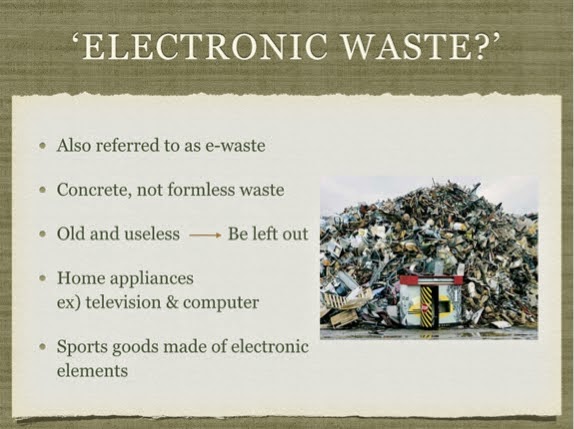
Three of my students put together a phenomenal presentation on the accumulation of electronic waste and what happens to a vast amount of it after it is tossed out of the user's home, never to be seen by them again, but to be affected by it again is another story. With permission of Dongjune Lee, Jeongsoo Yoo and Seulki Lee I am able to publish with presentation here. I sincerely thank my students for their great effort in making the presentation and for allowing me to share it!


Usable parts are manually disassembled and separated by metals for recycling. 
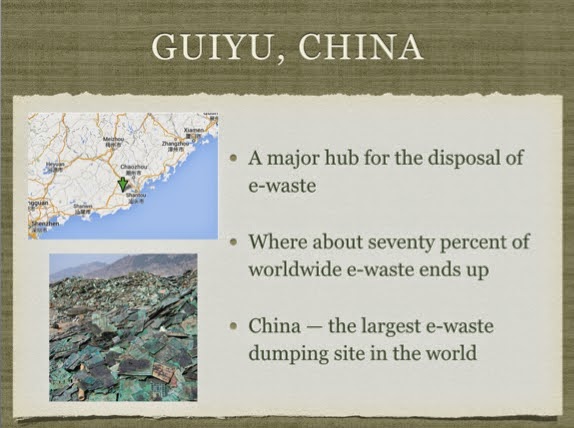
Workers in Guiyu work without gloves or any protective clothing. When tested, workers had 82% higher than average levels of lead in their blood. Not only are workers affected, but local water is contaminated and cannot be purified for safe consumption. So why do workers recycle when they know of the risks? A worker gets approximately $8/day for his/her work which is about five times higher than what would be received as a regular farmer or laborer.


Leaders of developing countries must use foresight, but this is hard when economics drive politics
and ready revenue promises quicker development.
Leaders of developed countries as a whole are driven by maintaining momentum for more economic development and expansionism of technology, resulting in economic development overshadowing social welfare. Leaders of developed countries must take a step back and consider the consequences outside of their own country that their push for more technological and economic development are causing. In short, they should act more responsibly for the welfare of the entire planet and not the welfare of the national budget.


Saturday, June 15, 2013

Ghengis Khan and the Making of the Modern World

Weatherford, Jack. Ghengis Khan and the making of the modern world.  xxxv, 312 pp., illus., bibliogr. New York: Crown Publishers, 2004. $25.00 (hard), $14.95 (paper)
(book review - by Cheryl Magnant)

This historical ethnography of the Mongol people as hunters growing into the powerful nation of destroyers, conquerors and shapers of history under the leadership of Ghengis Khan is a carefully researched piece of scholarship divided historically into three parts.  For introduction, the author relates his personal research endeavors in the Mongolian steppes and gives a broad overview of how Mongols are perceived in the present age and how and from where commonly known perceptions and misconceptions of the Mongols have arisen.  The first part of the narrative tells of Ghengis Khan’s birth in 1162, his rise to power and his charisma as a leader and unifier of the steppe tribes into a founded nation in 1206, and then recounts many of his successes at expansionism until his death over twenty years later. The second part relates the further expansions of his immediate heirs and their entering the Mongol World War, which lasted five decades until his grandsons went to war with one another; the war was the beginning of the end of the great nation which ruled nearly half of the world from the Mongol steppes north to the dense forests of Russia, south to Vietnam and westward to the edges of modern western Europe, and deeply southward into India. The third part examines Mongolia’s century of peace and the effects the Global Awakening had on modern society in terms of political, commercial and military institutions. 
 

Following the three narratives is an epilogue giving a culturally emotional tribute to a newly discovered site located by the author and his scholarly companions; it is the location of Ghengis Khan’s wife’s kidnapping, the pivotal event which ignited Ghengis Khan into ingeniously changing a tribe into a nation.  Extensive chapter notes provide cross-referencing in English, when available, and other languages if not; all referenced foreign scripts have been Anglicized.  For Anglicizations within the narrative, Jack Weatherford provides a note on transliteration of the Mongol language and a glossary of Mongolian names and places appearing in the text.  His selected biography is replete with no less than one hundred and ninety-five references, followed by acknowledgments to the diversity of people in Mongolia, Russia, China and the United States, ranging from herders to parliament members, who assisted him in his years of research.  Throughout the ethnography, intermittent drawings depicting historical moments reflective of Mongolian art and culture appear by Dr. S. Badral of Chinggis Khaan University.  Finally, a several-paged index culminates this ethnography. 

Jack Weatherford’s premise in writing Ghengis Khan and the Making of the Modern World is that through the influence of Ghengis Khan, contrary to popular belief, the world was not only threatened by his warring ingeniousness and revolutionary tactics but was also positively transformed.  Jack Weatherford writes about the ancient struggle between the hunter and the herder and portrays the triumph of the hunter in a revisionist history of Ghengis Khan reshaping civilization worldwide by conquering peoples but not destroying cultures.  Ironically, Ghengis Khan, an illiterate hunter who became Great Khan in his early forties, surrounded himself with scholars and skilled artisans of the conquered peoples and amalgamated their knowledge into his growing Mongol kingdom; thus, through his military thrusts primarily west and southward, he redistributed his newly gained knowledge and learned skills, and as a result, impacted world history by reshaping literature, language, art, music, erudition itself, methods of war, politics and diplomacy, commerce, philosophies, and, in fact, he was the first conqueror and ruler to successfully practice religious tolerance.  Ghengis Khan was a humanitarian who abolished torture, avidly sought out new technologies and forms of expertise, and as Great Khan, head of the Mongols, was representative architect of history.  His four male offspring were the dynasty founders of the Golden Horde in Russia, the Moghul Empire in India, the Ilkhanate in Persia and Iraq, and the Yuan Dynasty in China.  His blood legacy lasted for seven hundred thirty-one years until the last descendent, Alim Khan, was deposed as emir of Bukhara.  Yet, the legacy he gave the world was the foundation of modern civilization:  international paper currency, a postal system, technologies such as printing, the compass and abacus, as well as the spread of merchandises.  Namely, the legacy he bestowed on civilization was the beginning of the homogenization of our present global village.
 
Mediaeval Commerce Asia - source
Ghengis Khan and the Making of the Modern World is a theoretical narrative of historical events which took place eight centuries previous.  Extensive passage of time and translation concerns of The Secret History of the Mongol raise some questions as to the exactness of the events reconstructed in this ethnology, especially as The Secret History of the Mogols was written for the royal Mongol family significantly after Ghengis Khan’s death.  Over a period of five years Jack Weatherford researched and took cultural journeys through the “Great Taboo,” Ghengis Khan’s homeland and forbidden burial site.  Through careful readings of the more than a dozen language translations of The Secret History of the Mongols, Jack Weatherford, self-confessed as lacking proficiency in the Mongol language, along with two renowned Mongolian scholars, Professor Kh. Lkhagvasuren, archeologist, and Professor O. Sukhbaater, geographer, retraced the steps of Ghengis Khan in the same inclement weather as was presented in The Secret History of the Mongols.  Vast discrepancies between the translations became apparent as well as the difficulty in deciphering the context of relocating non-geographically named sites.  Other names appear to be in code or allude to places and events of common knowledge at the time but about which have been lost in the intervening centuries.  Due to harsh weather, the steppes are ever-changing and topographical landmarks have been erased or defaced, making positive identification difficult.  Transliterations of names into English alone also inhibit the preciseness demanded of empirical research; however, Jack Weatherford presents several names of controversial spelling and, explaining his choice in selecting one, systematically uses it throughout his narrative. 
 
The Secret History of the Mongols is a cultural tool, describing even the weepings of the Great Khan; nevertheless, there exists one cultural aspect that leaves gaps in the understanding of peoples of non-Mongolian backgrounds:  the topic of death, which is still not culturally discussed in Mongolia today.  As a result, a mystical vagueness surrounds the death and burial of Ghengis Khan, and no matter how scholarly or technical the searching may become, the steppes will never bring to light his disguised-by-trampling burial site.  Jack Weatherford, already holding a Ph.D. in anthropology from the University of California, yet, owing to his five years of extensive research with the steppe scholars and an additional year of literary research on Mongolia at Macalester College in St. Paul, Minnesota where he is the Dewitt Wallace Professor, was awarded an honorary Doctorate of Humanities from the Chinggis Khaan College in Mongolia for his scholarly research on Mongolia and Ghengis Khan.  His most recent ethnography, Ghengis Khan and the Making of the Modern World, is imbued with Jack Weatherford’s insightful steppe-life cultural experiences which clarify presupposed cultural knowledge in the recently corrected and translated The History of the Mongols: The Life and Times of Chinggis Khan (2001) by Urgunge Onon.  The books counterbalance each other.  The History of the Mongols focuses on the past and is a cultural translation from the original Uighur script into English, whereas Genghis Khan and the Making of the Modern World not only explores Mongolia’s ancient history but also ties in the ancient past with the modern present. 
 
Cheryl Magnant