Showing posts with label Poland. Show all posts

Thursday, November 1, 2018

The Bear Wojtek: Beer-drinking World War II Hero

Every semester in my Academic English class I have a speaking contest of some kind. One semester it might be "for 4 minutes talk about your favorite book", and the students are put in 4-5 student groups to battle out the "most interesting book" of the class. They start at small group level and then verbally battle it out in a second finalist round. This semester I thought we would have the speaking contest on "weirdest of the weird" news item, and again students had to "market their story" as the "weirdest of the weird" to win the prize. Much like the major leagues, the contest isn't just one-round of story-telling, but involves two before the students can choose the class pick for the weirdest story told to them. We had some amazing stories, but the most memorable story from the class was not the weirdest-of-the-weird, "The Ear That Was Made with Van Gogh DNA", but the beer-drinking bear Wojtek of World War II who was a war hero! My history-buff student loves war stories so he scrounged for a stunner, and indeed, he won "most jaw-dropping" story in the class! Total consensus!


How an orphaned Syrian bear named Wojtek became a Polish army hero 
Wikimedia Commons
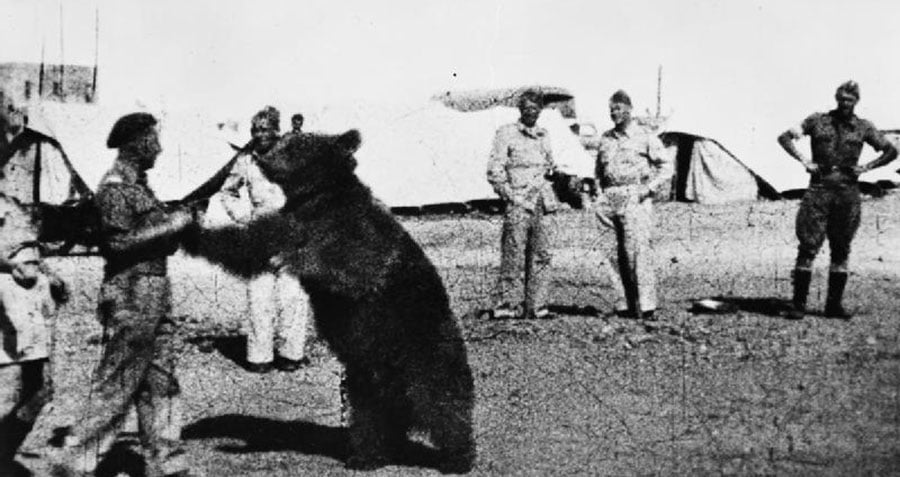
Troops of the Polish 22 Transport Artillery Company watch as one of their comrades play wrestles with Wojtek their mascot bear during the Middle Eastern campaign of World War Two, circa 1942-1943. 
Amid a long journey to join forces with the British Army in World War Two, one unit of the Polish II Corps stumbled upon an unlikely, and invaluable, comrade: A Syrian brown bear. 
A New Army And A New Mascot 

Poland bore a bulk of World War Two-related traumas. After the Nazis invaded Poland on September 1, 1939 — only to be followed by the subsequent Soviet invasion on the 17th — the country had only experienced a couple of decades of independence before it found itself under occupation once again. 
Following the invasions, Stalin and Hitler agreed to a nonaggression treaty, which effectively divided Poland in two. Hitler broke that pact on June 22, 1941, when he ordered an invasion of the USSR. 
In what came to be known as the Sikorski-Mayski Agreement, Stalin declared all previous pacts between the USSR and Poland to be null and void. Among other things, this allowed Poles to create their own army, despite technically being on Soviet soil. That they did, and the army became the Polish II Corps led by Lieutenant General Władysław Anders. 
In the spring of 1942, the newly-formed army left the USSR for Iran, along with the thousands of Polish civilians released from Soviet gulags. On the way to Tehran, the traveling Poles encountered an Iranian boy in the town of Hamadan who had found an orphaned bear cub. Irena Bokiewicz, one of the civilians, was so enamored with the cub that one of the lieutenants purchased him in exchange for a few tins of food. 
The cub became a part of the 22nd Artillery Supply Company, and soon received its own Polish name, Wojtek (pronounced voy-tek), which translates to “joyous soldier.” Wojtek traveled with the company through the Middle East, as the unit made its way to join forces with the 3rd Carpathian Division of the British Army in Palestine. 
Wojtek the Bear 
Wikimedia Commons Wojtek sits with a Polish soldier, 1942
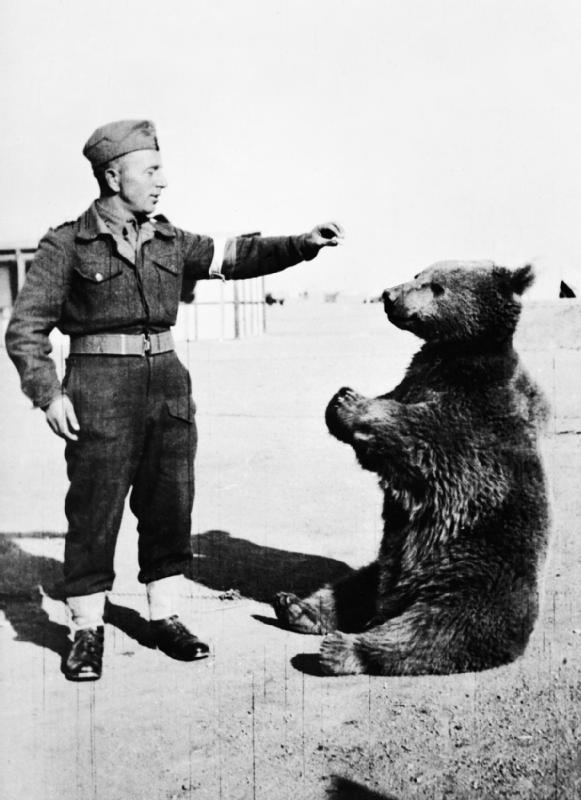
Growing up with soldiers, Wojtek adopted some rather curious habits. Indeed, reports say that the bear would drink milk from an old vodka bottle, imbibe beer and wine, and smoke (and eat) cigarettes with his army buddies, just as any soldier would. 
Wojtek quickly became a source of light in the midst of war. He would often wrestle with his fellow fighters, and even learned to salute when greeted by his company men. 
Wojtek’s fate with the company fell on uncertain times in 1943, when the unit prepared to board a ship and join the Allied campaign against Italy in Naples. Officials at the Alexandria, Egypt port refused to let the bear on as he was not officially part of the army.
In a quick, if not bizarre, workaround, soldiers made Wojtek a private of the Polish II Corps, and gave him a rank, service number, and pay book to legitimate his status. It worked, and Wojtek joined his comrades onto the Italy-bound vessel, this time as a legal member of the army. 
By the time the unit arrived in Italy, Wojtek had grown significantly from cub to a 6 ft tall, 485 lb. adult Syrian brown bear. Making good use of his size and strength, the company taught Wojtek how to carry crates of mortar rounds, which he reportedly did without fail during the bloody battle of Monte Cassino. 
Wojtek not only survived the conflict — soon after, he achieved legendary status. Indeed, following Wojtek’s valiant performance, Polish high command made Wojtek the official emblem of the 22nd Artillery Supply Company. 
When the war came to a close in 1945, Wojtek retired from army life and traveled to Scotland with his fellow soldiers. Unlike his fellow veterans, Wojtek retired to the Edinburgh Zoo. 
Wikimedia Commons
While 21-year-old Wojtek would die at the zoo on December 2, 1963, his memories of army life would stay with him for the rest of his days. Reports say that the bear would perk up when he heard visitors speak Polish.
__________________________________________________________________

My student did further studies on the bear for relating his story. Once curious story he found was that initially the bear, as he was sitting up with his arms out, was given ammunition for a moment. When the bear didn't drop it but accepted holding the ammunition, the soldier or officer thought of getting the bear to actually carry ammunition to the front. Wojtek willingly did it! As Wojtek became even more loved in his company, the emblem patch on the uniforms of the Twenty-Second Artillery Supply in which Wojtek belonged came to be that of a bear ... carrying ammunition!

       Wojtek, the Bear of Monte Cassino

The "wartime memoirs of Stanislaw Kroczak, an officer with the Twenty-Second Artillery Supply Company of the Polish II Corps ... [puts a lot of human-attributed behavior stories like carrying ammunition in his forepaws to the front] to rest but does note the bear’s role in helping maintain the troops’ high morale during the bloody campaign up the mountainous Italian peninsula, culminating in the capture of Monte Cassino by the Poles on May 18, 1944. After the war, Wojtek shared the lot of most of his Polish friends who chose not to return to their Soviet-dominated homeland. Many of them settled in Scotland, and Wojtek was placed in the Edinburgh Zoo, frequently visited by his old army buddies, journalists, and crowds of admiring fans. Wojtek died in Edinburgh in 1963, but his fame lives on in several Polish and English children’s books, a BBC film documentary, and commemorative plaques in the Edinburgh Zoo, Imperial War Museum in London, and the Canadian War Museum in Ottawa. His story is now also documented in the Hoover Archives." -- Hoover Institution, 21 March 2012

Thursday, June 8, 2017

The Zookeeper's Wife

The Zookeeper's Wife is a war story about Warsaw under siege and the Jewish holocaust. Jan Zabinski, the zookeeper, and his wife Antonina ran the Warsaw zoo, but when the animals were shot for sport by a German zookeeper Lutz Heck after selectively taking the preferred and rare animals (European bison, Przywalski horses which had only been "discovered" in 1879, and a few others) for Nazi selective breeding, Jan and Antonina stayed on at the zoo to assist in the running of a fur farm for making fur coats for the Nazis. [Under the Third Reich, animals became noble, mythic, almost angelic -- including humans, of course, but not Slavs, Gypsies, Catholics, or Jews. Therefore, breeding programs were for the selected animals and medical procedures and experiments were for the undesirably "humans". The subjects of Auschwitz's operating doctor Mengele could be operated on without painkillers, but a remarkable example of Nazi zoophilia was that a leading biologist was once punished for not giving worms enough anesthesia during an experiment.]

The zoo, despite its loss of wild animals, was a cover for hiding Jews right under the invaders' noses. In the course of the war Jan and Antonina managed to save 300 by hiding them on the zoo grounds, which were, by the way, right next to a Nazi compound. The Jews referred to as "guests" were given animal names that reflected their character and their cage of domicile. This naming method also prevented slip-of-the-tongues or prevented people who overheard their talk from guessing the truth of what really was going on at the zoo. The people who lodged in the lion's cage were, therefore, called the lions. "Pheasants" often came in the night and lodged in the pheasant house, only to fly a few days later when their trail wasn't so hot. 


During the five years of the war, 860,000 Poles were uprooted and resettled; 75,000 Germans took over their lands; 1,300,000 Poles were shipped to Germany as slave labor, and 330,000 simply shot. With ingenuity the Polish Resistance sabotaged German equipment, derailed trains, blew up bridges, printed over 1,100 periodicals, made radio broadcasts, "illegally" taught in schools and colleges (attended by 100,000 students), aided Jews in hiding, supplied arms, made bombs, assassinated Gestapo agents, rescued prisoners, staged secret plays, published books, held its own law courts, and ran couriers to and from the London-based government-in-exile. At the height of the war, 380,000 soldiers with Jan Zabinski among them comprised the military wing of the Home Army.

Jan was the leader of an Underground cell, and he used the delivery of hay and fodder for the animals as a way to bring in and pass on explosives and other counter-intelligence equipment, which Antonina never knew about until after the war. He poisoned pigs, butchered them, and then arranged the meat to be eaten by German soldiers. During one month in 1943, his cell derailed 17 trains and damaged 100 locomotives! Antonina basically knew that he was part of the resistance but not that he led parts of it so actively, often narrowly escaping capture or death. Antonina would only learn of his great exploits after the war and Jan's return from a POW camp. Jan figured that Antonina had enough stress on her plate with taking care and protecting her very young son, and of course ensuring the meals, shelter and safety of her continue flow of "guests".

In the earlier part of the war Germans established food lines for the starving people of Warsaw. They calculated a calorie-feeding system for the differing races who stood in three separate food lines based on race. The Germans received 2,613 calories of food per day, the Poles 669, and the Jews 184. German Governor Frank who controlled all matters in Warsaw declared, "I ask nothing of the Jews except that they disappear."

According to German figures, Germans shipped 316,822 people from Warsaw to concentration camps between early 1942 and January 1943. Many were shot in the ghetto so the death rate was actually much higher. Aided by friends on the Aryan side, tens of thousands escaped the ghetto, but some who stayed, such as Kalonymus Kalman Shapira, the ghetto's Hasidic rabbi, revealed a tigerish struggle with faith as was discovered after the war by his discovered diary. How could anyone reconcile the agony of the Holocaust with Hasidim, a dancing religion that teaches love, joy, and celebration? During World War II, 30-40% of the world's Jews were killed, but more specifically 80-90% of the Orthodox community was wiped out; this was the group that kept alive the ancient tradition of mysticism and meditation traced back to the Old Testament world of the prophets.

In 1941, Governor Frank decreed everyone must have an identity card complete with serial number and fingerprints. For two years, Polish offices responsible for making the cards stalled. Meanwhile, they along with Underground offices and greedy opportunists were able to set up a system for making fictitious identity cards. Hordes of people suddenly seemed to have lost their records (born in Russia, born to Muslim Poles, records burned in a church fire), so needed to reissued identity credentials. By 1943 it was commonly known that 15% of all identity cards and 25% of all working papers had been forged.

After the war and his return from the POW slave labor camp, Jan was forced to retire from zookeeping at the age of 54. Times were hard after the war and anyone who praised pre-war independence or resistance during the war (and especially for someone who fought in such a war) were judged to be dangerous. Jan retired from zookeeping but still devoted to zoology, he focused on writing and ended up writing 50 books on the lives of animals and conservationism. He also spent much time writing and researching the pedigree of the European bison that had been returned to Warsaw by Lutz Heck, which turned out to be good since Germany was bombed right afterwards killing its bison herd. Antonina, after the war, stayed in contact with the former "guests" who were spread among many countries. She and Jan never left Poland, but their hearts remained bound with all of the many people they helped save.

(Fascinating source article)
Some of the 300 "guests were Irena Mayzel, Kazio and Ludwinia Kramsztyk, Dr. Ludwig Hirszfeld (a specialist in communicable diseases), Dr. Roza Anzelowna from the National Hygiene Institute, the Lemi-Lebkowski family, Mrs. Poznanska, Dr. Lonia Tenenbaum, Mrs. Weiss (wife of a lawyer), the Keller family, Marysia Aszer, journalist Maria Aszerowna, Rachela Auerbach, the Kenigswein family, Drs. Anzelm and Kinszerbau, Eugienia "Genia" Sylkes, Magdalena Gross, Maurycy Fraenkel, and Irena Sendler, among many others. All 300 "guests" survived the war except Kazio and Ludwinia Kramsztyk (cousins of renowned painter Roman Kramsztyk), Dr. Hirszfeld (specialist in infectious diseases), and Dr. Roza Anzelowna and her mother. They were arrested by the Gestapo a few months after leaving the zoo and were summarily killed.