Showing posts with label Iran. Show all posts

Thursday, November 1, 2018

The Bear Wojtek: Beer-drinking World War II Hero

Every semester in my Academic English class I have a speaking contest of some kind. One semester it might be "for 4 minutes talk about your favorite book", and the students are put in 4-5 student groups to battle out the "most interesting book" of the class. They start at small group level and then verbally battle it out in a second finalist round. This semester I thought we would have the speaking contest on "weirdest of the weird" news item, and again students had to "market their story" as the "weirdest of the weird" to win the prize. Much like the major leagues, the contest isn't just one-round of story-telling, but involves two before the students can choose the class pick for the weirdest story told to them. We had some amazing stories, but the most memorable story from the class was not the weirdest-of-the-weird, "The Ear That Was Made with Van Gogh DNA", but the beer-drinking bear Wojtek of World War II who was a war hero! My history-buff student loves war stories so he scrounged for a stunner, and indeed, he won "most jaw-dropping" story in the class! Total consensus!


How an orphaned Syrian bear named Wojtek became a Polish army hero 
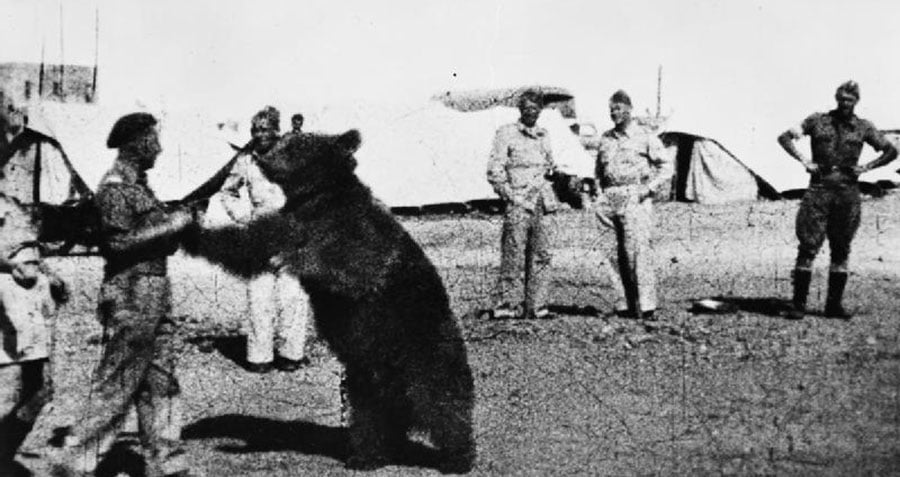
Wikimedia Commons
Troops of the Polish 22 Transport Artillery Company watch as one of their comrades play wrestles with Wojtek their mascot bear during the Middle Eastern campaign of World War Two, circa 1942-1943. 
Amid a long journey to join forces with the British Army in World War Two, one unit of the Polish II Corps stumbled upon an unlikely, and invaluable, comrade: A Syrian brown bear. 
A New Army And A New Mascot 

Poland bore a bulk of World War Two-related traumas. After the Nazis invaded Poland on September 1, 1939 — only to be followed by the subsequent Soviet invasion on the 17th — the country had only experienced a couple of decades of independence before it found itself under occupation once again. 
Following the invasions, Stalin and Hitler agreed to a nonaggression treaty, which effectively divided Poland in two. Hitler broke that pact on June 22, 1941, when he ordered an invasion of the USSR. 
In what came to be known as the Sikorski-Mayski Agreement, Stalin declared all previous pacts between the USSR and Poland to be null and void. Among other things, this allowed Poles to create their own army, despite technically being on Soviet soil. That they did, and the army became the Polish II Corps led by Lieutenant General Władysław Anders. 
In the spring of 1942, the newly-formed army left the USSR for Iran, along with the thousands of Polish civilians released from Soviet gulags. On the way to Tehran, the traveling Poles encountered an Iranian boy in the town of Hamadan who had found an orphaned bear cub. Irena Bokiewicz, one of the civilians, was so enamored with the cub that one of the lieutenants purchased him in exchange for a few tins of food. 
The cub became a part of the 22nd Artillery Supply Company, and soon received its own Polish name, Wojtek (pronounced voy-tek), which translates to “joyous soldier.” Wojtek traveled with the company through the Middle East, as the unit made its way to join forces with the 3rd Carpathian Division of the British Army in Palestine. 
Wojtek the Bear 
Wikimedia Commons Wojtek sits with a Polish soldier, 1942
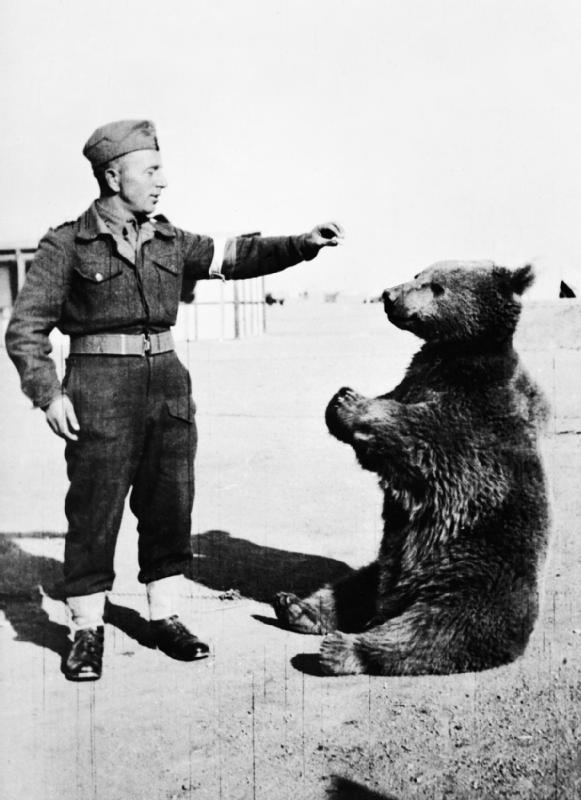
Growing up with soldiers, Wojtek adopted some rather curious habits. Indeed, reports say that the bear would drink milk from an old vodka bottle, imbibe beer and wine, and smoke (and eat) cigarettes with his army buddies, just as any soldier would. 
Wojtek quickly became a source of light in the midst of war. He would often wrestle with his fellow fighters, and even learned to salute when greeted by his company men. 
Wojtek’s fate with the company fell on uncertain times in 1943, when the unit prepared to board a ship and join the Allied campaign against Italy in Naples. Officials at the Alexandria, Egypt port refused to let the bear on as he was not officially part of the army.
In a quick, if not bizarre, workaround, soldiers made Wojtek a private of the Polish II Corps, and gave him a rank, service number, and pay book to legitimate his status. It worked, and Wojtek joined his comrades onto the Italy-bound vessel, this time as a legal member of the army. 
By the time the unit arrived in Italy, Wojtek had grown significantly from cub to a 6 ft tall, 485 lb. adult Syrian brown bear. Making good use of his size and strength, the company taught Wojtek how to carry crates of mortar rounds, which he reportedly did without fail during the bloody battle of Monte Cassino. 
Wojtek not only survived the conflict — soon after, he achieved legendary status. Indeed, following Wojtek’s valiant performance, Polish high command made Wojtek the official emblem of the 22nd Artillery Supply Company. 
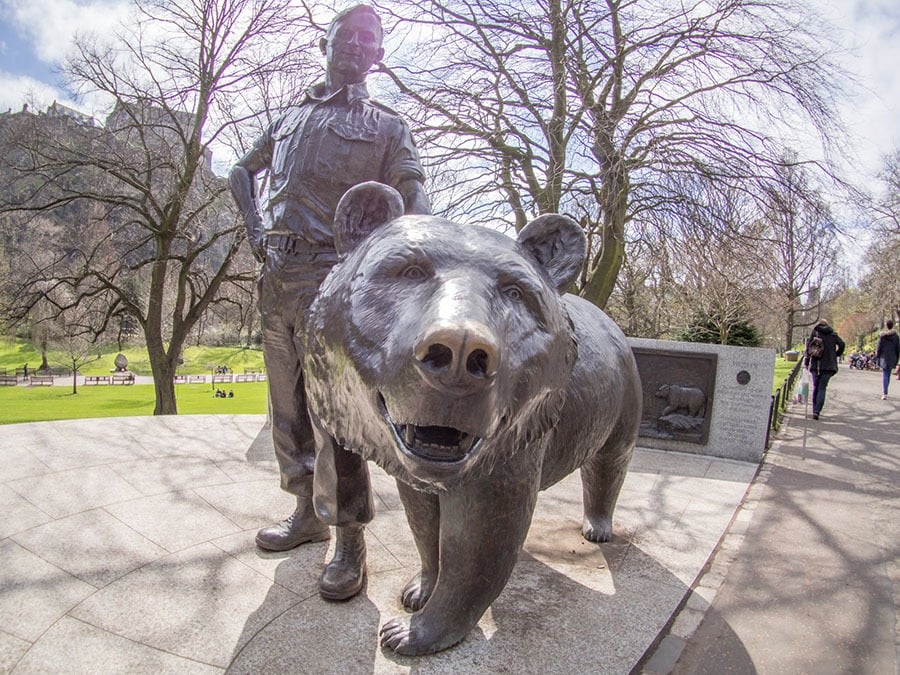
When the war came to a close in 1945, Wojtek retired from army life and traveled to Scotland with his fellow soldiers. Unlike his fellow veterans, Wojtek retired to the Edinburgh Zoo. 
Wikimedia Commons
While 21-year-old Wojtek would die at the zoo on December 2, 1963, his memories of army life would stay with him for the rest of his days. Reports say that the bear would perk up when he heard visitors speak Polish.
__________________________________________________________________

My student did further studies on the bear for relating his story. Once curious story he found was that initially the bear, as he was sitting up with his arms out, was given ammunition for a moment. When the bear didn't drop it but accepted holding the ammunition, the soldier or officer thought of getting the bear to actually carry ammunition to the front. Wojtek willingly did it! As Wojtek became even more loved in his company, the emblem patch on the uniforms of the Twenty-Second Artillery Supply in which Wojtek belonged came to be that of a bear ... carrying ammunition!

       Wojtek, the Bear of Monte Cassino

The "wartime memoirs of Stanislaw Kroczak, an officer with the Twenty-Second Artillery Supply Company of the Polish II Corps ... [puts a lot of human-attributed behavior stories like carrying ammunition in his forepaws to the front] to rest but does note the bear’s role in helping maintain the troops’ high morale during the bloody campaign up the mountainous Italian peninsula, culminating in the capture of Monte Cassino by the Poles on May 18, 1944. After the war, Wojtek shared the lot of most of his Polish friends who chose not to return to their Soviet-dominated homeland. Many of them settled in Scotland, and Wojtek was placed in the Edinburgh Zoo, frequently visited by his old army buddies, journalists, and crowds of admiring fans. Wojtek died in Edinburgh in 1963, but his fame lives on in several Polish and English children’s books, a BBC film documentary, and commemorative plaques in the Edinburgh Zoo, Imperial War Museum in London, and the Canadian War Museum in Ottawa. His story is now also documented in the Hoover Archives." -- Hoover Institution, 21 March 2012

Sunday, December 11, 2016

Silk Riders: On the Trail of Marco Polo

Silk Riders: Jo and Gareth Morgan's Incredible Journey on the Trail of Marco Polo was an interesting read. Jo and Gareth were avid motorbikers, and as they were finishing a ride high in the Indian Himalaya they started thinking of their future tours. A fellow rider tossed out the silk road and Jo and Gareth really liked the idea. The trip took two years to organize. In that time they had to figure out political details, travel logistics, cultural awareness issues, get and curry sponsorship, and of course figure out who among their friends could join them on their trip. BMW only provided at large discount 7 bikes and so the trip was limited to 7. 

The 7 were kiwis, but their trip would begin at the BMW factory in Munich where the new bikes recently broken in in the Australian outback and imported into Germany to begin the trip would get a total tuning in readiness for the multi-thousand-kilometer journey.


Then in 2005 the trip began. They were waved off in Munich by a single person, an English motorcyclist who journeyed from Yorkshire to Bavaria to see them off, and off they went through the lower reaches of Germany, into Austria, to the foothills of the Alps, and onward to Venice, the family home of Marco Polo. Despite the Polo family being one of the most prominent families of Venice and despite the since fame of the explorer, the 7 were surprised at the few memorials commemorating one of the city's most famous past residents. There is a library where Marco's last will and testament is held and the San Lorenzo church, in the yard of which he was buried in 1324. Near the site of his homestead is an area of little courts called 'Il Milione', which was Marco's nickname, 'the teller of a million tales'. 

Then off to the Balkans they sped. Few people are aware that Marco Polo was not a Venetian by birth but rather a Croatian. Marco was born on Korcula, an island of what is now Croatia. Of course the 7 had to go to the island, ferrying one of the bikes over for a picture with the iconic bike in front of what is said to be the house of Marco Polo's birth. 

To Serbia, Bulgaria, then Gallipolli, Turkey, which was very significant to the Kiwis as they recalled the Kiwis who died trying to claim the cliffs of Gallipolli. Onward to Istanbul where Jo started to having trouble as women were not to be seen in public, certainly not on a motorbike, and even though as she progressed further into Iran, the chador she wore just wasn't quite enough because it outlined her provocative bottom as she sped along. 

A disappointment to me in the book was the little attention given to following the trail of Marco Polo, as far as information on what they discovered in relation to Marco. Instead, the intent of the book was just to skim over the countries the 7 sped through and give mostly motorcycle commentation on the road conditions or visa issues. There were tidbits on culture but obviously the book was about a mad dash across Asia following a trail and not really picking up that many culturally rich experiences. 

That said, the highlight of the Iranian segment of the trip was the visit to the Valley of the Assassins, of which Marco wrote. The fortress of Alamut still remains, and as legend goes, an 11th century Hashish-iyun sect, basically an Islamic mercenary group led by a fanatical imam, had an unusual method for training young men to fight unconditionally. He would dose them with hashish and then turn them loose in a five-star pleasure garden stocked with milk and honey and virgins--all accouterments of paradise. After a couple of weeks, he removed them and cut off their narcotic supply. Finding themselves in a military camp they were told that they had been to paradise and if they hoped to live again in the style they had experienced in paradise, they would need to distinguish themselves in battle, and the imam of course provided that. These feared, driven warriors were known as Hashish-iyun, and the word 'assassin' derives from this group.


The Silk Riders only did the overland route from Venice to Xanadu (now Yuanshangdu) and down to Beijing. They didn't even attempt to follow Marco's route of 20+ years. 

To Tehran (the city that couldn't possibly have worse traffic, and motorcycles were forbidden in them for fear of drive-by motorcycle gunners) so their motorcycles were transported via truck. Lots of problems but eventually they were allowed to proceed onward to Turkmenistan, perched on the edge of the Karakum Desert across which they would have to travel. 

Then to Uzbekistan, the country that is the world's largest silk producer, and the country that was the half-way point of the 7 bikers' trip. Onward to Kyrgyzstan and most notably to Kara-Kul in the northwest where there are soaring mountains, alpine meadows and cooler temperatures. Close is the beautiful Lade Issyk-Kul, the second highest navigable alpine lake in the world after Lake Titicaca in Peru. Jo had swum in Lake Titicaca two years previous on another tour, and she attempted to take a dip in Lake Issyk-Kul in memory of her previous swim.

Of course they had chances to try the many exotic foods on the regions they passed through. In Kyrgyzstan is was the kumys, the fermented mare's milk popular among the nomads and which Marco had reported favorably that the drink tasted like white wine. The 7 heartily disagreed!

To China. One of the most amazing highlight in China was in Dunhuang, known for the famous Mogao Grottoes, or the Caves of 1000 Buddhas, which is a structure carved into a rocky cliff-face at the edge of the Lop Nor Desert. The Buddhas trace back to the first which was carved in AD366 when a Buddhist monk carved one Buddha figure into a rock. Over the ensuing 1500 years, more Buddhas were added, but not only Buddhas as the name suggests, but also the life of the local people. In the 20th century a chamber was discovered containing thousands of manuscripts which had been sealed since the 11th century. Unfortunately, explorers from England, Germany, Russia and more countries pillaged the place, dispersing artifacts around the globe but leaving the caves as empty shells, but ones which continue to whisper the reminders of great secrets from Chinese antiquity.

Continuing onward out of the desert great mounds of packed earth started appearing ... remnants of the ancient Great Wall which ended in the desert and which in their entirety were built over a period of 1500 years. This amazing wall eventually was over 10,000 kilometers in distance, but despite the great expanse, the beacon towers could relay a message of attack, fire, emergency from the furthest-most tower in the desert back to Peking in less than 30 minutes! 

Of course they cycled to Xian, the capital of China until Kubla Khan (Marco's Great Khan), the man who shifted the reins of command to Peking in the 14th century. They viewed the 2000-year-old, life-sized warriors guarding the royal tomb that was discovered in 1974 by a farmer digging a well. The 7 reckoned 300,000 workers were needed in this construction that took over 35 years to build.

From Xian to Mongolia, the end of the road. They headed to Shangdu, known to Marco as Xanadu and which, according to Samuel Taylor Coleridge, Kubla Khan had his stately pleasure-dome. Once they got there, they were in trouble with the authorities as to their purpose in that town. And then they came to realize that Shangdu was not the old Xanadu but Yuanshangdu, 200 kilometers away, was. And off they sped to Yuanshangdu, where in 1275 Kublai Khan had received Niccolo and Maffeo Polo and Niccolo's boy, Marco. This was the town that marked the eastern limit of Kublai Khan's empire, which stretched right back the way they had come, to Hungary. This was the end of the Silk Riders enterprise. Since April, they had covered almost 20,000 kilometers, crossed two major deserts, dodged through a war zone, visited the three inland oceans of the Black Sea, the Caspian Sea and the Aral Sea, and traversed the entire distance from west to east of the Great Wall.

They saddled up and set off for Beijing, the city known as Khan-Balik, "the Lord's City", in Kublai Khan's day. Their journey culminated with a ceremonial banquet at the New Zealand embassy and well attended by members of the BMW owners' club. would be held in their honor for the completion of their journey.

For a 52:30 minute YouTube clip on their journey, watch "Silk Riders - Motorcycling tour in the footsteps of Marco Polo",  and their blog on their journey.