Showing posts with label biography. Show all posts

Wednesday, November 20, 2019

Monty Roberts, a Real Horse Whisperer


Many are familiar with the popular novel, The Horse Whisperer (1995) which was later made into The Horse Whisperer (1998), the movie directed by and starring Robert Redford. To write his incredible book that populated best seller lists, Nicholas Evans, author of The Horse Whisperer (1995), met Monty Roberts and heavily interviewed him among other knowledgeable horse trainers and owners before writing.

But while The Horse Whisperer is a work of fiction, what appeared on library shelves two years later, The Man Who Listens to Horses (1997), is the autobiography of Monty Roberts, a real-life horse whisperer. In his own book, Monty tells his remarkable journey with horses and how his horse training-methods have revolutionized horse training, from the violence and exercise of force and mastery previously used to the gentling methods of those today. Horses are not to be "broken" anymore but to be "gentled". 

Here is a postage-stamp version of the Monty Roberts story.
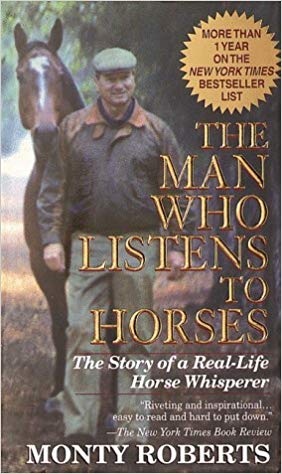
Source
Monty Roberts, born 14 May 1935, as a babe was held in the saddle in front of his mother as she trained neighborhood youngsters in the family riding school. By age 4 Monty was riding in shows and winning prizes. At age 7 he made a precocious and controversial discovery—the realization that horses have their own language, what he came to regard as “the language of Equus”, an extremely controversial thought at the time!

His father, a mean and violent horse trainer, also mean and violent with Monty, wouldn’t allow such a thought, and tried to beat (yes, physically) the thought out of Monty’s brain. Monty hated violence and despite the beatings, continued his observations on how horses communicate. By age 11 Monty was in the family rail car and riding across the country with typically 6 horses, a groom-trainer, and a school teacher. By this time he was known to be “professional” as his competitors were kids who actually attended school and merely rode on weekends, he swooped up the highest prizes rather consistently whenever and wherever he competed.

By age 13 he was taking summer trips to the Nevada desert to do mustang round-ups, and this was where he got the biggest epiphany on horse communication—from interactions at night between a young misbehaving stallion and the leading herd mare who was “punishing” the wayward youth! To be able to see these night interactions between the herd animals, Monty realized his rare achromatopic (complete colorblind) condition was actually a blessing, as it gave him ability to distinguish the textures of the night desert and not feel the loss of the colors!

On this earliest mustang roundup he observed a mare chasing a young rambunctious stallion 300 yards away from the herd and not allowing him to return. This ostracism is critical as it prevents group protection from the coyotes, wolves, mountain lions and other predators, and it is unnatural to be excluded as horses are herd animals and thrive in socializing family herds. The young stallion was chased out and the lead mare kept him ostracized by directly facing him, eyes riveted into him, with no letup on reprimanding stance or breaking of eye contact. After some minutes the young stallion started moving his mouth, and then sticking out his tongue a bit at times, actions that Monty later learned was his beginning to admit his submission to her authority. Following this, his head would drop to just inches off the ground while he continued with the mouth action. The mare was waiting for this submissive act and then would break eye contact and look a few inches in front of him. As he continued with his submissive movements and turning his body more and more laterally to her, an overt act of vulnerability and submission, her eyes would drift further in distance ahead of him, and she too would gradually turn laterally. The more she turned, the closer he approached. What was utterly astonishing to Monty, however, was how she showed her forgiveness to him after allowing him back into the herd, provided he continued expressing his submission and not misbehaving again. She would curry his mane, withers and around his tail gently with her lips and teeth and give him lots of attention as she welcomed him back, and forgave him. If he misbehaved, out he was chased again, and the process would be repeated.

For Monty, this was revolutionary! Horses had rules, meted out punishment, expressed forgiveness and caring love, and were in fact master trainers for raising “model” communities! Monty’s father used aggression, violent submission, force and cruelty in his horse-breaking methods, and Monty was quick to note the huge differences in both process and outcome. Monty developed training methods he gained from this mustang experience, and his horses were “broken” to saddle and bridle in an average of 30 minutes after meeting. His father’s violent method took 6 weeks, and the horse was forever damaged. Monty’s method was based on speaking the “language of Equus” with the horse and gaining its trust so that he could just quietly place the saddle on the horse, reassure the horse that it wasn’t a bad thing, and then slip the bridle on the horse with the same reassurance. Monty knew his father’s method of domination was inherently wrong, and Monty’s ultimate philosophy was that the horse is an honest soul and will tell you its story, if you but take the time to listen, as “the horse is always right”!

Monty’s Training Method

According to Monty, to break a horse in 30 minutes is not difficult if one speaks the “language of Equus”. The ideal method is to use a 50-foot arena, preferably without a lot of activity around it. The horse would be put in the arena for a time before Monty entered it in order for the horse to become familiar with the space rather than have too much unfamiliar stimuli at once during the initial gentling session. Then Monty would enter the arena with a rope, not to beat the horse at all, but to just flick the rope behind the horse to keep the horse circling at a nice pace. Monty, like the lead mare who was ostracizing the fractious youth, would squarely face the horse with eyes fixed on it and the horse would be running because he was realizing Monty spoke “Equus” and he, the horse, was being punished for something.

Once the horse started moving his mouth, and then lowering his head to just above ground level while moving his mouth and still making revolutions around Monty, Monty would adjust his eye focus to just in front of the horse. The horse would slow immediately, offer more submissive mouth movements with lowered head and the further Monty adjust his eye focus in front the horse, the slower the horse circled. Finally when Monty was no longer looking at the horse and his (Monty’s body) was turned laterally in the position of little awareness and in trusting vulnerability, the horse would gaze at Monty. Monty would then turn his back on the horse, being careful to never cut his eyes in any way to see how the horse was reacting, and just slowly walk away. The horse, the herd animal, would naturally approach Monty and with its muzzle over Monty’s shoulder, follow Monty trustingly around the arena.

After a couple minutes of “round-up”, Monty would turn and touch the spots of vulnerability—the spots where for example a mountain lion would grab if it attacked, many of the same spots that the mare had curried when she welcomed the fractious stallion back into the herd. Monty was saying with these touches, “You can trust me. I would never hurt you.” Monty would touch the vulnerability points, along the muzzle, the top of the head, along the mane, the throat, the flank, and as he developed his methods, he would even lift one hoof after another, an act that demanded ultimate trust as it denied the horse the ability to run when one of its hooves was lifted. With these acts allowed, the horse was acquiescent for allowing more acts of vulnerability, the adding of the saddle, and then the bridle. After each each piece of equipment was added, Monty would reassure the horse with appropriate touches, conveying his high regard and respect to the horse for the horse putting such trust in him. And so Monty could walk into an arena, and about 30 minutes later have a “green” horse introduced to a saddle and bridle and have a rider on his back for a few spins around the arena. Of course this was just the beginning of the training, but Monty did the initial horse “breaking”, a term that is actually a misnomer. The term in regard to Monty’s method should be more like “horse gentling”.

KNYSNA-PLETT HERALD
This book is the amazing journey of Monty from a small boy who never had a childhood or owned a toy to a grown man who, living and breathing with horses all of his life, learned a method of “horse breaking” that gained the horses trust and didn’t destroy its spirit. When Monty was into his 40s, Queen Elizabeth, quite the horsewoman herself, heard about Monty and invited him to Buckingham to see for herself his methods. She was amazed and she and Monty struck up quite the friendship which lasted for years, and developed further during many more visits. Until meeting Queen Elizabeth, Monty had learned to remain silent about his controversial gentling methods of training horses. After meeting such a renowned horse advocate, Monty started giving public demonstrations and instructions on his methods, and because of Queen Elizabeth’s keen passion for humanitarian treatment of horses and her passionate approval of Monty’s gentling methods, Monty’s ways became widely known … and even was the catalyst for this book!

Monty, beaten from ages 7 to 15, and often with a chain, refused to continue with the violence that he underwent growing up. His methods gentled the training methods of horses, and he and his wife with their big hearts and passion to help even youths at risk, over the years took in 47 foster kids (typically aged 12-14) who had a lot of baggage. They used the same methods of “herd mentality”, stern looks and welcoming touches as the mare had used. None of their kids were ever beaten, communication and love were the ingredients for a strong “family” tie. And Monty says that despite the heavy baggage that his 47 foster kids had, 40 of them were “successfully taught to fly”!

Definitely this book is a high recommend!

Thursday, August 29, 2019

Alex & Me: Anecdotes on Language Acquisition

Many people are aware of the 30-year long relationship Irene Pepperberg had with her African Grey Parrot, Alex (roughly May 1976 – 6 September 2007). 

Irene Pepperberg was trained at Harvard in chemistry, but while writing her chemistry dissertation she became fascinated with the biological aspects of language acquisition in animals. She finished her chemistry dissertation but never used the degree directly. That said, however, she had learned many research and other transferable skills to enter into the biological field of animal psychology. She studied constantly -- about child acquisition of language, about animal cognition which at the time was believed to be almost non-existent. For years she battled disinterest in her studies, and especially flack from the scientific world in general; animals were strictly believed to be governed by instinct and intelligence wasn't to be considered. Until this time, language acquisition had only been testing in some primates, gorillas, and corvids (crows, ravens). Irene thought that a grey parrot, an animal known to talk, would be the ideal subject to research animal cognition and intelligence with, and so went to an exotic pet store to get one. One was arbitrarily scooped up, and that parrot became the famous talking Alex! 

Source
A video on YouTube "Alex: One of the smartest birds ever" shows some of his training to demonstrate that animals, precisely African Grey Parrots, can not only "parrot" humans but actually understand and communicate with them intellectually, rationally, intentionally - all aspects of intelligence previously denied possible in the animal world. Humans just couldn't wrap their brains around the fact that humans aren't positioned as the only "animals" that acquire and communicate with meaningful language.


Some anecdotes I pulled from the "Alex and Me" book, which become clearer after seeing this YouTube clip.

In his early years of training:

In training, Alex "was less interested in colors than the objects, probably because all the colors tasted the same, while the different objects had different tastes and textures."

"He loved chewing clothespins. We called them 'peg wood', which he picked up quickly. I then gave him a green clothespin, something he'd never seen before, and asked, 'What's this?' He looked at it and cocked his head a couple of times, obviously intrigued, as he often was with novel objects. He then looked at me and said, 'Green wood peg wood,' all one phrase. We hadn't modeled it, so this was striking. Of course, a perfect response would have been 'Green peg wood'. 
[Pepperberg's early initial struggles with funding and getting published in a time when there was a growing controversy in the field of ape-human communication .... and therefore if apes weren't given legitimacy in communication, certainly no 'bird-brain' was going to get it! She writes:  
The chimpanzee known as Washoe, for instance, in the care of Roger Fouts, had apparently coined the phrase "water bird" the first time she saw a swan; Koko the gorilla, the subject of Penny Patterson's research, seemingly described a zebra as a "white tiger". These efforts were garnering a lot of public attention (NOVA programs were just part of that; magazine and newspaper articles proliferated too). Yet linguists were expressing a growing unease over the claim that these animals had demonstrated a rudimentary facility for language. 
In November 1979, Science published a long paper by Herbert Terrace and several colleagues: "Can an Ape Create a Sentence?" It was to become a classic in the growing controversy.]
Some language acquisition with Alex was unplanned, for instance, in December 1980 Alex was taken to a washroom on researcher Kathy Davidson's shoulder and he noticed his reflection in the mirror for the first time. He looked into it, cocked his head, and asked, "What's this?" Kathy answered, "That's you. You're a parrot." Alex looked some more and then asked, "What color?" Kathy said, "Gray. You're a gray parrot, Alex." And that was how Alex learned the word grey.

After several years of work with Alex:

Alex as as grey was very affectionate and loved to have his head lightly scratched. Lab workers called it tickling, so Alex when he wanted attention sometimes would lower his head and say, "You tickle", meaning "scratch my head". One day a stuffed gray was on the desk where Alex worked. After a bit he went over to it, gave it a good look, and then lowered his head to the stuffed bird and said, "You tickle." When nothing happened, he did it again. Again nothing happened, so in a huff, Alex said, "You turkey," and walked off. "You turkey" was a phrase the lab students sometimes said to Alex when he was uncooperative.

Another phrase he picked up inadvertently was "Pay attention!" He had aspergillus infection, a killer, and had to be taken to the vet and put into a nebulizer to help him breathe in drugs for treatment. Of course he didn't like it in the confining nebulizer. He knew he had to "wait" until the bell went off after the treatment, but one time there was an emergency and when no one came after his timer went off, he rapped on the glass and said not only his unhappy-with-this-environment phrase of "Wanna go back", he called out, "Pay attention! Wanna go back!" He had picked up "Pay attention" from students who were testing him in the lab.

At the vets, Alex was popular during the day, but at night he was basically alone. One night the accountant stayed late, and Alex tried to communicate with her. She was working so therefore quiet, so Alex asked, "You want a nut?" "No, Alex." He persisted, "You want corn?" "No, thank you, Alex, I don't want corn." This went on for quite a while with the accountant trying to ignore him in order to do work. Finally, Alex apparently in exasperation said in a petulant voice, "Well, what do you want?" The accountant cracked up laughing and gave Alex the attention he was demanding.

After recovery, Alex was taken back to the lab, but he didn't seem interested. In response to the question "How many wool?" based on the number of wool pieces on a tray, Alex answered, "One." The correct answer was two. When asked again, he said, "Four." Back and forth, one and four. Finally Irene said he would have to go into time-out and put him in his private room away from people. He immediately called out from behind the closed door, "Two ... come here ... two." Yep, Alex had fully recovered and was up to his old tricks!

Of course Alex wasn't the only bird in the lab. There were others like Griffin and Wart. Both were younger than Alex and both were obtained years after Irene had bonded with Alex, so Alex was king in the lab. He always had to have the higher perch, be closer to Irene's face in pictures and in communal work, and was therefore bossier. When Griffin was asked a question and didn't answer immediately, Alex would call out the answer (and sometimes the incorrect one to confuse Griffin). If Griffin's pronunciation wasn't clear enough, Alex would call out, "Say better" and Griffin better sound better on the next try. 

Did Alex understand language? Well, what do you think? 

Irene came storming into the lab one day angry to lose funding for her research ... yet again. Alex looked at her, and said, "Calm down!" 

He babbled and played with sound when alone, for instance, "green, cheen, bean, keen ..." So one day while Irene was testing him with a photographer on a limited schedule, she was asking Alex questions related to phoneme sounds, something she'd never worked with Alex on, but because the interviewer was on a tight schedule Irene skipped giving Alex a reward for every correct answer because Alex eating a nut after each answer would take too much time. Alex was getting frustrated and at not being appropriately rewarded for his efforts and would call out, "Want nut!" He continued to answer each phoneme question correctly, despite never being asked such questions before, and after each would demand more loudly, "Want nut!" Finally, in exasperation Alex called out, "Want nut! Nnn ... uh ... tuh!" Irene was stunned! His response was equivalent to, "Hey stupid, do I have to spell it out for you?" 

Could Alex put thoughts together to create new meaning? Well, one day someone brought a birthday cake into the lab and everyone shared it, including the birds. Community was very important for fostering communication and relationships. When Alex got his piece, he appreciatively said, "Yummy bread." He had known "yummy" and "bread" before, but putting them together was totally Alex's idea.

The night before Alex died, September 2007. 

Alex stayed in the lab with the other birds, and every night before Irene would leave, she and Alex would say their parting words. Wart and Griffin said nothing.
Alex: "You be good. I love you."
Irene: "I love you too."
Alex: "You'll be in tomorrow?"
Irene: "Yes. I'll be in tomorrow."
And those were the last words Alex spoke to her, "You be good. I love you!" Irene treasures them!


Friday, August 16, 2019

Quanah Parker - Empire of the Summer Moon

"Empire of the Summer Moon: Quanah Parker and the Rise and Fall of the Comanches, the Most Powerful Indian Tribe in American History" was quite the historical read. Writer S. C. Gwynne gives background to why the Comanches were so little known -- basically, they were in the wild west further than other tribes, and they didn't trade, mingle or interact with the invading Whites. They kept to themselves, rarely took captives, were quick to strike, elusive to catch, and commanded thousands of miles so were almost impossible to pin down anywhere. They were the true "cowboys" of the west. 

Source
The Comanches measured wealth in horses and in the years after the Civil War, managed a herd of some fifteen thousand. They also owned "Texan cattle without number" and they roamed freely and fought passionately over the land that contained the country's largest buffalo herds. The Spanish knew a lot about them and were their marked enemy, as were many of the other tribes in the area:  Apaches, Utes, Osages, Pawnees, Tonkawa, Navajos, Cheyennes, and Arapahoes. They were a nation of military supremacy with a keen eye for horse flesh and adept with controlling their cattle and following the buffalo herds. One sign of their domination in their huge region was that their language, the Shoshone dialect, became the lingua franca of the southern plains. 

The Whites continued to pour into the West and the Comanches, unlike some Indians, refused to make treaties. Comanches fought, raided, burned, killed and disappeared back into their wild prairies and soldiers could not safely follow them and exact revenge despite their superior musket power. It was proven that a Comanche could loose 20 arrows in the time it took a soldier to load and fire one round, and this was even more deadly because the Indians knew about using the terrain in their warfare and didn't make themselves easily visible. 

Times were changing and firearms would quickly overpower the Indians skill: the Colt revolver with quicker loading action and power for up-close shots suitable for killing Indians on horseback appeared in 1835,  in 1860 the Spencer repeating carbine revolutionized how a few soldiers could hold off a mass of attacking Indians, and in 1873 the powerful Winchester created a complete imbalance in the "fairness" of warfare. Whites could kill at a great distance while Indians became powerless with their second-hand flintlocks, castoff muskets and short-range arrows. [In 1876, however, Custer was defeated by the combined forces of Lakotas, Northern Arapahoes and Cheyenne at the Little Big Horn despite his weapon advantage. Comanches as southern tribes didn't participate in the battle but the battle's effect caused a very hardline against ALL Indians, and White brutality against almost all Indians escalated with the clear message: the Indians must go because the Whites have come.]

Amongst all the raids of Comanches which usually resulted in taking captives, a band of Comanches swooped down on a northern Texan new settlement and killed the majority and took a few young prisoners. Cynthia Ann Parker (1827-1871), age 9 or 10 at the time, was one, along with a young aunt, younger brother and two cousins. Cynthia Ann disappeared for the next 24 years into the land of the Comanches. The others who were captured at the same time either were killed soon afterwards or in the case of her cousin Rachel Plummer Parker were brutalized and escaped many months later to tell, and document, the story. 

The story of Cynthia Ann Parker is unclear. What is clear is she became full Indian, and whenever Whites came to the camp she was in, she would disappear ... by choice. In her 24 years with the Comanches she completely lost her first language, married Peta Nocona and it was a love match, bore three children, and then with the invasions into Indian land increasing, her husband was killed in front of her and the "blue-eyed Indian" was recaptured and repatriated to her "own  people" ... which she could not understand and she rejected White life, which Whites could not understand. 

Many times she tried to escape, but always was returned to yet another distant relatives' who watched over her, often imprisoning her in a house. Cynthia had seen her two sons fleeing and would never meet them again. One soon died of injury or sickness, and the other Quanah Parker (1845-1911) grew to become the last of the Comanche chiefs. Cynthia Ann's daughter Prairie Flower died of influenza after a few months, and finally after 10 years in White captivity and not adjusting or understanding why she couldn't return to "her people", Cynthia Ann lost all interest in life and starved herself, dying herself of influenza. Years later Quanah Parker would hear the full story of his mother and sister's capture, and their deaths. He somehow obtained the single photograph made of them together and, though he built a great wooden mansion and entertained lavishly both politicians and his fellow Indians, that picture was his single-most treasured possession.

Cynthia Ann Parker with daughter Prairie Flower
That last sentence was a big jump in time. Quanah held out as a free-roaming Indian chief as long as he could. However, his dwindling nation, which was now taking in former enemy tribe members who equally rebelled against the Whites, was weak in number, lacked food in the harsh winter, particularly since the buffalo were gone, and Quanah the strategist realized that fighting the Whites was a losing battle. When he saw the north Texan range where the buffalo had roamed by the millions, wave upon distance wave moving against the yellow distance, when he saw the plain devoid of life, only yellow with no spot of dark fur, he knew he and all the Indians were defeated. At that time, his single remaining option was to cooperate with the Whites. With the killing of the buffalo, they had won. 

Quanah Parker, only survive child of Cynthia Ann Parker, last chief of the Comanches
So being a highly intelligent strategist, he taught himself the White laws, eventually went to Washington DC, became a passionate spokesperson and was the representative powerful and charismatic voice for all the Indian nations. He made some difference, but the Whites were determined to take everything. The lands that were first awarded his Indian tribe were soon stripped from the Indians with White cunning. Quanah spoke out for the Indians who came to him, counseled them, and though they lost almost everything, without his voice, his Indian nation would not have fared even as well or for as long as they did.

Despite wearing White man's clothes, particularly on his visits to Washington, Quanah never cut his hair.
That was the one aspect of "being Indian" he retained, and he retained it with pride.
Source
In any regard, Quanah as a spokesperson and of very charismatic personality, became wealthy. He entertained lavishly with a massive table, china, cutlery and tablecloths. His home was equally open to all Indians who passed through for advice, talk, food. He fed everyone indiscriminately and teepees surrounded his wooden mansion. Over the years his 10 wives either died or divorced him, and  he died in near bankruptcy at the age of 66. But Quanah Parker, despite what Whites said about the lack of morals in Indians, was a man who lived with principle. Life might have attacked him, but he stood up and made a difference for both "his people" and was respected by Whites for his uprightness.  

Thursday, October 11, 2018

Over My Head - Story of a Brain Injury

Claudia Osborn wrote her autobiography of being a doctor but losing her occupation and almost her life through a serious brain injury. Claudia, a 42-year-old doctor and clinical professor of medicine, describes the aftermath of the brain injury nine years previous. She was stripped of her occupation and therefore her livelihood, for years deprived of intellectual companionship, and was challenged to do even the simplest tasks like reading a book, shopping for groceries or even sorting the mail. 

In Over My Head: A Doctor's Story of Head Injury from the Inside Looking Out she writes her story. After extensive therapy she regained a lot of function (she takes copious notes on all aspects of what she's doing, what she did already, leaves herself phone reminders, has her GPS programmed to get her to key places and also programmed to get her home when leaving from unfamiliar places). She is capable of writing, although her sentences are a bit stilted at times. She has very reliable people supporting her emotionally, and physically when necessary, and her mother, a very strong woman and advocate for Claudia to maintain her independence as much as possible, was the editor and advisor for this book. 


Some interesting points in the book:

Immediately after Claudia's catapult from the bicycle to the pavement and lying unconscious, she moved. A policeman and his son were the first on the scene, having witnessed the accident. The policeman was exulted when Claudia finally moved, but Marcia, the doctor-friend and housemate riding with Claudia, was not reassured as Claudia rigidly pulled her arms up to her chest in a reflexive, involuntary gesture of someone with serious brain stem injury. The extensiveness wasn't apparent with testing and a few hours later Claudia was allowed to go home under the indirect care of Marcia. Claudia was never the same again.

She attempted to go to work the next day, but circled in the bathroom aimlessly not remembering why she had gone in there. Marcia handed her her toothbrush and asked how she could practice medicine if she couldn't brush her teeth without guidance. Claudia responded "I know medicine" as she proceeded to put hand lotion on her toothbrush. 

After going to the office for a month, letters and mail were really beginning to pile up. She opened a letter which contained "The ... lab ... results ... on ..." but had no idea which lab, what results could they possibly be, and tossed the letter aside. Daily she faked her way through work with phrases like "it's interesting", the staff around her picking up the slack allowing her recovery time.

Her family and friends encouraged her but with her not getting better and frustration mounting, Claudia felt pushed to go to the recommended Head Trauma Program (HTP) in New York City. To be admitted she had to have a two-week screening-evaluation and then would be in the program for five months. 

Her mother would often call her, encouraged her, get her to talk, and then help her make simple decisions for her day, like the first day Claudia had gone to NY for brain injury assessment and was staying with a friend who was out working:
"... The good part is that the search will show that I'm basically okay." 
"That is true, darling. All the tests will reveal your strengths. Eat now, please don't forget." 
I wrote EAT on my phone pad and underlined it. "Lori has food here." 
"I'm sure. Why don't you make a simple list. It would remind you to eat and help you choose the menu." 
"Why? I know what I'm going to eat." I've done it often enough. Who needed to plan to eat? 
"You often forget. Tell me, what will you eat tonight?" 
"I'm too tired to think." Silence. "Uhm ... twisted juice, for one thing." I'd become better with multiple-choice questions than essays. 
"I've never heard of it." 
"Well, it's common." I had an image of the carton with the picture of oranges. "You know, flattened oranges." 
"Ah! Squeezed, not concentrate. What else?" 
"Postage ... crumbled cereal." I add quickly, "That's not quite right. I only have the brand name right." 
"Postage isn't a brand. It's Post, like Post Raisin Bran." 
I rolled my eyes and said with studied patience, "Mama, I was using the past tense." 
"Postage ... paste tense for Post." She laughed. "That would be fine. Now humor me.  When we hang up, go to the kitchen and see what's in the refrigerator and cupboards.  Write down two things. Then fix them. Will you do that?"
I curled up on the couch and closed my eyes. "OK, Mama." 
"Then you'll go to bed, right?" 
I didn't need to write it down. I did it first.
Claudia's day was filled with confusing moments. On one particularly day she was sure she had rolled up tissue and put it in her pocket, but in public when she pulled out the tissue, out came her bra ... the one she had forgotten to put on that morning. That was once, but oh so frequently she would go to get groceries but without a list, she couldn't make decisions, once coming home with $20 worth of Pepsi. When asked how she carried it home, she replied it was only a six-pack. She hadn't bothered to get the change. 

Ronald Geller said, 'Words are the clothes that thoughts wear.' 
My thoughts were pitifully naked.

Claudia perceived quickly that she was not on friendly terms with spoken language. To quote her, "Words elude me and refuse to come to my aid. I am incredulous, not to mention irritated, by the poor quality of my conversation. Ronald Geller has written, 'Words are the clothes that thoughts wear.' Frequently my thoughts were pitifully naked."

She was fascinated by Ronald Reagan's reputation as The Great Communicator during his presidency. She said he was a great speech reader, but his deficits became apparent when he was asked direct questions. For instance, when he was asked, "Can nuclear war be limited to tactical weapons?" he replied, "Well, I would, if they realized that we -- again if -- if we led them back to that stalemate only because that our retaliatory power, our seconds, or strike at them after our first strike, would be so destructive that they couldn't afford it, that would hold them off." People expected Reagan to perform well because he was the president and so the public made excuses for such oddity and rationalized the strangeness away. Like Reagan, people who didn't know Claudia didn't understand the extent of her not being able to function. What they perceived as "normal" was hidden behind the wall of limited interaction with her.

Claudia misses the person who she once was, the intelligent, snappy-minded, full-of-energy person with ambition and leadership. But that person died in 1988. She admits she wasn't a fun person, had a limited social life, steeped herself in work and was often unavailable for family and friends. She misses who she once was but has adjusted herself to accept who she presently is, a person with a very poor memory, a person who burns meals, loses car keys (and sometimes cars), forgets appointments, fails to return library books, and embarrasses herself (and others) regularly in public. That said, she can do things now she never did before. Now she paints .... and she writes. She has dreams now too, not her former dreams, but dreams nevertheless. Achievable dreams which she is carving out for herself. And she closes the book thinking of her dreams:

"I was a happy woman before my injury. 
I am a happy one today."

Thursday, June 7, 2018

29 "Difficult" Women Who Wrote Their Own Rules


Amelia Earhart is greeted by her husband George Palmer Putnam on her return to Newark Airport, New Jersey, after a transcontinental flight on June 22, 1931. When Earhart and Putnam married, she told him that she wasn’t going to be a “traditional” wife.
PHOTOGRAPH BY CSU ARCHIVES, EVERETT COLLECTION/ALAMY
Journalist Martha Gellhorn and Ernest Hemingway traveling together shortly after their 1940 marriage. Gellhorn was a noted writer and war journalist in her own right.
PHOTOGRAPH BY EVERETT COLLECTION HISTORICAL, ALAMY
Martha Gellhorn, the writer and journalist, is best known for being the partner of Hemingway. But she was much more than that, wasn’t she?
When I give shorter interviews, Martha is always Hemingway’s third wife. I know she is spinning in her grave, because she was a writer and intrepid journalist in her own right. In fact, she wound up leaving the marriage to Hemingway, the only wife who did leave, because she couldn’t bear the insular life they had. She wanted to be where the world was being made or unmade, as the case may be. 
She was extraordinarily courageous. She made it to the front in WWII by hook or by crook. She was forever sneaking aboard a ship, or flying under false pretenses, or pretending to be a nurse, in order to get to the front lines. Throughout her life, she was concerned with injustice—particularly economic injustice—for people all over the world who were not getting a good deal. She was smart, very difficult, and also glamorous! She was blonde, long-legged, and would wear these great hunting outfits.
Artist Frida Kahlo stands by her painting, entitled Me Twice, on October 24, 1939. Kahlo, like many “difficult women,” was gender-fluid, refusing to be limited in any area of her life, says author Karen Karbo.
PHOTOGRAPH BY BETTMAN/GETTY

Thursday, June 8, 2017

The Zookeeper's Wife

The Zookeeper's Wife is a war story about Warsaw under siege and the Jewish holocaust. Jan Zabinski, the zookeeper, and his wife Antonina ran the Warsaw zoo, but when the animals were shot for sport by a German zookeeper Lutz Heck after selectively taking the preferred and rare animals (European bison, Przywalski horses which had only been "discovered" in 1879, and a few others) for Nazi selective breeding, Jan and Antonina stayed on at the zoo to assist in the running of a fur farm for making fur coats for the Nazis. [Under the Third Reich, animals became noble, mythic, almost angelic -- including humans, of course, but not Slavs, Gypsies, Catholics, or Jews. Therefore, breeding programs were for the selected animals and medical procedures and experiments were for the undesirably "humans". The subjects of Auschwitz's operating doctor Mengele could be operated on without painkillers, but a remarkable example of Nazi zoophilia was that a leading biologist was once punished for not giving worms enough anesthesia during an experiment.]

The zoo, despite its loss of wild animals, was a cover for hiding Jews right under the invaders' noses. In the course of the war Jan and Antonina managed to save 300 by hiding them on the zoo grounds, which were, by the way, right next to a Nazi compound. The Jews referred to as "guests" were given animal names that reflected their character and their cage of domicile. This naming method also prevented slip-of-the-tongues or prevented people who overheard their talk from guessing the truth of what really was going on at the zoo. The people who lodged in the lion's cage were, therefore, called the lions. "Pheasants" often came in the night and lodged in the pheasant house, only to fly a few days later when their trail wasn't so hot. 


During the five years of the war, 860,000 Poles were uprooted and resettled; 75,000 Germans took over their lands; 1,300,000 Poles were shipped to Germany as slave labor, and 330,000 simply shot. With ingenuity the Polish Resistance sabotaged German equipment, derailed trains, blew up bridges, printed over 1,100 periodicals, made radio broadcasts, "illegally" taught in schools and colleges (attended by 100,000 students), aided Jews in hiding, supplied arms, made bombs, assassinated Gestapo agents, rescued prisoners, staged secret plays, published books, held its own law courts, and ran couriers to and from the London-based government-in-exile. At the height of the war, 380,000 soldiers with Jan Zabinski among them comprised the military wing of the Home Army.

Jan was the leader of an Underground cell, and he used the delivery of hay and fodder for the animals as a way to bring in and pass on explosives and other counter-intelligence equipment, which Antonina never knew about until after the war. He poisoned pigs, butchered them, and then arranged the meat to be eaten by German soldiers. During one month in 1943, his cell derailed 17 trains and damaged 100 locomotives! Antonina basically knew that he was part of the resistance but not that he led parts of it so actively, often narrowly escaping capture or death. Antonina would only learn of his great exploits after the war and Jan's return from a POW camp. Jan figured that Antonina had enough stress on her plate with taking care and protecting her very young son, and of course ensuring the meals, shelter and safety of her continue flow of "guests".

In the earlier part of the war Germans established food lines for the starving people of Warsaw. They calculated a calorie-feeding system for the differing races who stood in three separate food lines based on race. The Germans received 2,613 calories of food per day, the Poles 669, and the Jews 184. German Governor Frank who controlled all matters in Warsaw declared, "I ask nothing of the Jews except that they disappear."

According to German figures, Germans shipped 316,822 people from Warsaw to concentration camps between early 1942 and January 1943. Many were shot in the ghetto so the death rate was actually much higher. Aided by friends on the Aryan side, tens of thousands escaped the ghetto, but some who stayed, such as Kalonymus Kalman Shapira, the ghetto's Hasidic rabbi, revealed a tigerish struggle with faith as was discovered after the war by his discovered diary. How could anyone reconcile the agony of the Holocaust with Hasidim, a dancing religion that teaches love, joy, and celebration? During World War II, 30-40% of the world's Jews were killed, but more specifically 80-90% of the Orthodox community was wiped out; this was the group that kept alive the ancient tradition of mysticism and meditation traced back to the Old Testament world of the prophets.

In 1941, Governor Frank decreed everyone must have an identity card complete with serial number and fingerprints. For two years, Polish offices responsible for making the cards stalled. Meanwhile, they along with Underground offices and greedy opportunists were able to set up a system for making fictitious identity cards. Hordes of people suddenly seemed to have lost their records (born in Russia, born to Muslim Poles, records burned in a church fire), so needed to reissued identity credentials. By 1943 it was commonly known that 15% of all identity cards and 25% of all working papers had been forged.

After the war and his return from the POW slave labor camp, Jan was forced to retire from zookeeping at the age of 54. Times were hard after the war and anyone who praised pre-war independence or resistance during the war (and especially for someone who fought in such a war) were judged to be dangerous. Jan retired from zookeeping but still devoted to zoology, he focused on writing and ended up writing 50 books on the lives of animals and conservationism. He also spent much time writing and researching the pedigree of the European bison that had been returned to Warsaw by Lutz Heck, which turned out to be good since Germany was bombed right afterwards killing its bison herd. Antonina, after the war, stayed in contact with the former "guests" who were spread among many countries. She and Jan never left Poland, but their hearts remained bound with all of the many people they helped save.

(Fascinating source article)
Some of the 300 "guests were Irena Mayzel, Kazio and Ludwinia Kramsztyk, Dr. Ludwig Hirszfeld (a specialist in communicable diseases), Dr. Roza Anzelowna from the National Hygiene Institute, the Lemi-Lebkowski family, Mrs. Poznanska, Dr. Lonia Tenenbaum, Mrs. Weiss (wife of a lawyer), the Keller family, Marysia Aszer, journalist Maria Aszerowna, Rachela Auerbach, the Kenigswein family, Drs. Anzelm and Kinszerbau, Eugienia "Genia" Sylkes, Magdalena Gross, Maurycy Fraenkel, and Irena Sendler, among many others. All 300 "guests" survived the war except Kazio and Ludwinia Kramsztyk (cousins of renowned painter Roman Kramsztyk), Dr. Hirszfeld (specialist in infectious diseases), and Dr. Roza Anzelowna and her mother. They were arrested by the Gestapo a few months after leaving the zoo and were summarily killed.


Monday, April 24, 2017

Unbowed: Wangari Maathai (1940 - 2011)

Wangari Muta Maathai, born in Nyeri, Kenya (1940) ultimately became the first woman in East and Central Africa to earn a PhD (1971). She also became the first woman in her region to be a chair of the Department of Veterinarian Anatomy and to be an associate professor (1976). Seeing a political deficit and unmet needs by politicians, she entered politics and became an active member of the National Council of Women of Africa (1976-1987), which was where her idea of empowering women while rehabbing the environment was conceived, the birthchild of The Green Belt Movement. Over the years, she assisted women in planting more than 20 million trees on farms and schools and church compounds, and by 1986 the Movement had become a Pan African Green Belt Network. 

She became internationally recognized for her persistent struggle for democracy, human rights and environmental conservation. On several occasions she addressed the UN on behalf of women. She authored articles, books, served on boards of several organizations, and in 2002 was elected to parliament with an overwhelming 98% of the vote. Subsequently she was appointed by the president as Assistant Minister for Environment, Natural Resources and Wildlife in Kenya's 9th parliament. 

In 2004 the Nobel Peace Prize was awarded to Wangari Maathai "for her contribution to sustainable development, democracy and peace."

Her book Unbowed: A Memoir (2006, 2007) documents some moments that gave her a solid foundation of family and nature and which were fundamental in raising her awareness of a large escalating environmental problem ripping across the environment that had been so untroubled in her youth.

As the story goes, the name of Kenya was named by the explorers Johan Ludwig Krapf and Johannes Rebmann, when they encountered the awe-inspiring 17,000-foot-high mountain known today as Mount Kenya. "What do you call that?" they asked of their guide, and thinking the two were asking about the gourds he had in his hand, the guide answered, "Kii-nyaa", and thus the name of the mountain and the country became known by the colonial name and not the Kikuyus indigenous name of Kirinyaga, or Place of Brightness. Today the country of Kenya still feels the tug of conflict in their development and concept of self caused by the colonial and the indigenous ideas.

Before Wangari went to school, in her area the colonial government decided to establish commercial plantations of non-native trees. She remembers huge bonfires as the native fig trees went up in smoke. By the mid-1940s the British had introduced many exotic tree species to Kenya—pine in the north and eucalyptus and black wattle in the south. These trees grew fast and strong and contributed to the newly emerging timber business, but they eliminated local plants and destroyed the natural ecosystem. While the old trees had pierced deeply into the earth and allowed other trees and shrubs to thrive in their shadows, the new trees eliminated local plants and didn't retain the rainwater. Eventually, rivers and streams either dried up or were greatly reduced.

The native fig trees were strong trees, burrowing deeply into the ground, breaking through rock and into depressions and ultimately hitting water. It was known that wherever a fig grew, water would be found. Communities had great reverence for these trees and they were never used for fire wood. These trees held the soil together, reduced erosion and landslides. These trees brought life-sustaining water. 

In the early 1970s Wangari realized that many ticks were affecting livestock. While gathering ticks from many places and going out in the rural areas, she noticed the people did not have good food but were eating the colonial flours and processed foods and because there was not enough firewood for cooking and preparing food, the crops were in drought because of loss of trees, the cattle were not well watered and certainly not the land. After looking at the people and the environment, she came up with the idea to give women jobs by planting trees, which would bind the soil, retain and collect water, be a home to birds and provided fruit and food for the people. Trees would heal the land and regenerate the vitality of the earth.

And thus began her journey of planting trees ... to foster a strong relationship between people and their land once again.

"I'm doing the best I can."

Wangari Maathai closed her book with a story she heart from a Professor Suji in Japan. One day a massive fire broke out in a forest and the animals, with flames coming closer, fled the forest, all of the animals except one, a tiny hummingbird who said, "I'm going to do something about the fire!" And she flew to the nearest stream and in her tiny beak scooped up a drop of water and flew to the conflagration, dropping her water droplet, and then flying back to the stream. The other animals watched in horror and dismay, "Why are you doing this? You cannot begin to put out the fire!" And the little hummingbird turned briefly to them and said, "I'm doing the best that I can!" 

Wangari Maathai encourages everyone to work towards a better and greener world. She encourages everyone to plant, even if it's just one tree, just one tree at a time.

Monday, January 11, 2016

The Byerley Turk

Jeremy James, author of The Byerley Turk: The True Story of the First Thoroughbred, became involved in an intense scholarly quest to trace the origins of the "first thoroughbred". His on-horse search took him via Turkey, Bulgaria, Serbia, Romania, Hungary, Austria, Germany, Belgium, France, and his native English shores, and then Ireland by car. His textual search involved a prowl across languages, particularly ancient ones—Ottoman records in Arabic script and Ottoman Turkish—as well as Polish, German, Latin, and old court French. His interest in writing this book stems to his years traveling for the International League for the Protection of Horses as an equine nutritionist, which enabled his to gather extensive information on horse breeding and intercultural methods of viewing and appreciating equine creatures.


The story begins in the Balkans, 1678, with a Tekke seyis, a Steppe tribesman who functioned as "groom", a very simplistic English translation of what his job entailed. Good augur begins with the birth of a foal on the auspicious 15th night of Shaban, in the 8th month, on the Night of Justification takes place; the timing is filled with auspicious omens, every one that sooth-sayers have been predicting in addition to other augurious omens: born in the black of a storm in torrents of water amidst thunder and torrents, with the rare Whorl of the Spurs pointing most auspiciously upwards upon his back, a blessed augury for “safety in battle”. People would kill for such an auspicious horse. The seyis somehow knowing his destiny is entwined with this horse and so emboldened dares to name his master’s horse following proper traditional naming rules—beginning with the first name of the father’s name (Ates - Fire) and having one letter of the mother’s (Zarif – Elegant) to give her honor. Thus, the seyis, awed by the omens, dared to announce the only possible name for the colt—Azarax, Son of Fire.

Three years later after the minutest care in training Azarax and his stallmate Bora, the pair of colts along with their seyis was sent to war. Beneath the fluttering Holy Standard, beneath the flying Crescent Moon, the Turk army led by the Sultan, the Grand Vizier of the Ottoman Empire, stuck out on their war horses that were to cast dung on the tiles of the Nave of St. Peter’s in Rome. Insignificant seyises look after horses after the whim of the masters and Envir Altinay Paşa, a skilled horseman, had become the seyis’s new master, and accordingly could choose among the choice horseflesh for his mounts. The seyis regarded him and intuitively knew that no matter how skilled a horse-rider this man was, he was not in communion with the horse his rode or even aware that a horse and rider must intuitively connect; the Paşa was unaware of the inner voice of horses that responded outwardly to the rider, he was a mechanical rider and could not command the spirit of a horse. When Paşa rode Az, he could not feel the fire of the horse but the resistance of disconnect, so he choose Bora as his mount. The seyis was not unhappy at the choice; Az’s destiny was yet to be revealed and such perfect horseflesh should not be wasted on such a self-filled man.

One quiet day while waiting for battle, the seyis quietly takes Az along with Bora for a run on a sandy beach. He allows Az to set the pace—from a quarter trot to extended trot, a slow canter to a slow gallop and finally of Az’s own volition a fully stretched out gallop that seems to absorb energy from the sun, the wind and the sea, and as they streak along Az stretches even further to absolute maximum velocity whereupon the seyis easily turns into the cantle-less saddle, draws his bow and releases three arrows into his last three hoof prints, the mark of a horseman archer. Two hearts, two minds, one will. No one knows the power of Az or the skill of the quiet seyis. Their destinies are still to be revealed.

In war the horse feeds on food that he would formerly have ignored. The seyis has raised his colts on diets that give strength and when he can he continues to give them fruit—figs, pomegranates, peaches and pears—he puts garlic in their barley balls to rid them of worms because he knows the secret phases of the moon and the timing of medicine. Intuitively he watered them profusely when other seyises said no, not to water a hot horse, and his horses now carried muscle and weight and did not look pinched nor parched, their tongues were not dry and their eyes had not shrunk into their skulls. “Instead their eyes glistened, their bellies were filled with the seeds of the fruit and green grass, they moved with the power of the barley, and were not consumed by the worms.” To a Persian seyis the Tekke seyis, as he mixed dates with a raw egg, barley, chopped figs, skinned pomegranates and sliced pears, said, "it is important to give the horse the best feed so that his skin radiates the shine of the inner sun.” The Persian seyis walked away shaking his head and threw a measure of barley to his horse, wondering why his horse’s coat did not glow, exude good health and feel soft to the touch.

After feeding his stallions, the seyis lay between the hooves of the horses and fell asleep, knowing that the horses would stand vigilant all night and the three of them would remain together and safe. He does not drink raki with the other seyises, he has not sword or shield and others say he will die. He does not but lives strong in tight relation with his horses who do not mingle either; they are a three-entity team. They protect each other and take confidence in their tight bond.

Turks know the history of good horseflesh, and many strong horse breeds have evolved. Azarax was a Karaman horse, lighter in bone than the Germiyan, two of the breeds that came from the Steppe many centuries before. They are tall fast horses, flat of knee and wide of forehead, with brilliant eyes, broad backs and high intelligence. They are horses of spirit and fire, of ego and pride, with hard blue feet and flashing teeth. They are afraid of nothing. Cross them and they will kill you. They are Turks, pure Turks.

But not all battles are to be won, for in every battle a side must lose, and so it was with the Ottomans. With Bora killed in the heat of battle, only the seyis and Az remained alive, the duo were even more connected. Capture. Az was captured by the British empire, the enemy. Feeling his bond and his destiny still entwined in that of Az’s, the seyis requested to go with and care for the horse. The faithful groom, connected to his horse whose destiny was perhaps starting to unfold, felt that their threads of existence were still entwined in the spiritual world. The seyis went voluntarily, loyally and ended up in England where Az was either to be sold as a breeder or to a horse track. The seyis snorted that such a destiny—the race track, a place for middlings—could not be for the great powerful war horse with such auspicious augury, born in the storm and carrying the Whorl of the Spurs.

And indeed Az’s destiny was unfolding. The seyis knew when he saw Robert Byerley that here was the man who would sever his own connection to Az but who would lead Az to his full destiny; here was the man who would control the great horse that no one other than himself had ever really had control of before. These two would be connected, and the seyis knew his own destiny and role in training this mighty horse had been fulfilled. It was time to sever their connection so that Byerley and Az could be strengthened through their new and predestined bond. Robert Byerley, the unusual leader of men and principled former Parliament Justice of the Peace who refused to sign an act that he felt was unjust, bought Azerax for £1000. Byerley was to lead his own men to war and when he rode Az on the first day, he knew that here was a horse that was superior to any he had ever ridden and perhaps ever known, and together they would be safe in their togetherness in the war.

Byerley’s horse became the darling of the greater part of the English army, and his fame traveled before him. The horse seemed to know intuitively where the cannon balls would fly and when to side-step. Cavalry men gladly followed Byerley’s horse, who fought at the forefront of battles, side-stepping with the large cavalry successfully side-stepping also. He became a mascot in England and known as the King of all Horses, Protector of the Regiment, the Horse with the Sixth Sense. He was a charm, a mascot, an augury; it was counted good luck if he walked across a person’s path and good luck if seen drinking. Fortune was to the person who would gaze into his fiery eyes.

Years passed. He retired with Byerley on his country estate. He aged and seemed to look whistfully into the past at times as if in search of his first master, the seyis, and at others as if seeing images in the future or of another realm. The Byerley Turk died in his stable on March 16th, 1703. Byerley buried him not a stone’s throw from where he died and knew that the great war horse had achieved his paradise. The Turk’s grave marker was that of a tree, to grow mighty and tall and to feed on the physical strength of the great horse that fought with vigor and pride in multiple wars and to show stature and power to future generations.

The Byerley Turk, a painting commissioned of the famous horse along with his native Turkish groomsman,
the seyis, who was captured with the mighty stallion and took care of him during their early times in England.
The seyis had completed his destiny with Azarax, the Byerley Turk. Captured by Christian forces, he escaped after seeing that Azarax’s destiny for greatness was being fulfilled, and so he returned to the Privy Stables in 1690. At the age of 37 he succeeded the baş imrahor, Master of Horse of the Ottoman Sultan in Istanbul, and was said to have taken horse breeding in the Ottoman Empire to new heights. He was killed in the second Siege of Belgrade in 1717 at the age of 57.

In 1791, James Weatherby, nephew of the first James Weatherby, first Secretary of the Jockey Club, founded in the Star and Garter Coffee House in London, published the first General Stud-book. In it, he laid down the commonly-accepted principle that all lineage of all thoroughbred racehorses could be traced to three foundation sires: The Godolphin Barb in 1729, The Darley Arabian in 1706, and the Byerley Turk in 1686.


Old Turkish horse-training methods:

The seyis stayed day and night in the field with Azarax; he lived like an animal himself, always seeing to the minutest detail of Azarax’s diet, his brushing, his care, his emotional well-being, and training him for his role as a battle horse. His role in leading Azarax to his destiny was a pure symbiosis of man and horse. Living with and game playing were crucial to the training.

Day 1 – laying his hands upon the foal and gazing into his eyes—a connection of souls
Day 2-3 – placing on a headstall, embued with the blue bead to ward off the Evil Eye of a djinn; within two days Az can be lead; teaching him not to pull; no whip or fear tactics ever used, just firm confidence, encouragement and awards; establishing an intuitive closeness with the animal
Subsequent days – riding Zarif (Az's mother) with Azarax following, increasing Az’s trust and his strength; rubbing Az’s head and praising him after crossing a river, reinforcing no fear in water
Within 1 week – a sack  loosely tied on the colt’s back; a few days later, tightened and loaded with objects that clank; the seyis at all times projects trust and the clanking pots are allowed; by the end of a week, the colt carries a kagan shield, a saucepan with stones in it, a sack stuffed with clothes and on top a puppy. The seyis walks along always projecting safety, confidence, security.
By summers end – another colt is added to the training and the seyis now is training two. Az has transferred his playful affection to Bora, the new colt. The seyis feels jealousy but does not allow these thoughts. He must train these colts, especially Az, to achieve his destiny and to do so, Az must learn to associate and interact well with horses. He is a horse; no, he is a king of a horse and must learn to be that king.
Following weeks – the two colts schooled in unfamiliar sights and sounds—waving flags, lighted fires, small firecrackers, pistol shots. Bora slightly nervous but Az seems deaf, indifferent; his spirit is splendid.
By 2 months – nothing alarms the colts, not smoke or fire, gunshot or powder; they avoid sticks and stones hurled at them, they carry saddles and follow the command of humans.
1 year – the colts are weaned by their mothers, not taken away prematurely
After weaning – stirruped saddles fitted on horses and the slight seyis steps into the saddle briefly and steps out; the colts are never overbalanced, frightened, panicked.
At 3 years of age – the colts with their seyis are ordered to report for battle duty. Out of the 1000s of horses the seyis can recognize the voice of his horses, and they among the 1000s of seyises know his. They are an intimate threesome.