Showing posts with label linguistics. Show all posts

Thursday, February 14, 2019

Lost and Forgotten Languages of Shanghai

Ruiyan Xu, a Chinese, born and raised in Shanghai for the first ten years of her life and then transported to the US where she was immersed in English but knew not a word, wrote her first novel, a novel in part biographical, a novel on aphasia. Aphasia is typically an impairment of language, either of reception or production, but which does not affect intelligence. When Ruiyan later learned about aphasia in one of her university classes, she felt a connection because as a child, she felt lost in her abrupt move to the US when she was suddenly stripped of her language and her familiar social cues which replace language. Struggling with identity and language, Ruiyan identifies and creates a character similarly stripped of language and presented with a new life, one he would have to come to terms with as she as a child came to terms with English. 


The central character Li Jing had been raised in the US until 10 where he had acquired English, his first language. However, at the age of 10 his architect father had returned with young Li Jing to Shanghai and Li Jing had forgotten his English as he replaced it with Chinese. Years later as president of his own investment company, he charismatically meets, greets, manipulates and assures people and huge businesses of his savvy ability to invest their money. He is articulate. He is in control. And he is very good at what he does. However, his drive, his ability, his confidence is all blown up when an explosion in a building he and his father are in causes the building to collapse. His father, Professor Li, has a heart attack and soon dies, but Li Jing's damage goes much deeper. Physically Li Jing was scratched and bruised but mentally he was wounded, permanently, by a spray of exploding glass that struck his forehead and damaged the unique area in his brain where language is produced, Broca's area.

Source
The brain is complex, interwired, but also compartmentalized. Broca's area is the area which centralizes language production, meaning if that area is damaged, the person can still understand and receive language but just not be able to produce it. Wernicke's area, an area of the brain also on the left side of the brain but positioned further behind but not adjacent to Broca's is its counterpart and it is responsible for language reception. Damage to Wernicke's would have been much more serious as without understanding language, no language but only fluent sounds that are like language, could be produced. Li Jing woke from the accident to ... not no language, but limited English, the language of his childhood. His Chinese has been completely wiped from his mind.

Over night Li Jing loses his voice, therefore his ability to run his own company, his confidence, and most sadly his connection to his wife. She speaks Chinese. He speaks limited English. How do you speak of love, patience, offer encouragement, express sorrow or share remembrances without the language that linked you? The loss of both languages, Chinese and the language of love, are his inheritance from the explosion. The book takes them both on a journey of only having the past holding them together. The journey is long and remains long even as the book closes with Li Jing and son Pang Pang suddenly meeting wife/mother Meiling in a public park with glistening stretches of Chinese calligraphy being painted between them by a street artist. They carefully step around the rich and beautiful strokes of language on the ground as they slip from the public area to their private home ... as a family, leaving the Chinese behind them and possibilities of other language in front.

________________________________________________________________________

Do I recommend this book? Well, it wasn't what I thought it would be. From the cover I had assumed it would be more of a study on language and identity with some deeper insights into Broca's area and more on the medical journey aspect, perhaps like the Still Alice on Alzheimers and The Spirit Catches You and You Fall Down: A Hmong Child, Her Doctors, and a Collision of Two Cultures on epilepsy. The first half of the book promised that too, but the last half seemed to twist away from anything medical and the story oozed into a love triangle story, albeit the theme was still on language and identity. So while the first half was very enjoyable and I felt transported to Shanghai in the reading, the last half lost its rhythm and I didn't gain anything through the read. If you have my expectations for learning something from reading, then I don't recommend it. However, if you do want a book on language and identity with romance thrown in, then here is a good recommend.

Friday, July 13, 2018

Talking Hands: Signing in an Israeli Village

Margalit Fox, a New York Times reporter trained as a linguist, is the only Western journalist to have set foot in the remarkable Bedouin community in Israel where there is an unusually high rate of deafness. Margalit’s book Talking Hands: What Sign Language Reveals about the Mind (2007) is the outcome of her three-day immersion visit to the village with expert sign linguists. To be allowed into the village as an observer, Margalit had some background in American Sign Language but was under no circumstances to “speak” to anyone during the three days. She was allowed to document but not allowed to contaminate the pure sign language that had evolved in the previous 70 years into a third-generation language. Margalit explored the visit with an analysis of the unique syntactic sign language which was very different from the Israeli Sign Language (ISL), the sign language of the country.


Of Al-Sayyid’s 3,500 residents, about one in 25 is deaf—4% of the population! In Israel and the United States, the incidence of deafness in the general population is about 0.1 percent or one in a 1,000! Unlike in those areas, in Al-Sayyid there is no stigma against being deaf, and because of the high rate of deafness, and because of the remoteness of the village, the rest of the village sees deafness as normal and the majority of hearing villagers are bilingual, signing their local sign language while also speaking Hebrew.

Seventy years ago the first deaf child was born to the community and soon followed by nine more. In this first cohort of deaf children sprouted the pidgin sign which blossomed into the highly communicative local sign language three generations later. However, in the present generation the young deaf children are bussed to a neighboring village to be educated with Israeli Sign Language and linguists are madly trying to document the local sign language that is now  being infiltrated with more and more ISL. Thus, Margalit’s visit with linguists to Al-Sayyid.

Speakers and signers work side by side with almost no job being exclusive for either a speaker or a signer. In fact, the whole village has evolved into a speaking-signing village, but this is not new. From the early 1700s to mid-1900s Martha’s Vineyard had two up-island towns (West Tisbury and Chilmark) where the villagers had so intermarried that their incidences of deafness was one in 49 in Tisbury and one in 25 in Chilmark, just as it is in Al-Sayyid. Also like in Al-Sayyid, signing among all of the townspeople had evolved but was very difficult if not impossible for signing outsiders to understand. Apparently and unique to signing in the United States, Martha’s Vineyard sign language evolved from British Sign Language as 40% of the signs were found to have British cognates while only 22% had overlap with ASL. Martha’s Vineyard sign language was active for about 250 years until islanders started marrying off-islanders, diluting the recessive deaf gene. No deaf signers from Martha’s Vineyard are alive today. Similarly, the demise of the local sign language at Al-Sayyid is expected to rapidly decline, also to marriages outside of the village and with the more globalized education of bussing the young to broader educational opportunities outside of the Al-Sayyid community.

Interesting Points Related to Signing Noted by Margarit Fox
  • Al-Sayyid sign language has not evolved differently because of differences related to gender. However, sign language for Dublin’s deaf children was introduced in the mid 1800s by two Dominican nuns but taught in two gender isolated institutions—St. Mary’s School for Deaf Girls and St. Joseph’s School for Deaf Boys. The schools rarely mixed and thus their language evolved radically differently. However, the deaf girls frequently married the deaf boys with the girls learning the dialect of their husbands, making them bilingual Irish Sign Language users. Husbands rarely deigned to learn the dialect of the women as it was viewed as an inferior dialect. With children using the “male” dialect for schooling and interactions, the women’s dialect gradually disappeared.
  • In 1917 Thomas Gallaudet and Laurent Clerc opened the Connecticut Asylum for teaching the French version of sign language (the British refused to teach Gallaudet).
  • Nicaragua had no widespread education for the deaf until the 1970s. In 1977 a small 50-pupil school was opened and this cohort brought their many home-signs which started a more universal Nicaraguan sign language. The first cohort of students never really attained fluency but they did establish a mean of communication, much like a pidgin language. The second cohort came in 1983 and attached grammar, fluency and syntax to the pidgin, creating a Creole. In the space of just a few years the full-blown Nicaraguan Sign Language had evolved.
  • American Sign Language (and perhaps Al-Sayyid Sign Language) evolved into signs for complex words on seemingly an infinite rage and nuance, from compounds to constellations of inflections. As one researchers states, “The existence of such elaborate formal inflectional devices clearly establishes ASL as one of the inflecting languages of the world, like Latin, Russian, and Navajo.”
  • Spoonerisms are the reversal of two speech sounds, often with a humorous effect, and were made famous by the Oxford don, Reverend William A. Spooner (1844-1930). Examples:
    “the queer old dean”
    “noble tons of soil”
    “You have hissed all my mystery lecture. I saw you fight a liar in the back quad; in fact, you have tasted the whole worm.” (said to reprimand a student)

    Or others not attributed to Spooner:

    “Don’t throw your cigarette down, there’s a hire fazard.”
    “Who am I to sneeze at a flee runch?”
    “We’re having a rot post for dinner.”
    “fash and tickle”
    “Wing’s babliography”
  • Linguists study slips of the tongue to reveal info about language—language structure, language acquisition and historical language change. For signers, slips of the hand can similarly reveal the structure and organization of language.
  • Sign language is of “vertical” construction. People can speak faster than they can sign, with the ASL signers producing about two signs per second to typical speakers of English saying about four words per second. However, sign language has “vertical” construction which allows words to be pluralized by a shift in the hand or questions asked by the tilt of the head. In fact, these subtle sign cues make signing easier comparable to spoken English.
  • The most commonly word order for spoken languages in the world is SOV, e.g. Japanese and Korean. The local languages of Al-Sayyid are Arabic, a SVO (Standard Arabic is VSO) and Hebrew, also SVO. Israeli Sign Language, however, is relatively free, but the most common orders are SVO and OSV. The local sign language wasn’t specified, but it is modality-driven, has WH-questions tagged on the end, and is clearly a structure consistent language. Imagine that--a language evolving in a mere 70 years!

Wednesday, July 13, 2016

Don't Sleep, There Are Snakes

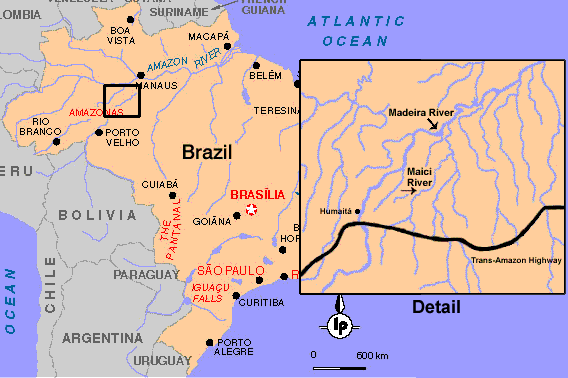
Language is a reflection of culture and in 1979 when Daniel Everett with his wife and three young kids went to Brazil to live among one of the most remote tribes in the world, Dan was forever discovering differences rather than similarities between the cultures. Initially, Dan went as a missionary to the Pirahã with intentions to convert the natives to Christianity, but living among the tribe that had no word or concept for war, shared equally with all members of the village, was non-materialistic, he began to see that his "lifestyle" was inferior to the one he sought to convert, so he gave up mission work and refocused his energies on learning the Pirahã language and culture, both of which were hugely different from his own or any other he had studied.

Even the name of his book Don't Sleep, There Are Snakes: Life and Language in the Amazonian Jungle is a reflection of that difference. The expression "Don't sleep, there are snakes" is actually a way of saying 'good night' but the difference comes with the intent in saying 'good night'. To the Pirahã, they believe that sound sleeping puts one in danger, drops one's defenses, and so they must "harden themselves" into nocturnal awareness to ward off predators. In fact, the Pirahã laugh and talk much of the night, and don't sleep much at any one time, perhaps 20 minutes to at most two hours at any time throughout each 24 hour period.


Euphemisms therefore seem common in the language. When visiting someone's house, the traditional way of approaching a house is to call out, "Hey, tell the dogs not to be mad at me!" Also, if someone gives you food, the person asks, "Do you already know how to eat this?" and if you want to politely refuse, you simply answer, "I already know how to eat this."

Similarly, phatic communication -- communication that primarily functions to maintain social and interpersonal channels like hello, goodbye, how are you?, I'm sorry, you're welcome and thank you -- do not exist as Pirahã sentences are either for requests for information (questions), assertions of new information (declarations), or for the most part commands. Their expressions are primarily limited to immediate experience, so they talk about what they have experienced or someone still living has experienced. Sentences are all simple sentences -- compound and complex sentences are structurally not possible and language structure is limited to simple present, past and future tenses; there are no perfect tenses, and certainly no embedded clauses. In application, translating the Bible, the Koran, or Buddhist Vedas would be impossible as these stories are outside of experienced immediacy and no eye witness could make assertions to their existence. Such stories would therefore, even if they could be translated, have no impact on the tribe. In fact, no known missionaries have had any impact on the Pirahãs for nearly 300 years.

The Pirahã's contact with the "outside" is virtually limited to the Caboclos, descendants of an Amazonian indigenous people living in close proximics to the Pirahã. The Pirahã call them xaobi-gii (authentic foreigners); Americans, Brazilians, etc are simply xaobi (foreigners), because the Pirahã view the Caboclos as more acceptable to interact with, partly because their two different tribes are still more alike than the Pirahã and "other" foreigners who the Pirahã have little social contact with and virtually no understanding of, which ultimately means no interest in.

The Pirahã have no counting system, no fixed expressions for color, no sense of tribal history, creation myth or folklore. Kinship terms are simple and limited to the lifespan, that is, with mortality at around 45, great-grandparents could not be known and so there is no term for such an imaginary relationship. There are no property terms and body-oriented directions are non-existent, e.g. 'turn left' or 'go straight ahead' are not spoken but rather directions for the Pirahã are focused on the directional path and flow of the river, which forces speakers to think of the overall world differently.

Their language has one of the smallest sets of speech sounds and phonemes in the world, with only three vowels (i, a, o) and just eight consonants (p, t, k, s, h, b, g, and the glottal stop x) for men and for women three vowels and seven consonants (women replace the masculine s sound with the h). Surprisingly the consonants are frequently interchangeable, but what is important is the tone, accent, and weight of the syllables which can ultimately be whistled, hummed, yelled or sung. Pirahã is very much a tonal language and cannot be whispered as voicing is necessary for completing communication. Pioneering work by the sociolinguist Dell Hymes noted that there are five pitch channels in Pirahã: whistle speech, hum speech, musical speech, yell speech, and normal speech, the latter using consonants and vowels.

One fascinating conversation Daniel had concerning food involved lettuce. A plane delivered lettuce, tomatoes and cabbage and Daniel was delighted to eat something besides rice, beans, fish and wild game smothered in tabasco sauce. A Pirahã was puzzled when he saw Daniel eating, and enjoying, the salad, and asked, "Why do you eat leaves? Don't you have any meat?" When assured that meat was available, the Pirahã made the "obvious" conclusion to the affair, "Pirahãs don't eat leaves. That is why you don't speak our language well. We Pirahãs speak our language well and we don't eat leaves." The statement confused Daniel but he was to finally come to the conclusion that to speak their language is to live their culture.


The Pirahãs were a hard to define tribe. Unlike other Amazonian groups, they did not wear feathers, enact elaborate rituals, paint their bodies, or have other outward exotic cultural manifestations. They don't display wealth because all Pirahã are equal, they don't need houses for privacy as privacy is not a strong value. They produce few tools, almost no art, and very few artifacts. Perhaps their most outstanding tools are their large, powerful bows (over two yards in length) and arrows (2-3 yards long). If a basket is needed, they quickly weave one on the spot out of wet palm leaves, of course not using the more durable wicker fibers but something for quickly completing what is immediately necessary. The women do wear necklaces made from seeds and homespun cotton string, decorated with feathers, beads, beer-tabs, and other objects, but their purpose is for warding off spirits, not to be artistic, show symmetry or reflect tribal colors or design, which don't exist. Neither do they have any method for food preservation. In death, Pirahã are buried in a prone position with their belongings alongside, but these amount to very little as Pirahã have relatively no material culture.

Marriage ties are for life but invariably men (maybe even women) cheat. The next day a woman will have the man with his head on her lap and she will be rapping his head repeatedly for hours. The woman can express her anger tangibly and the man by allowing her to rap expresses his remorse. The conflict is over by the end of the day, but this isn't to say that it won't happen again.

One anthropology student went to the Pirahã in order to collect data. Lacking Pirahã language, he attempted to conduct his research in Portuguese, which some the Pirahã had limited working knowledge of. When the Pirahã realized that the recording could go to their friend Daniel Everett (having long experienced tape recorders from Daniel's extended stays in the village), the researcher's questions were totally disregarded and they began talking about village affairs to Daniel. The researcher gave up trying, probably intuitively knowing that if he had been speaking "straight head" (Pirahã) instead of "crooked head" (Portuguese) his language constraints would have been lowered and his communication conventions would have been more in line with experiential immediacy.

Friday, April 10, 2015

Words Lost in Translation

When translating from one language to another, inevitably you will come across a word that just can't be translated directly into the other language and you must resort to description and explanation of the concept. This is true because language reflects culture and vice versa, culture reflects language, so our cultures like our languages are different and therefore result in different ways of looking at the world. Many cultures in fact have totally different world experiences from other cultures preventing full understanding between the cultures because they just can't quite identify with one another. 

Many people already are aware that the Inuit have a large number of words for "snow" that just don't translate into English. This is because when the Inuit talk about the snow, they are including references to how cold it is and therefore how fluffy, crisp, hard, blowy, etc and the snow is that is falling, the snow that is on the ground, e.g. in hard packed coverage or deep fluffy coverage that doesn't support a dogsled. In English we resort to description if we think the kind of snow on the ground or falling is important. That would take a long, long time in the Inuit language because about nine months of the year the Arctic has some kind of snow.

If you'll recall, the movie "The King and I" was about a missionary who went to Siam (Thailand) in the 1800s and had the palace concubines and children put on a play. In the play about Harriet Beecher Stowe's book "Uncle Tom's Cabin", the miracle of snow was introduced. The concubines and others didn't believe that anything cold could fall from the sky; it was outside of their world experience and so at first they didn't believe anything like that could exist, then they played with the word "snow" and the mysterious idea of a cold world and marveled that such a thing could exist. They were able to step outside their culture via literature and broaden their world concept.

Well, a rather new and interesting book on the shelf is "Lost in Translation: An Illustrated Compendium of Untranslatable Words from Around the World". The book has pages of illustrated words from other languages that just can't be translated easily or directly into English, but if they were, could be an asset to the ever-growing English language. Following are several of the entries with some charming illustrations:

Suadade (noun)

Probably one of the most famous (are beautiful) Portuguese words is "saudade" which refers to the feeling of longing for something or someone you love or have lost. Fado music, a form of music characterized by mournful tunes and lyrics, relates to saudade.

Saudade is not just a feeling but something you can literally "have". In Portuguese, you could say "Tenho saudades," which translates as "I have saudade."

This kind of reminds me of a Spanish expression, "No tengo ganas", with ganas being another word that doesn't translate. Ganas kind of means desire, will or energy, so "No tengo ganas" kind of means "I don't have the desire/will/inclination/energy to do that."


Cacimbo (noun)


This Kimbundu word, used in Angola, refers to a heavy mist or drizzle that occurs in the Congo basin area and which is often accompanied by onshore winds. It is synonymous for the cool season, and apparently there is no translation possible. Upon hearing the word, Angolans think about the fresh air, the summer, the cool weather and the very cold water.

This word reminds me of "siwonhada", a Korean word with perhaps more meanings on cool, refreshing, invigorating ideas. It seems to similarly be used for a breath of fresh air after the summer heat or the icy coldness of the air conditioner after the burning heat outside. It has no specific temperature range but often reflects the change in coolness after the hotness. Actually, siwonhada is an idiom with many more meanings, but this one on coolness is probably the most commonly used one.

Extrawunch (noun)


This useful German word is used to denote someone who is slowing things down by being fussy. It means an additional request which turns a simple delivery/operation/undertaking into a complicated one, often with only a marginal benefit and a sense of it being an unnecessary complication.

Hiraeth (noun)


Hiraeth is Welsh and refers to a particular type of longing for the homeland or the romanticized past. The Japanese word "natsukashii" means something similar. It sometimes has connotations of nostalgia for an idealized past that never was.

Somewhat similarly is the Korean word "han", which is in fact a cultural disease of the Koreans before Korea became a democratic country (in the late 1980s - early 1990s). Han means a rancor, bitterness or inability to express one's feelings of turmoil or resentment, kind of like a bitterness that could not be expressed (because of the military government) and an eating away of bottled up pain, anger and frustration. The oldest generation may still have the cultural disease of Han but the younger generations, experiencing freedom of speech and action, certainly do not.

Korembi (noun)


A beautiful Japanese word that refers to the sunlight that filters through the leaves of trees. Taking pictures of korembi is popular with photographers and this word seriously needs to be added to the English language!


Mokita (noun)


The word "mokita" comes from the Kivila language in Papua New Guinea. It translates loosely as "the truth we all know but agree not to talk about". Another necessary word addition for English!

Dapjeongneo (noun?)


The next time your girlfriend asks you, "Don't you think I'm pretty in my new dress?" you'll get an instinctive feel for the meaning of this word. Dapjeongneo (답정너) is a recently created Korean word used when somebody (usually, you may have guessed, a woman) has already decided the answer you want to hear, and all is left for you to do is to utter the answer.

Waldeinsamkeit (noun)


Waldeinsamkeit is German for "a feeling of solitude, being alone in the woods and a connectedness to nature." Perhaps not the most useful word out there, and to be fair, it's a fairly old term that nobody uses nowadays, but it's still pretty cool and would make you look very smart if you were to throw it in  a discussion, and mention that Ralph Waldo Emerson even wrote a whole poem about it.

Depaysement (noun)


A word that is in every French-speaking traveler's vocabulary. It doesn't translate to "homesick" but rather to the feeling that comes from not being in one's home country, of being a foreigner or immigrant or displaced from your place of origin. Literally translated in English, it would be something like "unlandscaped" (Italian has an exact translation, "spaesamento".)

The word can also have a positive connotation, a "change of scene" that is experienced in a completely new place. Therefore, in using and understanding the exact meaning of the word, one must pay attention to context and tone.

Iktsuarpok (noun)


Iktsuarpok is Inuit for the feeling of anticipation that leads you to go outside and check if anyone is coming. It also denotes impatience. Imagine living in an igloo in the middle of the northern tundra where not a single living soul lives within 100 square kilometers, then you can quickly get the sense of the meaning of the word for expectancy. The environment certainly has shaped the creation and use of this word.


Jayus (noun or adjective?)


A very useful word if you have friends with a bad sense of humor. Jayus is Indonesian for "a joke so poorly told and so unfunny that one cannot help but to laugh." English has the expression of "corny" and Koreans can use the above word "siwonhada" (cold) in this situation, but neither English nor Korean have a word for the embarrassed laughter following such a joke. Both languages could benefit by this word!


Mamihlapinatapei (noun)


Mamihlapinatapei is an amazing word in Yagan, an indigenous language of Tierra del Fuego (an archipelago off the southernmost tip of the South American mainland, across the Strait of Magellan). It means the wordless yet meaningful look shared by two people who both desire to initiate something but are both reluctant to start. Yeah, this word could seriously work in English! "The look", the closest translation is English, just has too many possible meanings.

Verschlimmbessern (verb)


Another German word, a verb in fact, means "to make something worse when trying to improve it," something we've all experienced but now we have a word for it. Somehow if this word gets borrowed into English, I do believe it'll have to be introduced as a contraction, maybe something like "The boss versched the reconstruction." It does sound appropriately negative so maybe this shortening will find its way into English ... eventually.

Eomchina (noun)


Eomchina (엄친아) is a hilarious Korean contraction of the phrase "Mom's friend's son" (엄마친구아들). Korean mothers are often very competitive and compare their children against the offspring of their friends. This word is used to describe a person who is more successful or skilled than you - the kind of person your mother would compare you to in a negative light so as to motivate you to study harder. Wow, yes, Korea is so competitive that I bet my students hear this word a LOT!

Schadenfreude (noun)


This German word literally translates as "harm-joy" and refers to the feeling of joy or pleasure when one sees another fail or suffer misfortune. The philosopher Arthur Schopenhauer mentioned schadenfreude as "the most evil sin of human feeling." A number of interesting scientific studies of schadenfreude were undertaken in recent years.


Following are some more culture revealing words, for as Virginia Wolf said in the only surviving recording of her voice, "Words belong to each other". Words are indeed a magnificent meditation and cultural reflection on the beauty of language. Language is what makes us human; it defines us, our essence, our souls.

Gurfa - Arabic (noun)


The amount of water that can be held in one hand. (I'm wondering how this word became popularized in Arabic and in what context it is really used.)


Tsundoku - Japanese (noun)


Leaving a book unread after buying it, typically piled up together with other unread books. Hmmm, I think I need this word.

Palegg - Norwegian (noun)


Anything and everything you can put in a slice of bread. Well, why not? A sandwich connotes two pieces of bread with a filling and people describe the filling via language, cheese-lettuce-and-tomato sandwich, PBJ sandwich. Why not put anything between bread, I mean, food is food, right?


Forelsket - Norwegian (noun)


The indescribable euphoria experienced as you being to fall in love. Useful indeed!


Trepverter - Yiddish (noun)


A witty riposte or comeback you think of only when it is too late to use. Literally, "staircase words."


Wabi-sabi - Japanese (noun)


Finding beauty in the imperfections; an acceptance of the cycle of life and death.


Jugaad - Hindi (noun)


Ensuring that things happen even with minimal resources, even if they happen "by hook or by crook." Oh, yes, English needs this!


Komorebi - Japanese (noun)


The sunlight that filters through the leaves of the trees. Komorebi is just plain word poetry!


Kilig - Tagalog (noun)


The feeling of butterflies in your stomach, usually when something romantic or cute takes place.


Fika - Swedish (verb)


Gathering together to talk and take a break from everyday routines, usually drinking coffee and eating pastries (either at a cafe or at home) and often for hours on end.


Commuovere - Italian (verb)


Often taken to mean "heartmoving" but directly relates to a story that moved you to tears. Guess this means something different from tear-jerking, but they seem quite similar to me.


Luftmensch - Yiddish (noun)


Refers to someone who is a bit of a dreamer and literally means "air person". The closest English I can think of is the person has his head in the clouds, but a one-word descriptor is so much more culturally powerful.


Tretar - Swedish (noun)


On its own, "tar" means a cup of coffee and "pelar" is the refill of said coffee. A "tretar" is therefore a second refill, or a "three-fill".


References:


15 Untranslatable Words You Wish Existed in English - Lingholic

Lost in Translation: An Illustrated Catalog of Beautiful Untranslatable Words from Around the World - Brain Pickings


Tuesday, December 16, 2014

Nursery Rhymes and Their Origins

(Wikipedia) A nursery rhyme is a traditional song or poem taught to young children, and specific actions or dances are often associated with particular songs. Learning such verse assists in the development of vocabulary, and several examples deal with rudimentary counting skills, e.g. eenie, meenie, mynie, mo.


Many cultures (though not all, see below) feature children's songs and verses that are passed down by oral tradition from one generation to the next, however the term "nursery rhyme" generally refers to those of European origin. The best known examples are English and originated in or since the 17th century. Some however are substantially older, "Baa Baa Black Sheep" exists in written records as far back the Middle Ages. Arguably the most famous collection is that of Mother Goose (French: Ma Mère l'Oye, a legendary author of nursery rhymes—no human writer has ever been identified with the name.)  Some well known nursery rhymes originated in America, such as "Mary had a little lamb".[1].

Generally nursery rhymes are innocent doggerel, though some scholars have attempted to link their meaning to events in European or English history. Urban legends abound with regard to some of the rhymes, though most of these have been discredited. Some of the more plausible explanations indicate that some rhymes may have been contemporary social or political satire. ("Hey Diddle Diddle" is one example, the "dish" and "spoon" possibly being nicknames for the figures involved in a sex scandal in the court of Elizabeth I [2])

"Ring-Around-the-Rosie" (alternatively "Ring-a-ring of Rosies") is popularly believed to be a metaphorical reference to the Great Plague, although this has been widely discredited, particularly as none of the "symptoms" described by the poem even remotely correlate to those of the Bubonic plague, and the first record of the rhyme's existence was not until 1790. [3], [4].

A credible interpretation of "Pop goes the Weasel" is that it is about silk weavers taking their weaver (known as a "weasel"), to a pawnbrokers to obtain money for drinking. It is possible that the "eagle" mentioned in the song's third verse refers to The Eagle freehold pub along Shepherdess Walk in London, which was established as a music hall in 1825 and was rebuilt as a public house in 1901. This public house bears a plaque with this interpretation of the nursery rhyme and the pub's history. Alternatively, the term "weasel" might be Cockney rhyming slang for a coat ("weasel and stoat" = "coat"), and the coat itself was pawned.

Scholars occasionally think they have "all" nursery rhymes written down, or know the last time that a rhyme was in use (some fall out of favor). However, due to the fact that they're mainly an oral tradition, nursery rhymes will "pop up" anew. See Bill Bryson's book Made in America : An Informal History of the English Language in the United States for an excellent example.

There are some aboriginal tribes which consider music sacred, so that only elder men may sing songs, and the songs are taught during sacred rituals in adulthood. It is forbidden for women or children to sing. Hence, these cultures don't have these kinds of songs.

TWINKLE, TWINKLE LITTLE STAR

Twinkle, twinkle, little star
How I wonder what you are.
Up above the earth so high
Like a diamond in the sky
Twinkle, twinkle, little star
How I wonder what you are.
Then a traveller in the dark
Thanks you for your tiny spark
He could see which way to go
If you did not twinkle so
Twinkle, twinkle, little star
How I wonder what you are.

Twinkle, twinkle little star is the English name of a popular French melody named Ah! Vous dirais-je, Maman. It was first published in 1761, but the origin is unknown. Today it is one of the most popular nursery rhymes among toddlers and small children.

JACK, BE NIMBLE, JACK, BE QUICK
Jack, be nimble, Jack, be quick.
Jack, jump over the candlestick.
This nursery rhyme owes its origin to a superstition that was prevalent in medieval England concerning the luck for the following year.  The lace-makers of Wendover in Buckinghamshire were a lively bunch. Every year on November 25th, they celebrated the feast of St. Catherine, their patron saint. Costumed as men, singing special love songs for the occasion, they visited neighbors, who served them “wiggs" - buns flavored with caraway seeds - and a hot pot - a drink of warm beer thickened with rum and whipped eggs. Afterward, they held a banquet and set off fireworks, especially Catherine Wheels. In conclusion of the evening, they played leap-candle. In those days, if a person wanted to know what Dame Fortune had in store for him he would leap over a lighted candle placed on the floor. If the candle remained lit, good luck was forecast for the following year; if it went out, it indicated bad luck.    (The Great American Baby Almanac)

ROCK-A-BYE-BABY

Rock-a-bye-baby
On the treetop
When the wind blows,
The cradle will rock.
When the bough breaks,
The cradle will fall
And down will come baby
Cradle and all.

The author of this well-loved lullaby was reportedly a pilgrim who sailed on the Mayflower. The Wampanoag Indians, who befriended the colonists, carried their infants in cradleboards on their backs. In temperate weather, they suspended the cradles from tree limbs so that passing breezes could rock the babies while their mothers tended the maize and beans. With typical motherly indulgence, the cradles were decorated with shells, beads and porcupine quills. For sober-minded puritans, the sight of a birch tree festooned with such cradles must have been very memorable indeed.  (The Great American Baby Almanac)

LITTLE JACK HORNER
Little Jack Horner
Sat in a corner
Eating a Christmas Pie.
He put in his thumb
And pulled out a plum
And said
"Oh, what a good boy am I!"
According to legend, Little Jack Horner was actually Thomas Horner, steward to the Abbot of Glastonbury during the reign of King Henry VIII. Rumor had it that the inquisitive king would soon be reaching for some Glastonbury holdings. The nervous Abbot, hoping to appease the royal appetite, sent the king a special gift: a pie containing twelve deeds to manor houses. On his way to London, the not-so-loyal courier Horner stuck his thumb into the pie and extracted the deed for Mells Manor, a plum piece of real estate, where his descendants live to this day.   (The Great American Baby Almanac)

RIDE A COCK-HORSE TO BANBURY CROSS
Ride a cock-horse to Banbury Cross,
To see a fine lady upon a white horse;
With rings on her fingers and bells on her toes,
She shall have music wherever she goes.
Before the suffragists came along, women were sometimes compelled to obtain their ends by unusual means. Consider the case of Lady Godiva. Her husband Leofric, Earl of Mercia, imposed a heavy tax on his subjects. Distressed by their hardship, Godiva pleaded their case. Her husband listened politely for a few days, then with mounting annoyance, and finally offered a dare…."Ride naked through Coventry, and I'll do as you ask."

Confident that his wife would never commit such an act, Leofric returned to his ledgers. Undaunted, Godiva galloped through town on a handsome white horse, clad only in her coppery tresses, while all the folk in Coventry stayed indoors with the shutters locked, to spare her blushes. The earl conceded, and lifted the tax. And if she hears music wherever she goes, it's probably the townspeople singing her praises.   (The Great American Baby Almanac)

THERE WAS A LITTLE GIRL
There was a little girl
Who had a little curl
Right in the middle of her forehead;
And when she was good,
She was very, very good
But when she was bad she was horrid.
This poem is the work of American poet Henry Wadsworth Longfellow. He composed it one day when his daughter Edith refused to submit her hair to a curling iron. For many years afterward, Longfellow, the author of such works as Evangeline and "Paul Revere's Ride," denied having written the verse.

When pressed by friends, he owned up somewhat crossly; "When I recall my juvenile poems and prose sketches, I wish that they were forgotten entirely. They however cling to one's skirt with a terrible grasp."  (The Great American Baby Almanac)

HUMPTY DUMPTY
Humpty Dumpty sat on a wall.
Humpty Dumpty had a great fall.
All the king's horses and all the king's men
Couldn't put Humpty together again!
Belief #1:  Who is Humpty Dumpty?  An egg, you might say. But scholars believe the verse was written to ridicule a powerful nobleman who fell from royal favour during the reign of the English king, Richard III.

Belief #2:   Humpty Dumpty was a powerful cannon during the English Civil War (1642-49). It was mounted on top of the St. Mary's at the Wall Church in Colchester defending the city against siege in the summer of 1648. (Although Colchester was a Parliamentarian stronghold, it was captured by the Royalists who held it for 11 weeks.) The church tower was hit by the enemy and the top of the tower was blown off, sending "Humpty" tumbling to the ground. Naturally the King's men (infantry) tried to mend him but in vain.   (The “king’s horses” were the cavalry troops.)   (East Anglia Tourist Board in England)

RING AROUND THE ROSIE

(old)    Ring-a-ring o'roses,
A pocket full of posies,
A-tishoo! A-tishoo!
We all fall down. 
(now)   Ring around the Rosie
A pocket full of posies
Ashes, ashes,
We all fall down.
A pocket full of posies
Ashes, ashes,
We all fall down.
Belief #1:  This old, nonsensical nursery rhyme frightened the wits out of people during the plague outbreak in England in the 17th century.  More than 70,000 people died in the Great Plague of London in 1664-65.  The 'ring-o'roses' refers to the circular rosy rash that was one of the early symptoms of the disease or even the circles around the eyes.  The pocket full of posies was a medieval belief that posies held some curative measures against the plague, so carrying around that flower would keep you safe.  Coughing up dried blood from the lungs resembled ashes [later version] but likewise, “A-tishoo! A-tisho  We all fall down.” refers to the final sneeze—after which the victim fell down dead.

Belief #2:  Philip Hiscock, a folklorist at Memorial University in Newfoundland, states that this rhyme likely originated as a way of skirting Protestant bans on dancing:

"Adolescents found a way around the dancing ban with what was called in the United States the 'play-party.' Play-parties consisted of ring games, which differed from square dances only in their name and their lack of musical accompaniment. They were hugely popular, and younger children got into the act, too. Some modern nursery games, particularly those which involve rings of children, derive from these play-party games. 'Little Sally Saucer' (or 'Sally Waters') is one of them, and 'Ring Around the Rosie' seems to be another. The rings referred to in the rhymes are literally the rings formed by the playing children."

SING A SONG OF SIXPENCE (Old and more recent version)


(old)    Sing a Song of Sixpence,
A bag full of Rye,
Four and twenty naughty boys,
Bak'd in a Pye.
When the pie was opened,
The birds began to sing;
Was not that a dainty dish,
To set before the king?
The king was in his counting-house,
Counting out his money;
The queen was in the parlor,
Eating bread and honey.
The maid was in the garden,
Hanging out the clothes,
There came a little blackbird,
And snapped off her nose.
(now)   Sing a song of sixpence
A pocket full of rye
Four and twenty blackbirds
Baked in a pie
When the pie was opened
The birds began to sing
Was that not a tasty dish
To set before a king?
The King was in his counting house
Counting out his money
The Queen was in the parlor
Eating bread and honey
The Maid was in the garden
Hanging out the clothes
When down came a blackbird
And snapped off her nose!


Claim:   The nursery rhyme 'Sing a Song of Sixpence' originated as a coded message used to recruit crew members for pirate ships.
Status:   True.
Origins:   Many of us of us fondly recall the rhyming ditties we learned as children, such as "Jack Be Nimble" and "The Farmer in the Dell." But how many of us realize that several of our most fondly-recalled nursery rhymes (e.g., "A Tisket, A Tasket" and "Little Jack Horner") were not mere nonsense songs, but actually originated as coded references to such dark events as plagues and religious persecution? Such was the case with another childhood favorite, "Sing a Song of Sixpence."
The surprising truth is that this innocent little rhyme, which dates from the early 1700s, actually represents a coded message used to recruit crew members for pirate vessels!
Pirates (or corsairs, privateers whose activities were sanctioned by letters of marque from a sovereign) did not spend all their time at sea: they cruised the waters in areas such as the Mediterranean, the Spanish Main, or the Atlantic coast of North America, looking for prizes, and they returned to port when the need for supplies or repairs demanded it. Upon reaching port, the ship's captain paid off the crew (primarily by dividing the spoils of whatever they had captured), and the crew members then dispersed ashore (usually to spend all their pay on alcohol and prostitutes as quickly as possible). Some crewmen tended to stay in the vicinity, but others left for other regions, caught on with other ships, died, were killed, or simply disappeared. Thus, much like the captains of naval vessels and merchant traders, the captains of pirate ships needed to recruit new crew members whenever they embarked on yet another venture. Since piracy (as opposed to privateering) was against the law, pirates devised codes that could be used to advertise for crew members without openly revealing their illegal affiliations.
The nursery rhyme "Six a Song of Sixpence" was a coded message that evolved over several years' times and was used by confederates of the notorious pirate Blackbeard to recruit crew members for his prize-hunting expeditions. Like many other messages passed down to us over hundreds of years by oral tradition, there is no one "official" version, nor is there a "correct" interpretation for any particular variant. In general, however, the most common form of this rhyme bore these veiled meanings:

Sing a song of sixpence / A pocket full of rye

Blackbeard's standard payment of sixpence a day was considered good money in the 1700s, especially since most pirate vessels did not pay a salary: the crew only received a share of the spoils if they were successful in capturing prizes (and many a pirate ship had to return to port empty-handed after spending several fruitless months at sea). As well, his crew was promised a pocket (a leather bag somewhat like an early canteen which held about a liter) full of rye (whiskey) per day. Not bad, considering that alcohol was the average sailor's raison d'etre.
Four and twenty blackbirds / Baked in a pie
As Henry Betts points out in his book on the origins and history of nursery rhymes, "It was a favourite trick in the sixteenth century to conceal all sorts of surprises in a pie." Buccaneers, too, were fond of surprises, and one of Blackbeard's favorite ruses to lure a ship within boarding range was to make his own vessel (or crew) appear to be in distress, typically by pretending to have been dismasted in a storm or to have sprung a leak below the waterline. Passing ships -- both honest sailors wanting to help and other pirates looking for an easy catch -- would sail in close to offer assistance, whereupon a crew of two dozen heavily-armed crewmen dressed in black would board the other vessel (via a boat in darkness or fog, or by simply jumping into the other ship when it came alongside if no other means of surprise attack was possible) to quickly kill or disable as many crew members as possible. Thus the four and twenty "blackbirds" (i.e., Blackbeard's crewmen) "baked in a pie" (i.e., concealed in anticipation of springing a trap).
When the pie was opened / The birds began to sing
This follows from the previous line. Once the victim's ship was lured in for the kill, the "blackbirds" came out of hiding and attacked with a fearsome din.
Was that not a tasty dish / To set before a king?
This line is commonly misinterpreted. The King is not a reference to any real king, but rather to Blackbeard himself, the king of pirates. And the tasty dish is the plundered ship that was so easily captured.
The King was in his counting house / Counting out his money
Again, the King is Blackbeard (no real king would take on such a mean task as counting money). This line of the message signals that Blackbeard had the cash on hand to pay a crew on salary rather than strictly on divided spoils.
The Queen was in the parlor / Eating bread and honey
Blackbeard's main vessel was a French merchant ship named "Le Concorde de Nantes" that was jointly captured by Blackbeard and Captain Hornigold in the Grenadines in November of 1717. Upon his retirement from pirating, Hornigold presented the ship to Blackbeard, who renamed it "The Queen Anne's Revenge". Thus the "Queen" referred to here is Blackbeard's ship, and "eating bread and honey" meant that it was in port taking on supplies in preparation for a cruise.
The Maid was in the garden / Hanging out the clothes
The use of the word "maid" indicated that the location/route of one or more prize ships was known, and they were going to be specific targets of the upcoming cruise (this greatly enhancing the probability of the crew's collecting prize money). The waters around the Carolinas down to the Caribbean were referred to as the garden, as this was an area where pirates would often cruise for easy pickings. "Hanging out the clothes" meant the targeted ship was already at sea or just about to leave port (thus its sails -- or "clothes" -- have been hung).
When down came a blackbird / And snapped off her nose!
There is some scholarly debate in literary and maritime circles as to whether the last part was originally "and snapped off her nose" or "and snapped off a rose." Either way, the passage is taken to be a Blackbeard's bragging about his plans to swoop in and have his way with the targeted ship.  So, next time you hear this innocent children's song, remember that it was originally recited in taverns by drunken, bloodthirsty buccaneers as a code to recruit other pirates for their next murderous voyage!
You will note a few changes since then, but not many:
The rhyme is almost certainly older than 1744, but no earlier publication has been found (at least, not as of 1970). There are earlier indirect references. Shakespeare, in Twelfth Night: "Come on, there is sixpence for you; let's have a song." And a 1614 work by Beaumont and Fletcher includes the line, "Whoa, here's a stir now! Sing a song of sixpence!"
According to the Oxford Dictionary of Nursery Rhymes, an Italian cookbook from 1549 (translated into English in 1598) actually contains a recipe "to make pies so that birds may be alive in them and flie out when it is cut up." The ODNR also cites a 1723 cook who describes this as an earlier practice, the idea being that the birds cause "a diverting Hurley-Burley amongst the Guests."
It was not uncommon in the 16th century for a chef to hide surprises in the dinner pie; this is also reflected in the nursery rhyme "Little Jack Horner".  So the most obvious explanation of "Sing a Song of Sixpence" is that it reflected an actual practice--baking a pie full of live birds that popped out when the pie was opened.

Other theories include:
o   The 24 blackbirds reflect 24 hours in a day; the king is the sun, the queen is the moon.
o   King Henry VIII is the king, Catherine of Aragon is the queen, and Anne Boleyn is the maid. The blackbirds are--get ready for this--manorial deeds baked in a pie. During the period when Henry VIII was taking over the property of the Catholic Church, the abbot of Glastonbury is said to have sent his steward to London with a Christmas gift intended to appease the king--a pie in which were hidden the deeds to twelve manorial estates. The steward, Thomas Horner, is alleged to have opened the pie and extracted one deed, that of the manor of Mells, where his descendents still live. This may be the origin of the aforementioned Little Jack Horner nursery rhyme.
o   The song commemorates the publication of the first English bible, with the blackbirds being the letters of the alphabet set in pica type ("baked in a pie"). Personally My own uneducated opinion is that this interpretation is dubious, since the 24-letter alphabet only existed between the 10th and 11th Centuries. (W appeared in the 11th Century to condense UU, and J in the 15th Century as an initial form of I.)

A few other explanatory notes, some courtesy of William S. and Ceil Baring-Gould, authors of The Annotated Mother Goose:
o   The "bag" in the 1744 version later became a pocket full, and it's presumed that a "pocket full" was once a specific measurement, like a cupful.
  • Rye is, of course, a grain that was (and is) commonly used in bread making, or piecrust making, as the case may be.
  • The number four and twenty is among the most common in Mother Goose rhymes. It is twice twelve, or a double dozen. The number 12 brims over with tradition and associations. We have already described why the birds might be baked in a pie.
  • The "counting house" was the place used to conduct business, and is referenced many times in Shakespeare's Merry Wives of Windsor.
By the way, some later versions of the rhyme include happier endings for the maid, such as:
They sent for the king's doctor,
Who sewed it on again,
He sewed it on so neatly,
The seam was never seen.

JACK AND JILL

Jack and Jill went up the hill
To fetch a pail of water.
Jack fell down and broke his crown
And Jill came tumbling after.

Jack and Jill who went up the hill are thought to represent the incoming and outgoing of the tides. The waves (Jack and Jill) are drawn up the hill (shore) by the pull of the moon. But when the moon's pull weakens, the tide goes out and Jack and Jill go tumbling down the hill again. 

PETER, PETER, PUMPKIN EATER

Peter, Peter, Pumpkin Eater,
Had a wife and couldn’t keep her.
Put her in a pumpkin shell
And there he kept her very well.

Peter was a poor man who had an unfaithful wife. She kept cheating on him (he couldn’t keep her), so he had to find a way to stop her running around. His solution, fairly common in the middle ages, was a chastity belt (pumpkin shell). For those who don’t know, a chastity belt is roughly a pair of metal underwear with lock and key, so that no one could enter the private region of the woman except whoever held the key, usually her husband. And as the rhyme goes, once he put her in that belt, he kept her very well.
RUB-A-DUB-DUB THREE MEN IN A TUB 
Rub-a-dub-dub,
Three men in a tub
And who do you think they be?
The butcher, the baker,
The candlestick-maker.
Turn ‘em out, knaves all three!

Why would these three men be sharing a bath? Latent homosexuality, maybe? Not enough water for three individual baths? No, this is a case of not hearing the whole joke, just the punch line. The part of the story we aren’t getting was the setting. A fair side-show, where three young, beautiful women were sitting in a bath-tub, entertaining a mostly male audience, when three of the men jumped up and climbed in with the girls, to be promptly thrown out again by the fair manager. Just three working folk.

BAA, BAA, BLACK SHEEP

Baa, baa, black sheep,
Have you any wool?
Yes sir, yes sir,
Three bags full.
One for my master,
One for my dame,
And one for the little boy
who lives in the lane.
 (1799)
            
Baa Baa Black Sheep was about taxation and written in “protest against the export tax imposed in Britain in 1275.  The master [symbolizing] the king” (Delamar, 123). 

___________________________________________________________

As can be seen, almost every nursery rhyme has a story behind it. Humpty Dumpty was actually King Richard III, and the famous farmer’s wife from the Three Blind Mice was supposedly Queen Mary I. The Old Woman Who Lived In a Shoe was referring to the British Empire trying to control its colonies.  'Old Mother Hubbard' was first published in London in 1805; in its original form it is a long, fourteen-stanza verse, authored by a woman named Sarah Catherine Martin.


Yet children year after year recite these stories, not knowing the original joke or gossip hidden within, not really caring if Jack Sprat was King Charles I. The fake stories that we invent for the rhyme now are much more fun, anyway.

_________________________________________________________________________

This compilation from many on-line sites was made over 12 years ago. Was trying to go back through some of the compilation and link in the sources, but I realize that so much on the web has changed over the past years that sourcing isn't that easy, so I just gave up. Example of one key source, Wikipedia. The first few paragraphs above were originally borrowed from 'nursery rhymes' in Wikipedia 12+ years ago, but now the content has changed so much that I didn't link the information as ... it ... is ... so ... different! Wow, the amazing Internet is evolving at a tremendous pace!