Showing posts with label Inuit. Show all posts

Sunday, September 29, 2019

The Jungle Effect: Notes on Indigenous Diets

In The Jungle Effect: The Healthiest Diets from around the World--Why They Work and How to Make Them Work for You (2008), Daphne Miller, MD, seeks to explore the traditional diets of some of her patients whose ethnic heritages haven't been generations of American-born and raised. When various patients from ethnic backgrounds outside of the United States were having health complications that people of their own heritage rarely had, Dr. Miller sought to question the "new" diet and look at the differences between the SAD (Standard American Diet) that seemed to be causing the health issues and the patients' native heritage diet. Following are a collection of anthropological discoveries she made in her search to form better diets for her patients:

  • Research has shown the 80% of medical problems involving heart disease, stroke and type 2 diabetes and 40% of cancer cases could be avoided by following a healthy diet, exercising regularly, and avoiding tobacco.
  • San Francisco bay area is a hot spot for breast cancer.
  • "Nixtamilization" is a process used to treat maize in Central and South America. To prepare corn for consumption, corn is boiled in an alkali solution of lime and water which removes the tough outer layer of the kernels, and which also enriches the corn with essential nutrients like calcium, niacin, and certain amino acids. Without nixtamilization, Mesoamericans would have suffered from severe vitamin deficiencies, including pellagra (niacin deficiency). 
nixtamilization
  • Table manners and patterns of eating are apparent in almost all cultures, and in countries that practice communal eating, one simply does NOT eat alone. That is, how one eats is extremely important in many cultures. Take Cameroon and Crete, for example. In both cultures one is absolutely expected to eat slowly--a practice that very much improves digestion, and interesting enough, less food is consumed. Also, in Okinawa, the dictum Hara Hachi Bu, or "eat only until you are eight parts full," is a standard reminder not to overeat. In outcome, Okinawans maintain their weight from age 20 to 100, Americans on the other hand typically put on one pound per year after the age of 30.
  • Why are most toddlers disgusted by coffee, but many adults addicted? Because acidic, spicy and bitter foods are acquired tastes.
  • Eskimo tribes (Inuits), until recently, ate whale meat, seal, fish, sea bird and caribou, and despite this indigenous diet comprising about 50% high protein and 30-40% fat, Eskimos eating this diet had some of the lowest rates of heart disease and cancer in the world. Why? Probably because their blood levels showed very high levels of two omega-3 fats: EPA and DHA, fats known to prevent many chronic diseases. Eskimos ate fats from seafood and wild game, which in turn synthesized their omega-3s directly from sea greens and vegetation from the tundra. 
  • Peruvian villagers in Las Palmas in the Amazon eat the cashew fruit but avoid the nut, which is known to cause stomach cramps and nausea after a few hours of ingestion due to urushio, a toxin, in the nut. These Peruvians are amused to learn that Americans consider cashews a luxury food and cook them to make them edible.
  • Thiamine deficient people will have mental confusion and problems walking, but eating a thiamine-rich meal of, for example, whole grains, beans, and lean meat, immediately improves one's sense of well-being.  
  • The practice of adding spices like garlic, onions, chilis, turmeric, and ginger not only aid digestion but also delay food spoilage. Many also have anti-inflammatory qualities. These tangy, spicy additions are acquired tastes. 
  • Many cultures developed fermented and pickled foods which they discovered aided their digestion: Icelandic skyr (yogurt), Greek yogurt, Cameroonian fou fou and millet beer, Korean kimchi, Japanese tempeh and natto, and German sauerkraut. 
various kinds of fermented foods
  • Refining grains involves removing the two most nutritious parts -- the coarse husk and the oily inner germ. These two parts give bread a rough texture and a nutty flavor, but their removal leaves only a white endosperm, a fluffy form of starch with little nutritional value. Even whole-wheat bread (as opposed to whole-grain bread) is a highly refined food as it's made with flour which has retained some husk but no germ. Basically, the flavor is removed and sweetness remains.
  • Lactose intolerance. A good portion of the world's population has some discomfort or difficulty after eating dairy products. This is because their bodies don't produce lactase, the enzyme for digesting the carbohydrate lactose. Blacks, American Indians, and Asians are large ethnic groups commonly known to have difficulties with milk, while northern Europeans, some tribes in East Africa and the Middle East are able to digest lactose into adulthood.
  • The Pima Indians in Arizona have some of the highest rates of type 2 diabetes in the world. Scientists have found that the Pima have a host of gene mutations that may relate to insulin reaction and sugar processing. Ironically, the Pima's cousins, the Tarahumara Indians living several hundred miles south in Sonora and Chihuahua, have a low rate of diabetes.
  • 35% of Hawaiians are considered to be morbidly obese with similar numbers suffering from diabetes type 2 and heart disease. Middle-aged Hawaiians 100 years ago had the bodies of 20-year-olds, so what happened? The traditional diets of taro, breadfruit, fern shoots, purple yams, kukui nuts, fish, and free-range chickens are now only available at expensive prices in supermarkets for tourists while the foods of modern convenience are the only foods subsidized.
  • Type 2 diabetes in the past 70 years in the US has increased 700% and is now affecting even the younger population. The ethnic groups most dramatically impacted by this change are Latinos, Asian Americans, Native Americans and African Americans. 
  • All carbohydrates are not equal. The traditional carbs (e.g. cheeky yam, black bean seed, bush onion)  eaten by Pacific Islanders and Aboriginals seem to have had a protective effect against diabetes while Western food carbs (russet potatoes, white bread, white pasta, mass-produced corn, and white rice) seem to switch on diabetes.
  • Over 50 species of beans are native to the Americas.
  • Cretans of two generations previous consumed a guesstimated 50 kilos of olive oil per year, and lived to be quite old. A health-challenged Cretan returned to the old ways of stone-pressing olive oil when he realized the pesticides and fertilizers he used were in his precious olive oil and getting in his water supply, He also realized the modern way of processing olive oil of washing with large quantities of water, which, since antioxidants are water soluble, was washing away the most important nutrient. He returned to natural living without fertilizers and started stone-pressing his olive oil again. Health problems resolved.
stone press for making olive oil naturally
  • Depression, second only to heart disease, ranks as the highest health disability worldwide, and in the U.S., 20% of women are likely to experience depression and 12% of men. In Europe, depression rates for people over age 65 are influenced by seasonal affective disorder (SAD, or "winter blues") and by location, that is, Munich, London, Amsterdam, Verona, and Berlin have the highest depression rates, whereas Iceland (with its quite Northern, sunless winter) ironically had the lowest.
  • Icelanders love their fish and consume 225 pounds of fish per year, while Japanese consume the second-most at 147 pounds annually. People in the US consume only 48 pounds. The countries with the lowest per capita fish consumption rate (e.g. West Germany, New Zealand, and the United States) have, perhaps not so surprising, higher depression rates. Icelanders believe that eating high omega-3 fish, depression is greatly reduced. 
  • Lamb is almost as rich in omega-3s as fish.
  • Swiss alpine cheese (from Switzerland) is a dairy product of free-range cows grazing on clover and moss-rich pasturage. The cheese from these cows have milk five times the omega-3 fats and has 20-30% less saturated fat than the standard US cheddar.
  • Colon cancer, next to lung cancer, is the second biggest cancer killer in the US, affecting all ethnicities fairly equally. Western and southern Africa are cancer cold spots; it's suggested that they eat virtually no processed foods, large amounts of omega-3 fish, and their cooking oils are made from simple home-processing. Americans, on the other hand, eat a diet high in refined carbohydrates and meat, both of which promote bacteria in the gut. The traditional western and southern diet contain a diet rich in fiber, probiotics and nutrients, and the people evacuate much more frequently, which in turn eliminates the build-up of toxins more regularly.
  • One of the staple foods of Okinawans is sea vegetables. Like maize in Mexico, potatoes in Iceland, and barley in Crete, sea veggies appear in an array of traditional dishes: raw in salads, pickled as sauces and relishes, dried for a snack or a wrapper for rice, cooked in soups, sweetened in jelly or ice cream. It also appears in traditional herbal medicines, cosmetics, and treatments for asthma to hemorrhoids to stomach ulcers. Studies have showed that the people eating the highest amount of sea veggies were the healthiest in villages.
various kinds of seaweed -- a seaweed salad

Friday, April 10, 2015

Words Lost in Translation

When translating from one language to another, inevitably you will come across a word that just can't be translated directly into the other language and you must resort to description and explanation of the concept. This is true because language reflects culture and vice versa, culture reflects language, so our cultures like our languages are different and therefore result in different ways of looking at the world. Many cultures in fact have totally different world experiences from other cultures preventing full understanding between the cultures because they just can't quite identify with one another. 

Many people already are aware that the Inuit have a large number of words for "snow" that just don't translate into English. This is because when the Inuit talk about the snow, they are including references to how cold it is and therefore how fluffy, crisp, hard, blowy, etc and the snow is that is falling, the snow that is on the ground, e.g. in hard packed coverage or deep fluffy coverage that doesn't support a dogsled. In English we resort to description if we think the kind of snow on the ground or falling is important. That would take a long, long time in the Inuit language because about nine months of the year the Arctic has some kind of snow.

If you'll recall, the movie "The King and I" was about a missionary who went to Siam (Thailand) in the 1800s and had the palace concubines and children put on a play. In the play about Harriet Beecher Stowe's book "Uncle Tom's Cabin", the miracle of snow was introduced. The concubines and others didn't believe that anything cold could fall from the sky; it was outside of their world experience and so at first they didn't believe anything like that could exist, then they played with the word "snow" and the mysterious idea of a cold world and marveled that such a thing could exist. They were able to step outside their culture via literature and broaden their world concept.

Well, a rather new and interesting book on the shelf is "Lost in Translation: An Illustrated Compendium of Untranslatable Words from Around the World". The book has pages of illustrated words from other languages that just can't be translated easily or directly into English, but if they were, could be an asset to the ever-growing English language. Following are several of the entries with some charming illustrations:

Suadade (noun)

Probably one of the most famous (are beautiful) Portuguese words is "saudade" which refers to the feeling of longing for something or someone you love or have lost. Fado music, a form of music characterized by mournful tunes and lyrics, relates to saudade.

Saudade is not just a feeling but something you can literally "have". In Portuguese, you could say "Tenho saudades," which translates as "I have saudade."

This kind of reminds me of a Spanish expression, "No tengo ganas", with ganas being another word that doesn't translate. Ganas kind of means desire, will or energy, so "No tengo ganas" kind of means "I don't have the desire/will/inclination/energy to do that."


Cacimbo (noun)


This Kimbundu word, used in Angola, refers to a heavy mist or drizzle that occurs in the Congo basin area and which is often accompanied by onshore winds. It is synonymous for the cool season, and apparently there is no translation possible. Upon hearing the word, Angolans think about the fresh air, the summer, the cool weather and the very cold water.

This word reminds me of "siwonhada", a Korean word with perhaps more meanings on cool, refreshing, invigorating ideas. It seems to similarly be used for a breath of fresh air after the summer heat or the icy coldness of the air conditioner after the burning heat outside. It has no specific temperature range but often reflects the change in coolness after the hotness. Actually, siwonhada is an idiom with many more meanings, but this one on coolness is probably the most commonly used one.

Extrawunch (noun)


This useful German word is used to denote someone who is slowing things down by being fussy. It means an additional request which turns a simple delivery/operation/undertaking into a complicated one, often with only a marginal benefit and a sense of it being an unnecessary complication.

Hiraeth (noun)


Hiraeth is Welsh and refers to a particular type of longing for the homeland or the romanticized past. The Japanese word "natsukashii" means something similar. It sometimes has connotations of nostalgia for an idealized past that never was.

Somewhat similarly is the Korean word "han", which is in fact a cultural disease of the Koreans before Korea became a democratic country (in the late 1980s - early 1990s). Han means a rancor, bitterness or inability to express one's feelings of turmoil or resentment, kind of like a bitterness that could not be expressed (because of the military government) and an eating away of bottled up pain, anger and frustration. The oldest generation may still have the cultural disease of Han but the younger generations, experiencing freedom of speech and action, certainly do not.

Korembi (noun)


A beautiful Japanese word that refers to the sunlight that filters through the leaves of trees. Taking pictures of korembi is popular with photographers and this word seriously needs to be added to the English language!


Mokita (noun)


The word "mokita" comes from the Kivila language in Papua New Guinea. It translates loosely as "the truth we all know but agree not to talk about". Another necessary word addition for English!

Dapjeongneo (noun?)


The next time your girlfriend asks you, "Don't you think I'm pretty in my new dress?" you'll get an instinctive feel for the meaning of this word. Dapjeongneo (답정너) is a recently created Korean word used when somebody (usually, you may have guessed, a woman) has already decided the answer you want to hear, and all is left for you to do is to utter the answer.

Waldeinsamkeit (noun)


Waldeinsamkeit is German for "a feeling of solitude, being alone in the woods and a connectedness to nature." Perhaps not the most useful word out there, and to be fair, it's a fairly old term that nobody uses nowadays, but it's still pretty cool and would make you look very smart if you were to throw it in  a discussion, and mention that Ralph Waldo Emerson even wrote a whole poem about it.

Depaysement (noun)


A word that is in every French-speaking traveler's vocabulary. It doesn't translate to "homesick" but rather to the feeling that comes from not being in one's home country, of being a foreigner or immigrant or displaced from your place of origin. Literally translated in English, it would be something like "unlandscaped" (Italian has an exact translation, "spaesamento".)

The word can also have a positive connotation, a "change of scene" that is experienced in a completely new place. Therefore, in using and understanding the exact meaning of the word, one must pay attention to context and tone.

Iktsuarpok (noun)


Iktsuarpok is Inuit for the feeling of anticipation that leads you to go outside and check if anyone is coming. It also denotes impatience. Imagine living in an igloo in the middle of the northern tundra where not a single living soul lives within 100 square kilometers, then you can quickly get the sense of the meaning of the word for expectancy. The environment certainly has shaped the creation and use of this word.


Jayus (noun or adjective?)


A very useful word if you have friends with a bad sense of humor. Jayus is Indonesian for "a joke so poorly told and so unfunny that one cannot help but to laugh." English has the expression of "corny" and Koreans can use the above word "siwonhada" (cold) in this situation, but neither English nor Korean have a word for the embarrassed laughter following such a joke. Both languages could benefit by this word!


Mamihlapinatapei (noun)


Mamihlapinatapei is an amazing word in Yagan, an indigenous language of Tierra del Fuego (an archipelago off the southernmost tip of the South American mainland, across the Strait of Magellan). It means the wordless yet meaningful look shared by two people who both desire to initiate something but are both reluctant to start. Yeah, this word could seriously work in English! "The look", the closest translation is English, just has too many possible meanings.

Verschlimmbessern (verb)


Another German word, a verb in fact, means "to make something worse when trying to improve it," something we've all experienced but now we have a word for it. Somehow if this word gets borrowed into English, I do believe it'll have to be introduced as a contraction, maybe something like "The boss versched the reconstruction." It does sound appropriately negative so maybe this shortening will find its way into English ... eventually.

Eomchina (noun)


Eomchina (엄친아) is a hilarious Korean contraction of the phrase "Mom's friend's son" (엄마친구아들). Korean mothers are often very competitive and compare their children against the offspring of their friends. This word is used to describe a person who is more successful or skilled than you - the kind of person your mother would compare you to in a negative light so as to motivate you to study harder. Wow, yes, Korea is so competitive that I bet my students hear this word a LOT!

Schadenfreude (noun)


This German word literally translates as "harm-joy" and refers to the feeling of joy or pleasure when one sees another fail or suffer misfortune. The philosopher Arthur Schopenhauer mentioned schadenfreude as "the most evil sin of human feeling." A number of interesting scientific studies of schadenfreude were undertaken in recent years.


Following are some more culture revealing words, for as Virginia Wolf said in the only surviving recording of her voice, "Words belong to each other". Words are indeed a magnificent meditation and cultural reflection on the beauty of language. Language is what makes us human; it defines us, our essence, our souls.

Gurfa - Arabic (noun)


The amount of water that can be held in one hand. (I'm wondering how this word became popularized in Arabic and in what context it is really used.)


Tsundoku - Japanese (noun)


Leaving a book unread after buying it, typically piled up together with other unread books. Hmmm, I think I need this word.

Palegg - Norwegian (noun)


Anything and everything you can put in a slice of bread. Well, why not? A sandwich connotes two pieces of bread with a filling and people describe the filling via language, cheese-lettuce-and-tomato sandwich, PBJ sandwich. Why not put anything between bread, I mean, food is food, right?


Forelsket - Norwegian (noun)


The indescribable euphoria experienced as you being to fall in love. Useful indeed!


Trepverter - Yiddish (noun)


A witty riposte or comeback you think of only when it is too late to use. Literally, "staircase words."


Wabi-sabi - Japanese (noun)


Finding beauty in the imperfections; an acceptance of the cycle of life and death.


Jugaad - Hindi (noun)


Ensuring that things happen even with minimal resources, even if they happen "by hook or by crook." Oh, yes, English needs this!


Komorebi - Japanese (noun)


The sunlight that filters through the leaves of the trees. Komorebi is just plain word poetry!


Kilig - Tagalog (noun)


The feeling of butterflies in your stomach, usually when something romantic or cute takes place.


Fika - Swedish (verb)


Gathering together to talk and take a break from everyday routines, usually drinking coffee and eating pastries (either at a cafe or at home) and often for hours on end.


Commuovere - Italian (verb)


Often taken to mean "heartmoving" but directly relates to a story that moved you to tears. Guess this means something different from tear-jerking, but they seem quite similar to me.


Luftmensch - Yiddish (noun)


Refers to someone who is a bit of a dreamer and literally means "air person". The closest English I can think of is the person has his head in the clouds, but a one-word descriptor is so much more culturally powerful.


Tretar - Swedish (noun)


On its own, "tar" means a cup of coffee and "pelar" is the refill of said coffee. A "tretar" is therefore a second refill, or a "three-fill".


References:


15 Untranslatable Words You Wish Existed in English - Lingholic

Lost in Translation: An Illustrated Catalog of Beautiful Untranslatable Words from Around the World - Brain Pickings


Friday, October 18, 2013

The Hearts of Horses

The Hearts of Horses by Molly Gloss is a nostalgia novel mostly about the winter of 1917 and 1918. The story is as meandering as a winding trail up a mountain, and like a winding trail that suddenly ends at the top, the story culminates with a written view of where the heroine, Martha Lessen, 19, female horse-whisperer and bronco-buster has been and experienced in her youth as well as giving a verbal glimpse of her future life in the west as it was further tamed.

In the meandering story Molly Gloss shared fascinating lost horse-sense on horse markings and pigmentation:

  • a white-faced horse's eyes will weep
  • a horse with white feet is prone to split hooves
  • palominos, claybacks, skewbalds, piebalds, some strawberry roans have amber hooves that are brittle and prone to cracks
  • white hides will scald and chaff from sweat and heat
  • some paint horsesthe ones with mostly white on themand blue eyes are not right in the head
  • a pure black horse will sunburn in hot weather and fade out under the saddle and harness
  • but horses seem to know that those of them that are the plain-colored ones are the lucky ones (p. 115)

Molly Gloss also wove little known knowledge of the 1910s, a time when cars were replacing horses, and other era-specific tidbits into her narrative. For example, some young kids collected the shed antlers of bulk elk and bull deer to be sold for a few cents a pound at a hardware store. Or cars were driven backwards up hills to keep fuel going into the carburetors. Or ptomaine poisoning, from improperly canned foods, was a very serious matter. She shared the time-era social gossips of the time too. As the war picked up (1917), women gathering at the many functions debated over whether Americans should get involved in Europe's war, whether Margaret Sanger in Brooklyn ought to have been arrested for handing out birth control information and whether Jeannette Rankin over in Montana would cause a riot when she arrived in Washington DC as the first woman elected to Congress.

Molly did later add some insightful humor on Margaret Sanger later in her book:  Although Margaret Sanger in Brooklyn was arrested for just passing out birth control information, condoms did in fact already exist. Evidently it was as illegal to share birth control information publicly just as it was illegal to ship condoms across state lines and in some/many counties, buying and selling them was also illegal.

Other social dynamics in the books concerned entertainment, which primarily centered around theaters. Back in the 1910s the plots of movies were the near equivalent of dime novels. "Stories of Mounties and Texan Rangers abounded, frontiersmen in coon caps, heroes with swords and plumed hats, Kit Carson-style scouts; titillating stories of girls dressed in breeches and pith helmets, cave girls in fur tunics, brown-skinned girls in grass or leather skirts, innocent girls in jeopardy from mustache-twirling villains. Quite a few movies made a point of the barbaric and the unusualEskimos in the far North, for example, building their igloos. The movies brought a lot of people their first glimpse of a seaside bathing beach, a woman smoking, colored people in a jazz band, men in swallow-tailed tuxedos, a woman in a negligé. Charlie Chaplain was popular, and Buster Keaton, an unlucky young many coping with the mysteries of modern life; it was from these picture shows that most people in the West had their first images of electric streetcars, ocean liners, airplanes. And in the war years there rained down a storm of movies about boys in uniform, boys who were the pride of their fathers and the envy of their younger brothers" (p. 261).

During the movie real changes, Four-Minute Men, community volunteers who spoke for encouraging enlistments or making communities aware of other wartime needs, delivered speeches. They might incite members in their communities to look for spies among their neighbors, expound on the evil of extravagance (eating sugar, wheat, pork chops when soldier boys get stale bread and cold meat), laud the virtues of wearing half-soled shoes and mended trousers and of signing food pledge cards to eat less, and of course to extol the wearing of Liberty Badges to confirm their patriotism. This was the era when Germans were hated, and even those German families with children born in America and fighting against the Germans overseas were hated. Such were the social dynamics of the times.

Patriotism ran wild. Conscientious objectors were jailed, war protesters were to be kicked out of the country, as well as pacifist ministers and journalists who wrote anti-war editorials, soldiers who complained of bad conditions in the army, and teachers who spoke out in favor of German literature.

The spirit of ruthless intolerance and repression continued after the war. The Ku Klux Klan became strong and put ads in the paper calling for "Patriots Who Hold This Country Dear" to conceal their identities in robes and hoods and come for public initiations. Negroes and Chinese were not as yet in Elwha country where Martha Lessen had her riding ring for breaking horses, and the KKK was determined to keep them out as well as plan their attacks on the "unwanted" Jewish family, some Basques, Mexicans and Catholics already there.

The Heart of Horses was not focused on the political or social currents but rather on the mundane riding circle of Martha Lessen and her gentle-taming of horses who were owned by seven separate households. Written in the first person, Martha rides her ring daily, breaking and loving the horses. Her thoughts are shared on the horses she rides as well as their owners, for as Martha says, knowing the owners is primary to knowing the horse itself.

Thursday, March 29, 2012

Wild: An Elemental Journey

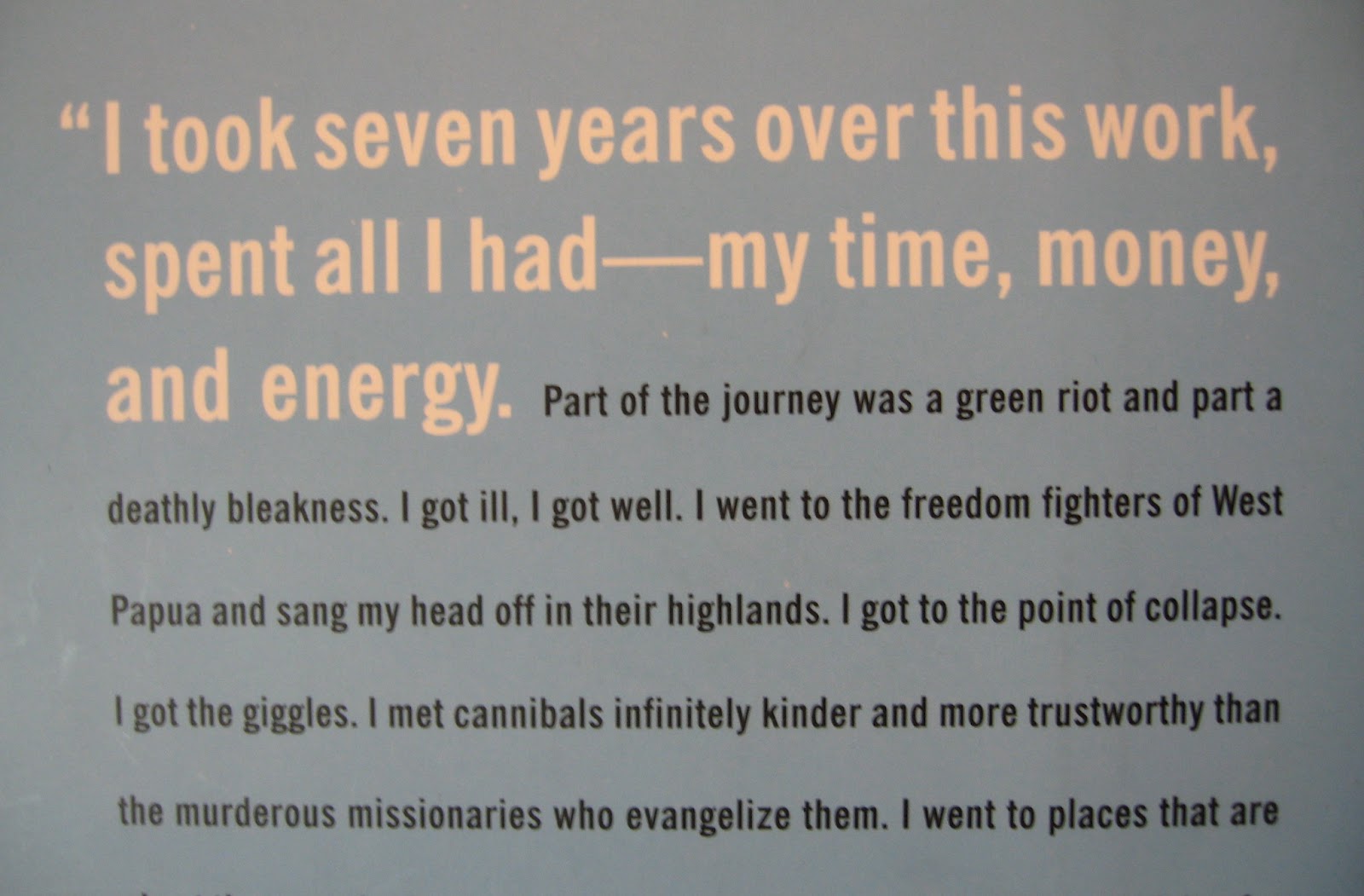
Wild: An Elemental Journey (2006, and already out of print) is of the author's travels to hidden, dark and forbidding corners of the world in search of "wildness", that untamed existence known in remote and unforgiving terrain where the elements - eath, air, water, fire, air and she adds mind - are in control and rule. Jay Griffiths exhausts seven year in her journey to discover the wild roots of the earth and challenge God and Culture, which she equates as being the same, to speak out against missionaries who are God-followers and therefore Culture lovers. This premise threading throughout her book states that God is a god of rules and control and order and therefore God is the anti-thesis of Nature, a place of wildness without law or order or control, a place therefore of freedom.

While in the Amazon, she explores the meaning of "wildness" and she glories, or perhaps exalts, in discovery the wildness of the untilled, the untamed, the self-willed.

"Terra viridis incognita" - the green unknown land - was the way Europeans first saw this forest wilderness. American wilderness author Roderick Frazier Nash writes of the etymology of the word wilderness from the prefix wild and the Old English deor (animal) - thus wild-deor-ness meant the place of wild beasts. There is an echo in the Amazon as people speak of monte real - primary forest where people go to hunt or, indeed, where people are scared because they fear the wild beasts.

But what of the wild part of the word wilderness? This is to me the most interesting. Nash writes, "In the early Teutonic and Norse languages, from which the English word in large part developed, the root seems to have been 'will' with a descriptive meaning of self-willed, willful, or uncontollable. From 'willed' came the adjective 'wild' usedto convey the idea of being lost, unruly, disordered, or confused." And so you could say, a wilderness is a self-willed land - easily my favorite definition. What is wild is not tilled. Self-willed land does what it likes, untilled, untold, while tilled land is told what to do. (p41)
Her "wild" experiences in Nature included writing her notes by the light of a firefly silk threaded to her pen, anchoring a boat to an iceberg where polar bears slept, eating witchetty grubs and visiting sea gypsies. She treks past a woman in the highlands of Papua New Guinea whose breasts were hanging out of holes in her t-sirt, but who was suitably and modestly dressed as her back was properly covered. She learns of Inuit beliefs in regard to the Northern Lights, that the ancestors are playing ball with a walrus skull. The Northern Lights are also thought to be children not yet born, or the souls of the dead wishing to come back to earth as they softly whistle to the living in hopes of being whistled in response to draw nearer. She explores the cultures of the people and the language used to "control" or at least disempower them. One of many examples is the mighty mountain, Chomolungma, which according to Tibetans is "Mother Goddess of the World", to Nepalese as Sagarmatha, or "Goddess of the Sky", to the sherpahs, Tseringa or " Mother of Long Life", but to the western world the female diety has been stripped and the mountain is renamed in commemoration of a male functionary, George Everest, the surveyor-general of India.

Her writing bespeaks of a yearning to be at one with Nature, to be enveloped in its wildness and make that wildness a part of herself. At times I wonder at her link with sanity, and she says at times she explores the perimeter of sanity and at other times, even beyond.

In the Amazon in the town where the air was fetid and "unhealthy as a fly trap" and where tourists took transport to fly on to Cuzco, Jay met some Harakmbut men who were driving up to an altiplano and trekking through the jungle. Fevered and eating coca to stay sane, she urged her body to go with them and experience the "wildness". And once inside the jungle, the wildness and desperation within herself was released and she journals on the jungle - "Here, the two seasons (spring and fall) are not separate times of the year but are verbs that take place concurrently, to spring and to fall. A sapling springs up and a mossy log falls, nudging another inch nearer earth. A glittering jewel of flourescent green is so new, sprung up brilliant overnight, while the forest itself is so old ..."