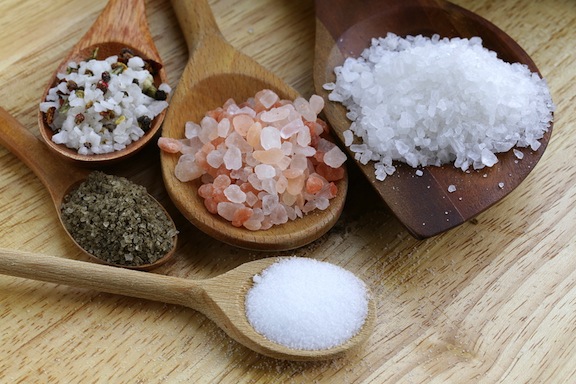
This article taken from Guide to Salt Varieties by VegKitchen: Salt comes in all colors, shapes and sizes; as well as pure white, salt may be pink, grey, black or green. Salt truly is a rainbow-hued rock. Here’s a guide to many of the salt varieties available.
Fleur de sel
What is it? Fleur de sel, the “flower of the salt,” is the name used for salt that has been raked by hand from salt ponds surrounding certain villages in France, predominately those around Brittany, on the Atlantic coast, and in the Camargue, on the Mediterranean.
It is harvested from May to September, when artisan paludiers patiently wait as the shallow pools of water in the salt ponds evaporate, creating the prized salt crystals. It is a delicate art: excessive movement will cause the “flower” to sink to the bottom, so salt can only be collected when the weather is warm and winds are light. The ponds are the same ones where the coarser sel gris is harvested, but for every 40 kilograms of sel gris produced, only around 1½ kilograms of fleur de sel is harvested. Each day a new layer of salt rises to the top of the pond, crystallizing in delicate flakes that are scooped up by the paludier using a wide, flat board on the end of a long pole. Each day’s harvest comprises one batch of fleur de sel.
Properties: The salt itself is white, although it can acquire a pinkish hue, and has long been prized by chefs and gourmets for its high quality.
Uses: Light, flaky, and with a pure, slightly mineral taste, fleur de sel is perfect for finishing dishes, either in the kitchen or at the table.
Sea Salt
What is it? Sea salt is the generic term for unrefined or minimally refined salt, usually containing many of the trace minerals found in sea water as it has been naturally evaporated from a living ocean, sea or bay. Some of the more common sources for sea salt are the North Sea, the Mediterranean Sea and the Atlantic Ocean, particularly in France on the coast of Brittany, although sea salt can be made from the waters of any ocean, large or small.
Properties: Sea salt is typically unrefined, so the minerals it contains may include iron, calcium, magnesium, potassium, manganese, zinc and iodine. These contribute to its bright, pure, clean flavor, which many consider carries the tang of the ocean.
Uses: Less delicate —and less expensive—than fleur de sel, sea salt is perhaps the ideal general-purpose salt, suitable for nearly all uses in the kitchen, particularly if you keep both a coarse and a fine-grained variety on hand. Suitable for both seasoning and finishing at the table.
Rock Salt
What is it? The term rock salt applies to any salt that has been mined from salt deposits on or under the ground. This definition may also apply to salt which has been extracted from underground deposits by dissolving it in water, pumping the brine to the surface and then precipitating the liquid back into salt.
Properties: Rock salt comes in a variety of sizes and is generally very cheap.
Uses: As it is cheap, it can be used for anything that requires salt in large quantities, such as baking anything in a bed of salt.
Table Salt
What is it? Table salt is highly refined salt—usually between 95% and 99% pure sodium chloride—which has been created to a uniform size by mechanical evaporators. It is often iodized, and usually contains an anti-caking agent to allow it to flow freely.
Uses: For much of the twentieth century, most homes had iodized table salt in their kitchen and nothing else. There remains a place for iodized table salt, mainly where it will not be used directly on food—the salting of cooking water, for example—or in baking, where its uniform size makes for accurate measuring (although a fine sea salt is preferable). The strong, sharp taste of table salt means that, given the wealth of alternatives, it should never be used at the table or as a finishing salt.
Grey Salt
What is it? Sel gris, grey salt, usually refers to the grey French sea salt that is hand harvested with wooden rakes in the traditional method. A moist, unrefined sea salt produced along most coastal areas of France, it is typified by a light grey, slightly purple tinge, which comes from the clay found in the salt flats.
Properties: Because it comes from France, sel gris is a little more expensive than local salt, but it is still an ideal all-purpose salt. It is unrefined, so it contains a range of minerals, and the evaporation process leaves it slightly moist, meaning it can be easily handled with your fingers. Learning to judge the amount of salt you are adding by how it feels is an essential skill in cooking, one that professional chefs learn early in their training.
Uses: For maximum flavor, sprinkle this salt by hand over foods just before serving to draw out the full flavors of the other ingredients. This is a natural compliment to fresh salads and vegetable dishes. An excellent all-round seasoning.
*A cheaper alternative to sel gris is Korean grey salt, which is available at many Asian supermarkets. It is similar in texture, color, and taste, though it will generally be drier than sel gris.
Pink Salt
What is it? Of all the colors that salt comes in, pink is definitely the most popular. Or at least the most common.
The color comes either from the minerals that are bound in with the salt crystals, or from a salt-loving bacteria that produces a red carotenoid pigment, providing a valuable source of beta-carotene. Pink salts come most frequently from inland areas, where deposits have been left by the evaporation of prehistoric seas.
Himalayan pink salt, Peruvian pink salt and Australia’s Murray River pink salt are perhaps the three most popular varieties.
Himalayan and the Peruvian salts are mined from pure salt deposits that lie high in the mountains, and they both possess the rich, mineral flavor that is common to pink salt.
Properties: Because they are mined rather than evaporated, the crystals are substantial, and contribute a definite ‘crunch’ to dishes on which they are used.
Uses: This is a gentle salt with a subtle, crunchy texture. Try with barbecued or highly-spiced food.
Murray River pink salt is sourced from an underground aquifer near Mildura, Victoria, which is pumped to the surface through the mineral-rich soil, absorbing nutrients as it goes. The brine is evaporated first by the sun, then mechanically, producing a uniform flake salt that is now used by chefs around the world.
Uses: Murray River pink salt has a mild flavor without harshness. Justin North, of Becasse, favors the salt for its “beautifully balanced clean finish” and its “delicate crunch.” Good with vegetables such as mushrooms and potatoes.
Red, Black and Blue Salt
As we have seen, salt comes in most colors of the rainbow, and from all corners of the globe. Because pure salt is pure white or even translucent, the colors they gain are from natural elements incorporated into the salt crystals as they are produced.
Hawaiian ‘Alaea salt is almost red; these salts take their name from the iron oxide-rich red volcanic clay, called ‘Alaea, which gives them color.
Properties: Harvested on the Hawaiian island of Kauai, which is their only source, these are claimed to have the highest concentration of trace minerals and elements of all salt.
Uses: Authentic ‘Alaea red clay will cause a fizzing reaction when added to a liquid, and imparts a subtle, mellow flavor to the salt. However, because clay and salt will separate in water, ‘Alaea salt should be mainly used as a finishing salt.
Persian Blue salt harvested from Iran, is a natural rock salt that is mineral rich with a hint of sweetness. It is dotted with blue crystals which are in fact salt crystals that have been highly compressed, causing them to turn blue.
Kala Namak, also known as black salt or sanchal, is an unrefined volcanic table salt with a strong sulphuric flavor. Despite its name, kala namak, which is mined in Central India, is actually light pink in color when ground.
Properties and Uses: It is rich in minerals and most often used to flavor Indian dishes like chaats, and vegetable and fruit salads.
Smoked Salt
What is it? The effects of smoke on salt are quite remarkable: the smoke clings to the surface of the salt crystals, coating them with a rich, woody color and imparting a strong, smoky flavor. And when the salt dissolves, that flavor goes straight into the food.
People have been smoking their salt since at least the time of the Vikings, who produced salt by evaporating seawater in a big vessel over an open, smoky fire containing juniper, cherry, elm, beech and oak woods.
In modern times, the salt is often produced first, then subsequently smoked.
Uses: Both Maldon from England and Halen Môn in Wales produce a salt that has been smoked over oak wood. The type of wood used has a distinct effect on the flavor: salt smoked over chardonnay oak wine barrels, for example, will achieve a gentle smoke flavor with a savory hint of wine.
Similar in concept to smoked salt is jook yeom, a Korean salt made by roasting sea salt in bamboo cylinders plugged with yellow mud. The salt absorbs minerals from the bamboo and mud, which in turn leach the salt of impurities. Many Koreans use bamboo salt for its nutritional value and as an aid for indigestion.
Flavored Salt
There are many flavored salts on the market now, but the best ones to buy are those that you would be unable to make yourself.
Truffle salt – The black truffle is one of the most sought-after foods in the world; it is also one of the most expensive. An ideal way to add the taste of black truffle to food is to add it to salt, which is an ideal medium for carrying both the strong aroma and the delicate flavor of the truffle.
Properties: Perhaps the best of these is Tetsuya’s Truffle salt – a delicate and aromatic blend of ground black truffle and sea salt, sourced from Italy, which brings the unique aroma of truffle to everyday dishes, turning them into something exotic and exciting.
Vanilla salt is also very useful to have in the cupboard: you will be surprised how many things it will enliven, from fruit to seafood. And many salt companies sell prepared combinations of salt, herbs and spices to use as the basis of rubs and marinades. Just be aware that, unlike ordinary salt, these flavored salts will not last forever, so buy them in quantities you know that you will use.
The Himalayan Salt Block
Cut from slabs of solid crystal salt, the Himalayan salt block is an innovative way to add salt to the cooking (or curing) process. The salt block may be chilled to freezing point or heated up to 32 degrees F (230˚C), making it ideal for serving a range of hot or cold foods.
Properties: The blocks are carved from slabs of pure salt that is estimated to be up to 250 million years old. They look a little like pink marble, but one touch with the tongue confirms that they are indeed made of salt.
Uses: They can be used as serving platters, to cure food and to cook it—and not just savory dishes: a chilled block can be used for tempering chocolate, setting caramel, or even for creating a dramatic fruit flambé to present at the table.
Tips: Although salt blocks will sustain temperatures from –18˚C to over 450˚C, it is best to reserve one block for each purpose. Those that have been subject to heat will change their appearance as a result, becoming more tempered and less suitable for presentation. The salt block must also be heated SLOWLY. This can be done in the oven or on the stove top, but care should be taken to avoid it touching electric elements. The salt block should also be carried very carefully when hot, particularly if it has developed any cracks.
__________________________________________________________________________
__________________________________________________________________________
Choosing Salt for Recipes
edited by Ruth Reichl
1056 pages -- following info from page 54
Table salt, kosher salt, and rock salt all come from salt mines, whereas sea salt is obtained by evaporating seawater. Some manufacturers add iodine to salt, for nutritional reasons, as well as free-flowing agents to prevent the crystals from clumping together.
TABLE SALT has small crystals. When iodine has been added, it's called iodized salt. In our recipes, when we call for just "salt", we mean table salt.
KOSHER SALT is preferred by many chefs because it's easy to grab when making a dish and doesn't dissolve on the fingers. It may or may not have additives, depending on the brand. When applied to salt, the word "kosher" doesn't mean kosher in the usual sense of conforming to Jewish dietary laws. (All salt, coarse or fine, is considered pareve -- neither animal nor diary). Rather, it means that the salt is a coarseness suitable for koshering meat and poultry. (One part of the koshering process is salting the meat to remove as much blood as possible. If the salt is too fine, it dissolves on the surface; if it is too coarse, the flakes or pellets won't draw out enough blood.)
ROCK SALT usually found in hardware stores and used for melting snow, is very coarse grayish salt. Because it isn't manufactured under the same standards as table, kosher and sea salts, it isn't FDA-approved for culinary use.
SEA SALT, available in coarse or fine crystals, comes from seawater that has been allowed to evaporate naturally. Depending on the brand, iodine and free-flowing agents may have been added. Most of the sea salt sold in the United States is imported. The most famous kind is from France's Brittany region. According to Mark Kurlansky, the author of
Salt: A World History, Brittany's
sel gris acquires its distinctive color when salt crystals sink to the gray earth at the bottom of the salt ponds.
Fleur de sel is not
sel gris washed white; it's lightweight crystals that float to the ponds' surface and are skimmed off. Other sea salts include Maldon, harvested in England since the Middle Ages; Anglesey from Wales; Sicilian salt from the huge salt flats at Trapani; Korean salt, which is roasted in bamboo cylinders; pink Hawaiian salt harvested from clay salt pools; and black Hawaiian salt from lava-lined pools.
Sea salt can add not just flavor but a spike crunch to food, so it is best used as a garnish or condiment. Big, almost shardlike crystals of Maldon salt are delicious, for example, sprinkled on a tomato sandwish or a grilled fish. If you do want to cook with sea salt (for some reason, greens seem especially delicious when cooked with fleur de sel), be aware that you can't substitute measure for measure (particularly in baking) if a recipe calls for table or kosher salt, so err on the cautious side.
 In The Jungle Effect: The Healthiest Diets from around the World--Why They Work and How to Make Them Work for You (2008), Daphne Miller, MD, seeks to explore the traditional diets of some of her patients whose ethnic heritages haven't been generations of American-born and raised. When various patients from ethnic backgrounds outside of the United States were having health complications that people of their own heritage rarely had, Dr. Miller sought to question the "new" diet and look at the differences between the SAD (Standard American Diet) that seemed to be causing the health issues and the patients' native heritage diet. Following are a collection of anthropological discoveries she made in her search to form better diets for her patients: