Showing posts with label Africa. Show all posts

Sunday, September 29, 2019

The Jungle Effect: Notes on Indigenous Diets

In The Jungle Effect: The Healthiest Diets from around the World--Why They Work and How to Make Them Work for You (2008), Daphne Miller, MD, seeks to explore the traditional diets of some of her patients whose ethnic heritages haven't been generations of American-born and raised. When various patients from ethnic backgrounds outside of the United States were having health complications that people of their own heritage rarely had, Dr. Miller sought to question the "new" diet and look at the differences between the SAD (Standard American Diet) that seemed to be causing the health issues and the patients' native heritage diet. Following are a collection of anthropological discoveries she made in her search to form better diets for her patients:

  • Research has shown the 80% of medical problems involving heart disease, stroke and type 2 diabetes and 40% of cancer cases could be avoided by following a healthy diet, exercising regularly, and avoiding tobacco.
  • San Francisco bay area is a hot spot for breast cancer.
  • "Nixtamilization" is a process used to treat maize in Central and South America. To prepare corn for consumption, corn is boiled in an alkali solution of lime and water which removes the tough outer layer of the kernels, and which also enriches the corn with essential nutrients like calcium, niacin, and certain amino acids. Without nixtamilization, Mesoamericans would have suffered from severe vitamin deficiencies, including pellagra (niacin deficiency). 
nixtamilization
  • Table manners and patterns of eating are apparent in almost all cultures, and in countries that practice communal eating, one simply does NOT eat alone. That is, how one eats is extremely important in many cultures. Take Cameroon and Crete, for example. In both cultures one is absolutely expected to eat slowly--a practice that very much improves digestion, and interesting enough, less food is consumed. Also, in Okinawa, the dictum Hara Hachi Bu, or "eat only until you are eight parts full," is a standard reminder not to overeat. In outcome, Okinawans maintain their weight from age 20 to 100, Americans on the other hand typically put on one pound per year after the age of 30.
  • Why are most toddlers disgusted by coffee, but many adults addicted? Because acidic, spicy and bitter foods are acquired tastes.
  • Eskimo tribes (Inuits), until recently, ate whale meat, seal, fish, sea bird and caribou, and despite this indigenous diet comprising about 50% high protein and 30-40% fat, Eskimos eating this diet had some of the lowest rates of heart disease and cancer in the world. Why? Probably because their blood levels showed very high levels of two omega-3 fats: EPA and DHA, fats known to prevent many chronic diseases. Eskimos ate fats from seafood and wild game, which in turn synthesized their omega-3s directly from sea greens and vegetation from the tundra. 
  • Peruvian villagers in Las Palmas in the Amazon eat the cashew fruit but avoid the nut, which is known to cause stomach cramps and nausea after a few hours of ingestion due to urushio, a toxin, in the nut. These Peruvians are amused to learn that Americans consider cashews a luxury food and cook them to make them edible.
  • Thiamine deficient people will have mental confusion and problems walking, but eating a thiamine-rich meal of, for example, whole grains, beans, and lean meat, immediately improves one's sense of well-being.  
  • The practice of adding spices like garlic, onions, chilis, turmeric, and ginger not only aid digestion but also delay food spoilage. Many also have anti-inflammatory qualities. These tangy, spicy additions are acquired tastes. 
  • Many cultures developed fermented and pickled foods which they discovered aided their digestion: Icelandic skyr (yogurt), Greek yogurt, Cameroonian fou fou and millet beer, Korean kimchi, Japanese tempeh and natto, and German sauerkraut. 
various kinds of fermented foods
  • Refining grains involves removing the two most nutritious parts -- the coarse husk and the oily inner germ. These two parts give bread a rough texture and a nutty flavor, but their removal leaves only a white endosperm, a fluffy form of starch with little nutritional value. Even whole-wheat bread (as opposed to whole-grain bread) is a highly refined food as it's made with flour which has retained some husk but no germ. Basically, the flavor is removed and sweetness remains.
  • Lactose intolerance. A good portion of the world's population has some discomfort or difficulty after eating dairy products. This is because their bodies don't produce lactase, the enzyme for digesting the carbohydrate lactose. Blacks, American Indians, and Asians are large ethnic groups commonly known to have difficulties with milk, while northern Europeans, some tribes in East Africa and the Middle East are able to digest lactose into adulthood.
  • The Pima Indians in Arizona have some of the highest rates of type 2 diabetes in the world. Scientists have found that the Pima have a host of gene mutations that may relate to insulin reaction and sugar processing. Ironically, the Pima's cousins, the Tarahumara Indians living several hundred miles south in Sonora and Chihuahua, have a low rate of diabetes.
  • 35% of Hawaiians are considered to be morbidly obese with similar numbers suffering from diabetes type 2 and heart disease. Middle-aged Hawaiians 100 years ago had the bodies of 20-year-olds, so what happened? The traditional diets of taro, breadfruit, fern shoots, purple yams, kukui nuts, fish, and free-range chickens are now only available at expensive prices in supermarkets for tourists while the foods of modern convenience are the only foods subsidized.
  • Type 2 diabetes in the past 70 years in the US has increased 700% and is now affecting even the younger population. The ethnic groups most dramatically impacted by this change are Latinos, Asian Americans, Native Americans and African Americans. 
  • All carbohydrates are not equal. The traditional carbs (e.g. cheeky yam, black bean seed, bush onion)  eaten by Pacific Islanders and Aboriginals seem to have had a protective effect against diabetes while Western food carbs (russet potatoes, white bread, white pasta, mass-produced corn, and white rice) seem to switch on diabetes.
  • Over 50 species of beans are native to the Americas.
  • Cretans of two generations previous consumed a guesstimated 50 kilos of olive oil per year, and lived to be quite old. A health-challenged Cretan returned to the old ways of stone-pressing olive oil when he realized the pesticides and fertilizers he used were in his precious olive oil and getting in his water supply, He also realized the modern way of processing olive oil of washing with large quantities of water, which, since antioxidants are water soluble, was washing away the most important nutrient. He returned to natural living without fertilizers and started stone-pressing his olive oil again. Health problems resolved.
stone press for making olive oil naturally
  • Depression, second only to heart disease, ranks as the highest health disability worldwide, and in the U.S., 20% of women are likely to experience depression and 12% of men. In Europe, depression rates for people over age 65 are influenced by seasonal affective disorder (SAD, or "winter blues") and by location, that is, Munich, London, Amsterdam, Verona, and Berlin have the highest depression rates, whereas Iceland (with its quite Northern, sunless winter) ironically had the lowest.
  • Icelanders love their fish and consume 225 pounds of fish per year, while Japanese consume the second-most at 147 pounds annually. People in the US consume only 48 pounds. The countries with the lowest per capita fish consumption rate (e.g. West Germany, New Zealand, and the United States) have, perhaps not so surprising, higher depression rates. Icelanders believe that eating high omega-3 fish, depression is greatly reduced. 
  • Lamb is almost as rich in omega-3s as fish.
  • Swiss alpine cheese (from Switzerland) is a dairy product of free-range cows grazing on clover and moss-rich pasturage. The cheese from these cows have milk five times the omega-3 fats and has 20-30% less saturated fat than the standard US cheddar.
  • Colon cancer, next to lung cancer, is the second biggest cancer killer in the US, affecting all ethnicities fairly equally. Western and southern Africa are cancer cold spots; it's suggested that they eat virtually no processed foods, large amounts of omega-3 fish, and their cooking oils are made from simple home-processing. Americans, on the other hand, eat a diet high in refined carbohydrates and meat, both of which promote bacteria in the gut. The traditional western and southern diet contain a diet rich in fiber, probiotics and nutrients, and the people evacuate much more frequently, which in turn eliminates the build-up of toxins more regularly.
  • One of the staple foods of Okinawans is sea vegetables. Like maize in Mexico, potatoes in Iceland, and barley in Crete, sea veggies appear in an array of traditional dishes: raw in salads, pickled as sauces and relishes, dried for a snack or a wrapper for rice, cooked in soups, sweetened in jelly or ice cream. It also appears in traditional herbal medicines, cosmetics, and treatments for asthma to hemorrhoids to stomach ulcers. Studies have showed that the people eating the highest amount of sea veggies were the healthiest in villages.
various kinds of seaweed -- a seaweed salad

Friday, March 9, 2018

8 Modern Advancements the Moors Brought to Europeans

The YouTube clip "When Black Men Ruled the World: THE MOORS" (3:05 minutes) sheds light on a little known fact -- on historically, who really was intellectually superior and developed.

“Moors were commonly viewed as being mostly black or very swarthy, and hence the word is often used for negro,” The Oxford English Dictionary
The Moors established an Empire spanning parts of northern Africa to southern Europe, ruling in Europe for nearly 800 years (711-1492 AD), which is longer than Europeans have been out of the Dark Ages,

In fact, the Moorish advances in mathematics, astronomy, art and agriculture brought Europe out of the Dark Ages and into the Renaissance. 

1 - UNIVERSAL EDUCATION  While Christian Europe had a 99% illiteracy rate, 2 universities and 0 libraries, the Moors had 17 universities in 7 cities along with over 70 libraries. The Moors introduced their education system to Europe, bringing it out of 1,000 years of intellectual gloom.

2 - FASHION AND HYGIENE — The Moor Ziryab pioneered the concept of changing clothes based on seasons. He also created deodorant, daily bathing, and invented toothpaste. He made popular the concepts of shaving, haircuts, and hair washing among men.

3 - CUISINE — Ziryab introduced the concept of the three-course meal, which included the soup, main course and desert. The Moors introduced a number of crops that remain prominent in Spain today.

4 - URBAN UTILITIES — Moorish cities had street lights, hospitals, and running water. Paved and lighted streets did not appear in London or Paris for hundreds of years later. Moors built an aqueduct that brought water from the mountains to the city.

5 - MEDICINE — The “father of modern surgery” was the Moor Al Zahrawi, who developed innovative and precise surgical instruments, as well as the premier textbook of Western medical training.

6 - HUMAN FLIGHT — The Moor Ibn Firnas made the first scientific attempt to fly. Although his flight worked, his landing was unsuccessful.

7 - ADVANCED AGRICULTURAL TECHNIQUES — The Moors introduced Spain to rice, hard wheat, cotton, and more. Along with this came knowledge of crop irrigation and cultivation, building underground grain silos that stored grain for up to 100 years.

8 - PAPER MAKING — Moors introduced paper making to Spain, allowing for accurate preservation and dispersal of knowledge.

Tuesday, February 13, 2018

Great Cat Quotes

In ancient times, cats were worshipped as gods. They have never forgotten this.

Anything on the ground is a toy. Anything not there yet soon will be.

Cats know how to obtain food without labor, shelter without confinement, and love without penalties. 

A house without a cat is  like a kiss without a hug.

Purrs and meows massage the heart.W. L. George


Mama, if you really loved you, you'd let me deep-fry the poodle.

Dogs believe they are human. Cats believe they are God.


Never feed your cat anything that clashes with the carpet.

I got rid of my husband. The cat was allergic.

Never try to out-stubborn a cat.

Cats can work out mathematically the exact place to sit that will cause the most inconvenience.


Cats are emotionally honest. Humans may hide their feelings; cats do not!

Cats have delicate constitutions, but you've never seen one suffer from insomnia.

My boyfriend said it was him or the cat. I miss him sometimes.

Variety is the spice of life. Cats ignore people one day and annoy them the next.

Why isn't there mouse-flavored cat food?


Anyone who considers protocol important has never dealt with a cat.

Cats know how to feel. They don't care, but they know.

What are cat diapers called? PamPurrs.


Dogs eat. Cats dine.

Cats are intended to teach us that not everything in nature has a function.

The cat could be man's best friend ... but would never stoop to it.

Cats care. They wake us up 20 minutes before the alarm goes off so we can get to the office on time.

People that hate cats will come back as mice in their next life.


Scold a cat ... and she will file that away for future reference.

A cat improves the garden wall in sunshine and the hearth in foul weather.

A cat accepts the comforts but rejects the bonds of domesticity.


Cats were put on earth to erase the dogma that all things were created to serve man.

To err is human, to purr is feline.

Cat: a beating heart and an angel's soul covered in fur.

A cat is a puzzle for which there is no solution.


Meow is like aloha. It can mean anything.

Cats are connoisseurs of comfort.

If you want the best seat in the house, you'll have to first remove the cat.


The dog may be wonderful prose, but only the cat is poetry. French proverb

If stretching were wealth, the can would be rich. African proverb

The cat is nature's beauty. French proverb

A person without a cat or dog is a scoundrel. Portuguese proverb


Monday, April 24, 2017

Unbowed: Wangari Maathai (1940 - 2011)

Wangari Muta Maathai, born in Nyeri, Kenya (1940) ultimately became the first woman in East and Central Africa to earn a PhD (1971). She also became the first woman in her region to be a chair of the Department of Veterinarian Anatomy and to be an associate professor (1976). Seeing a political deficit and unmet needs by politicians, she entered politics and became an active member of the National Council of Women of Africa (1976-1987), which was where her idea of empowering women while rehabbing the environment was conceived, the birthchild of The Green Belt Movement. Over the years, she assisted women in planting more than 20 million trees on farms and schools and church compounds, and by 1986 the Movement had become a Pan African Green Belt Network. 

She became internationally recognized for her persistent struggle for democracy, human rights and environmental conservation. On several occasions she addressed the UN on behalf of women. She authored articles, books, served on boards of several organizations, and in 2002 was elected to parliament with an overwhelming 98% of the vote. Subsequently she was appointed by the president as Assistant Minister for Environment, Natural Resources and Wildlife in Kenya's 9th parliament. 

In 2004 the Nobel Peace Prize was awarded to Wangari Maathai "for her contribution to sustainable development, democracy and peace."

Her book Unbowed: A Memoir (2006, 2007) documents some moments that gave her a solid foundation of family and nature and which were fundamental in raising her awareness of a large escalating environmental problem ripping across the environment that had been so untroubled in her youth.

As the story goes, the name of Kenya was named by the explorers Johan Ludwig Krapf and Johannes Rebmann, when they encountered the awe-inspiring 17,000-foot-high mountain known today as Mount Kenya. "What do you call that?" they asked of their guide, and thinking the two were asking about the gourds he had in his hand, the guide answered, "Kii-nyaa", and thus the name of the mountain and the country became known by the colonial name and not the Kikuyus indigenous name of Kirinyaga, or Place of Brightness. Today the country of Kenya still feels the tug of conflict in their development and concept of self caused by the colonial and the indigenous ideas.

Before Wangari went to school, in her area the colonial government decided to establish commercial plantations of non-native trees. She remembers huge bonfires as the native fig trees went up in smoke. By the mid-1940s the British had introduced many exotic tree species to Kenya—pine in the north and eucalyptus and black wattle in the south. These trees grew fast and strong and contributed to the newly emerging timber business, but they eliminated local plants and destroyed the natural ecosystem. While the old trees had pierced deeply into the earth and allowed other trees and shrubs to thrive in their shadows, the new trees eliminated local plants and didn't retain the rainwater. Eventually, rivers and streams either dried up or were greatly reduced.

The native fig trees were strong trees, burrowing deeply into the ground, breaking through rock and into depressions and ultimately hitting water. It was known that wherever a fig grew, water would be found. Communities had great reverence for these trees and they were never used for fire wood. These trees held the soil together, reduced erosion and landslides. These trees brought life-sustaining water. 

In the early 1970s Wangari realized that many ticks were affecting livestock. While gathering ticks from many places and going out in the rural areas, she noticed the people did not have good food but were eating the colonial flours and processed foods and because there was not enough firewood for cooking and preparing food, the crops were in drought because of loss of trees, the cattle were not well watered and certainly not the land. After looking at the people and the environment, she came up with the idea to give women jobs by planting trees, which would bind the soil, retain and collect water, be a home to birds and provided fruit and food for the people. Trees would heal the land and regenerate the vitality of the earth.

And thus began her journey of planting trees ... to foster a strong relationship between people and their land once again.

"I'm doing the best I can."

Wangari Maathai closed her book with a story she heart from a Professor Suji in Japan. One day a massive fire broke out in a forest and the animals, with flames coming closer, fled the forest, all of the animals except one, a tiny hummingbird who said, "I'm going to do something about the fire!" And she flew to the nearest stream and in her tiny beak scooped up a drop of water and flew to the conflagration, dropping her water droplet, and then flying back to the stream. The other animals watched in horror and dismay, "Why are you doing this? You cannot begin to put out the fire!" And the little hummingbird turned briefly to them and said, "I'm doing the best that I can!" 

Wangari Maathai encourages everyone to work towards a better and greener world. She encourages everyone to plant, even if it's just one tree, just one tree at a time.

Friday, September 11, 2015

King Peggy: From Secretary to King

August - September 2008:

Peggielene Bartels, secretary to Ambassador Kwame Bawuah-Edusei and divorcee of a ex-husband she was still in love with, worked virtually from sun-up to sundown as a secretary at the Ghanian embassy. She had no personal life; she dedicated it to her office job at the embassy, making sure that behind the scenes, the embassy was well-oiled and efficient. For 29 years she had worked in administrative positions in Washington DC, meeting African heads of state and US senators and planning glittering parties. Born in Ghana, she had been something of an anomaly, a female with a mouth, spirit and an attitude in the male-dominated society that just didn't fit. And then she got the strange 4 a.m. call, the call that transformed her from mere secretary to king of a city in Ghana ... if she would accept. She thought and thought and the spirits told her to accept. She knew if she did, finally her strong male-like outspoken qualities could be put to use in her home country of Ghana.

She had been raised a Christian, or at least having Christian principles, but she never totally turned her back on the spirits of her homeland for to do so would be disastrous. She poured water for her mother's spirit every night and schnapps every morning for everyone knew that the spirits were always thirsty. In the same way, Peggielene had been "chosen" to be the next king by the pouring of schnapps and the schnapps bubbling over when her name was intoned, thus the spirits informing the elders that Peggielene, the only woman on the list of 25 people suggested to be king, should be the one chosen and crowned.

Peggielene thought about the proposition but didn't readily accept. There were too many big considerations, and the biggest was that Otuam, the city she was to govern, was flat broke, the palace in total disrepair and the infrastructure for water and education almost non-existent. The task would be momentous, not to mention that she couldn't become king until the previous king, who was in refrigeration and incurring daily costs by being there, was properly buried with a big sendoff and that could only be done in the right setting - a totally refurbished palace. Where would she get that kind of money?!

After careful deliberation and the spirits seeming to speak to her constantly about accepting, she did. She flew to Otuam, Ghana and immediately missed her air-conditioned apartment, especially when she discovered that five people would be sharing her simple little hot room, because she was king and her relatives spirits would be needed in the room to protect her. She didn't think a slumber party at her age was fitting, but what could she do? She went to take a shower, and the bucket on the bathroom floor reminded her that there was no running water in Otuam. She bucket bathed.

The next day Peggy went to meet her elders, old, crafty and dishonest ... as she somewhat suspected and soon found out just how sneaky and snaky they were, for whatever money was collected in taxes went into their pockets and whatever money she gave for the restoration of her palace or anything else, never got beyond their pockets. And it was dishonorable to fire them ... they were men, and her elders and had been elders to her uncle the previous king. In time, she learned and on her second visit to Otuam, she began confronting them and voicing her strong opinion. Her favorite roar to a couple of her elders was, "You have elected a man with breasts! Maybe I don't have balls, but for all that, I am a king and I am a man! ... I am going to squeeze your balls so hard your eyes pop out!" But that was later.

On her first visit to Otuam, Peggielene evaluated what must be done to bury the king, prepare the palace for the burial ceremony and for her acceptance and crowning as king, in which her "stool" would be venerated and libations of schnapps poured daily to it. The stool in Ghana is like the metaphysical chair of enthronement. It is a decorated stool of some material that takes on spiritual qualities once a king is crowned, or rather "enstooled". And henceforth, the new king and all the king predecessors would have libations poured to them on the daily basis, and the elder pouring the libations would discuss spiritual matters with the stool ... or perhaps it would be better to say, the stools conveyed spiritual matters to the pourer of the libations and he in turn would pass the matters along to the enstooled king.

As a woman with strong opinions and which had been furthered sharpened in her years in the UK and the US, she had big ideals for her little Otuam village. She intended to end wife-beating, a chronic problem; she planned on getting medical aid for people and a midwifery clinic; the town desperately needed running water, and of course better education was a priority too. Of course getting a decent road to Accra would be needed, and then more people and statement would be inclined to visit. She continually added to the list of "needs" for her Otuam. And as a barren woman who could never have children, thus the reason for her divorce, she now had 7,000 children ... and she intended to take care of them. She might have been useless as a wife who was incapable of bearing children children, but she didn't intend to be useless as king who takes charge over "his" children.

She scrimped and scraped money, confronting dishonest elders to get money; she revised the board of elders to create a more honest arrangement, putting hard-working fishermen and even sharp-meeting women on the board, she suddenly the village started paying attention to her as king, and the money that had previously been given to the elders was now transferred to the proper hands, and thus to the coffers of the town, and so progress could start to be made!

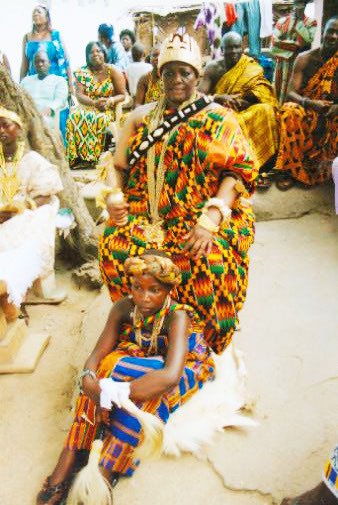
On the day of her "enstoolment" she ate her anti-urinary breakfast of boiled yams, palm oil and hard-boiled eggs (for a king must never be seen doing the basic functions of a man while holding court, which by the way could be every day). And sitting behind the Soul, a young vestal virgin girl whose own spirit would buffer that of the king's, Peggielene became king of Otuam, and finally a king-mother to 7,000.

Coronation day:  King Nana Amuah-Afenyi VI  of the Otuam people, sitting in state with her "soul," Nana Ama, twelve, the little girl whose innocence shields the new king from jealous evil spirits. Source

November 2010 - early 2011 (The book King Peggy: An American Secretary, Her Royal Destiny, and the Inspiring Story of How She Changed an African Village was published in 2012.)

After making wife-beating a punishable crime in Otuam and sinking two wells for public use and arranging for a Baptist school to be opened, King Peggy gained the respect of her people in the down-trodden poor town where the elders stole the town's tax money and spent it for themselves. Since becoming king, Peggy has been saving fishing fess and land sales to build a public latrine and create a library with Internet access for Otuam's kids. Nearby towns and city of Accra recognizes that King Peggy is building Otuam into a modern city and connecting roads are being repaired, resulting in investments in the town and the opening of shops, gas stations and other conveniences.

In October 2011, Pastor Colleton and members of Shiloh Baptist Church traveled once again to Otuam to submit a letter of intent for building a high school and meet with parents and kids to decide on scholarship awards and register them for scholarship programs. Furthermore, King Peggy and Pastor Colleton visited hospitals in Accra to determine the equipment and training needed for Otuam's nurses in order to open a medical center. Ambulances were also looked at for purchase.

The demands of Otuam are great and the income is small. All charitable efforts for the development of Otuam are to be directed through the Shiloh Baptist Church (on Facebook). Meanwhile, King Peggy continues her work as a secretary back at the Ghanian embassy in Washington DC. She is proud of her career, and the income, especially as being a king requires more income than her town at present can generate ... and she has such big goals for her town ... and so she continues to work for her 7,000 children.


Thursday, January 15, 2015

Monster: An Autobiography of an L.A. Gang Member

Kody Scott, born in 1963 and raised in South Central Los Angeles, was initiated as Crip at the age of 11. Before his teen years were gone, he had risen in Crip ranks to the status of Ghetto Star (ghetto celebrity). When he was 13, while robbing a man he was accidentally hit in the face by the victim. When the man was on the flee, he tripped and was then pinned in place while Kody in retaliation pounded and stomped him, then abandoned his disfigured body in an alley. The man was taken to a hospital where Kody last heard he had fallen into a coma. The police told bystanders that the person responsible for this was a "monster", and the name stuck. All Crips and all Bloods received some kind of nickname and 'Kody', already being a cool name, was then prefaced by Monster and was soon the moniker replacement for Kody.

published in 1993
When Monster was just joining the Crips, the war on the L.A. streets had only been going on about nine years, and was waged between the Crips and the Bloods. But as the nation of the Crips was growing, soon Crips were not just 75 or so in a set, but would later be a thousand deep. There were many sets, and sets in turns were broken down by streets, so literally there developed a Crip street gang on every street, and the Crip friends that Monster hung out with in his very early years as a gangster later became his mortal enemies as Crips started fighting other Crip gangs, rather than just ganging up on the Bloods. Initially the worst enemies were Crip and Blood sets, but by the late 1980s Crips were the number-one killers of Crips. In fact, as Monster Kody Scott writes his autobiography, he later states that in a 12-year period (1980-1993 approximately - he published his book in 1993) more Crips were killed in that time than Crips killed by Bloods in the entire 22 years of the war (1971?-1993).

By the time Monster was 15, he had already killed several, bashed in several and overall made quite a name for himself. Then in a drunken state, he smashed up 15 cars before he was captured and charged with assault and grand theft, receiving 9 months in camp. He had already been to the Hall, now he was going to be sent to the Camp, a tougher place to survive. Youth Authority, the next level for incarcerating adolescents under 18, would be next, followed by prison ... each sentence become longer and with harder convictions. Then of course there are many types of prison, L.A. country jail, Folsom prison, Chino state prison (with its Deep Seg or Deep Segregation unit), San Quentin, (100 years older than Chino and having double- and triple-max units). Monster experienced them all. Monster deserved them all. He makes no apologies. Monster simply states that once you're a Crip, you have to give attention to the 'hood, avenging disrespect from other gangs (or even within gang), protecting your family and protecting yourself. And that was why you joined a gang, to protect yourself. It seemed that every time he got out of youth camp or later prison, he would have a "strap", a gun, and would go out on a shooting spree before being home a full day. He had a name to keep up in the early days, and he had to give paybacks as a good and well-connected Crip should.

However, when he was 30 and in Chino, he started realizing that Crip on Crip and killing Crip was going nowhere. He met someone from the CCO, the Consolidated Crip Organization, which had a 'constitution', and the fundamental beliefs in respecting one's self (not calling one's self a nigga, not dissing one's family especially one's mother or sister, developing language of respect, and becoming educated to think logically for one's self and to make goals for one's self and the Crips as a whole).  The Constitution was new and it held promises to questions Monster had about where the Crips were taking the war -- basically, nowhere but the grave. He joined and then worked on creating a unified goal for the Crips, not to fight against one another but for a united cause.

In 1987 the Consolidated Crip Organization was disbanded. It was going nowhere except creating new faces to an old war. By this time Monster threw his lot in totally with the New Afkrikan Independence Movement. Even before going to San Quentin maximum security prison he had learned about the new movement but it was at San Quentin where he joined and was given his new name, Sanyika Shakur.

Sanyika Shakur was paroled in 1988, got his first job and tried to become a family man with a goal and to live more peaceably on the streets. When he got out of prison after being in for 4 1/2 years, he returned to mother's home and was appalled at the burnt down buildings around, the squallor, the homeless, and graffiti street gangs painted but he could no longer interpret as new gangs had been created since he had been imprisoned. This shock at his former reality confirmed that change was needed in his 'hood and that he could lead some members of his 'hood to leave their Crip-killing-gangs and realign themselves as New Afrikans revolutionaries with a purpose like himself.

Sanyika tried to live a more moral life, one showing respect for himself and also as a role model for his family. However, in 1991 he was captured by L.A.P.D. for assault and grand theft auto, charges that "stemmed from a healthy beating [he] had given a crack dealer who had refused to stop selling his product on [Sanyika's] corner." Sanyika then confiscated the dealer's van which, along with the beating, earned Sanyika another seven years in a maximum security prison. Sanyikda doesn't apologize, he has no regrets, but says "When the police and other government agencies don't seem to care about what is going on in our communities, then those of us who live in them must take responsibility for their protection and management."

___________________________________________

I found this book brutal but eye-opening as to the motivation of street gangs. It is one thing to sit in my white middle-class comfort and judge behavior as being morally right or morally wrong based on my genteel lifestyle and surroundings and totally another to see what is maybe not morally right but justifiably right when in a different context. As Sanyika Shakur states near the end of his autobiography, his early days in the Crips was without any real purpose except to belong to something big and tough and earn a reputation, but ultimately he realized there was no real purpose for all the killings, especially when the war became less Crip-on-Blood and more Crip-on-Crip. In his youth he didn't realize there was no real goal for the Crips in the killings. He didn't recognize the killings he and his tribe accomplished was just feeding an insatiably thirsty circle of action of purposeless killing.

The insights shared by Sanyika Shakur on the structure of the gang, the tribalism attitudes and shared street slang and signs connoting membership, and the code of conduct which was very strict are well documented. Living proximal to or condoning such a brutal live-or-die lifestyle alters a person. This is not my reality, but I am glad for Sanyika's insights to the reality of the New Afrikans and the people in the inner L.A. poverty zones so, as an educator and as an anthropologist, I can be more understanding of the educational and social needs I can endeavor to meet in my classroom. Being aware of the educational challenges caused by the social environment gives me a better understanding of how to potentially develop ways / a program / tools to assist youth in their learning process.

In fact, I think that educators, educational counselors, psychologists, anthropologists and sociologists should have this book on their reading list. The book gives a detailed psychological study of an L.A. gang member and discusses points of race, status, economics, prejudices, law interpretation ... While I am in no way connected or even familiar with gangs, I felt this book doesn't justify gangs but explains the motivations to belong to one and perform as a gang member. A very insightful book that made me less judgmental of brutal street behavior but more knowledgeable about why that brutality exists and in what form and by whom, almost always for a gang-viewed "logical" reason.

Thursday, May 30, 2013

Foreign Food Mart, an International Experience

International Grocery Store Project: Foreign Food Mart

(identifying 5 import items and giving a historical background in addition to dietary needs/interests, religious interests, import/export standards, etc)
 

             Foreign Food Mart in Itaewon, the area in Seoul historically known for foreign housing and foreign food restaurants catering to the foreign residences, is my favorite place to shop. For my interests, it offers a wide variety of beans, legumes, spices, as well as a few fresh vegetables and fresh herbs that just can’t be found on the Korean market. As a gluten-free near vegan, here I can find quite the food variety to extend my diet, but even if I’m not extending the diet, I’m very curious to know what’s new on the shelf, especially as the shop, which opened in 2006, has expanded several times. The store most recently expanded around New Year’s, at which time they added another 30-40% floor space, and the imports now appearing on the shelves are getting even more interesting.


One of my old standby purchases is Rotary® Onion Crackers, a product of Indonesia. Its four ingredients are incredibly simple—tapioca flour, garlic, salt and coconut oil. The product carries the seal of Majelis Ulama Indonesia which has halal in both English and Arabic at its center. Majelis Ulama Indonesia was established in 1975 and is Indonesia’s top Muslim clerical body for producing fatwā, the giving of legal judgment according to Islamic law, and for advising the Muslim community on contemporary issues. With the Indonesian Ulema Council’s seal, this product is approved for religious dietary consumption by the 1.62 billion global Muslims, that is, 23% of the world’s population and with the largest population living in the country of the products manufacture. As the entire simple packaging is written in English with the exception of the dual-lingual ingredients and the seal itself, this product targets English speaking countries. It also meets USA market standards with a clearly labeled product, the ingredients easy to read, the manufacturer’s name, address and contact provided, and the nutrition facts label present. Although this product will attract the eyes of Muslims in foreign countries, it by its simplicity and a cracker with a flavor, onion, well-liked by Americans, will be well received in the US or by people with savory proclivities, and particularly so by the more health conscience label readers and those wishing to be gluten-free, not an issue in a country where gluten crops aren’t grown and so the need for gluten-free labeling isn’t regarded as necessary or economically gainful yet.


            Crown Farms Vegetable Samosa is a product I’ve tried in the past, and is indeed very tasty and very spicy, as are most foods associated with Bangladesh, where it is manufactured. Eurasia Food Processing in Bangladesh manufactures the product but Euro Foods Group of England imports and distributes it, by all accounts for reasons of providing exotic food items to the more northern United Kingdom and also for boosting the growing Bangladeshi economy. This is definitely an export item, and not for sale in Bangladesh as the only Arabic word on the box is halal. The product is marketed toward Muslims or, more specifically, people in English, French or Italian speaking countries, as the ingredient list and preparation instructions are in those languages. The ingredients are whole foods with the filling containing mixed vegetables, salt, sugar, spices (onion, garlic, ginger, cumin powder, coriander powder, turmeric powder), vegetable oil and water, and the pastry is a composition of wheat flour, water, vegetable oil and salt. I couldn’t find evidence of this product being sold in the US which makes sense as, according to the FDA, all ingredients must be labeled in their descending order as based on weight, and this product doesn’t seem in compliance with that regulation, e.g. salt couldn’t possibly be the ingredient second in weight; the product would be sodium saturated and would far exceed the labeled sodium amount of less than 2,600 mg per serving, the single samosa. As for what the Food Standards Agency (FSA) of the UK requires on their labels, I wasn’t able to locate specifics but a FSA website did state that Scotland, Wales and Northern Ireland had different standards than England. In any regard, samosas, a name of Persian origin, have become widespread across the southern regions of Asia, the Arabian Peninsula, the Mediterranean, and in various parts of Africa, not to mention the large ethnic groups who have migrated from these countries or the many people previously exposed to these countries. Samosas have great global popularity and their popularity is further growing, putting this product as high on the well-to-be-received list in a number of countries.
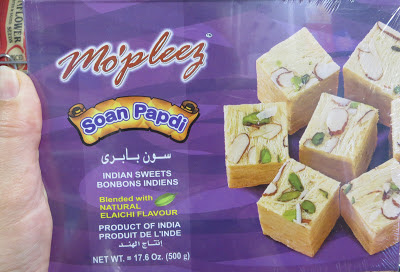


            One item in the mart that reminds me somewhat of baklava is Mo’pleez Soan Papdi, a product of India where it is a traditional dessert. Unlike Greek and Turkish baklava with the main ingredients being honey and/or sugar, wheat flour, cloves, cinnamon, frequently walnuts and typically phyllo, soan papdi typically contains sugar, gram flour, perhaps wheat flour, ghee, cardamom and often pistachios. Influences between the desserts may exist, but obvious regionalism from accessible ingredients influence the overall products. Although soan papdi also is a dessert, it is more savory than baklava. This particular soan papdi is packaged in three languages (English, Arabic and French) and is apparently for export. The packaging cites the ingredients sugar, refined peanut oil, chick pea flour, wheat flour, cardamom, almonds, pistachios and gluten. No preservatives or additives are included in this label, and by including the batch number, manufacturing date and expiration date, there seems careful concern in ensuring a quality product to a discriminating market. Though India homes the third largest population of Muslims in the world, no halal label is present on the packaging which perhaps unwittingly marginalizes the 177,291 Indian Muslims, or perhaps the target group, if the product is to be sold within country, is the vegetarian, the group (actually the majority of India) which traces its history back to 500 BC when India saw a rise in Buddhism and Jainism, the religions that practices ahimsa or “non-violence”. This product bears the symbol for “vegetarian”, a word only in existence since about 1847 and which was derived from the Latin vegetari, meaning “to enliven”; it was coined by Brits in reference to Britain’s colonial Indian vassals. Two other symbols include a recycling awareness, a larger concern in Western societies than in India, and a European Snack Association symbol, which is an organization that promotes savory snacks to the UK. Commerce between the England and India, England’s former colony, is expected to double by 2015, and this product will likely be included in promoting the trade connection.

             Lemnos Mediterranean Lifestyle Sun-dried Tomatoes were in refrigeration and were a product of, surprisingly, Australia. The concept of the Lemnos brand was conceived on an island in the Aegean Sea and now manufactures “premium quality Mediterranean style cheeses and dairy products” to about 40 countries. It even declares itself the number one dairy company in the world, and holds certifications for halal, Hazard Analysis and Critical Control Point (HACCP), Safe Quality Food (SQF), Dairy Safe, and organic. This particular product has no dairy which seems to be the focus of the brand, but the two kilogram pail is marketed towards the Muslim community within Australia and worldwide by its English and Arabic label of halal. No claims to this product being organic exist, nor does it seem to be aimed for the US market as measurements are limited to kilograms, unlike the onion crackers, samosas, and soan papdi already discussed. However, there is awareness of a growing population with gluten allergies, and included in the nutrition facts label is a label for gluten, a listing that is not typically seen and certainly not required on such labels. Certainly the FDA does not require it.
 

            The item at the Foreign Food Mart which most surprised me was the Tropiway™ Plantain Fufu Flour. Fufu flour is an African food, and yes, of late there is a very mixed African population in Korea, so there is a market here. Yet, this product is out of place. First of all, this mart seems to cater to Indians, Middle-Easterners of which the owner is one being from Bangladesh, to Thai, Filipinos, Vietnamese, among others, which include the very large and diverse English speaking expats in education and business. This item is the only identifiable African food in the mart; however, it’s only African by name when, in fact, it is an American manufacture. As Sudanese political refugees relocating to the US stated concerning the American packaged and processed food they encountered on the flight, “American food is not food”. They were used to whole and unprocessed foods, not highly processed pseudo-foods with flavor enhancers and chemical attributes. This fufu flour lists on its ingredients—plaintain, granular potato, cassava, mono and diglycerides, BHT (to protect flavor), sulphites (as preservatives), FD&C yellow #5. This list of non-food items might be accepted by Americans used to such ingredients, but why would this item be in this store? And, it must be asked, who would the market even be back in South Carolina where the 28.1% black population seems to be black Americans, not African Americans craving food memories from their mother country?

Bibliography

Compare Infobase Ltd. 24 Dec 2012. Top ten countries with largest Muslim population. Maps of the World. Retrieved from http://www.mapsofworld.com/world-top-ten/world-top-ten-countries-with-largest-muslim-populations-map.html.

Eurofoods Group Blog. 13 Jan 2011. Bangladesh: The new frontier in Eurofoods Group Blog. Retrieved from http://eurofoods.wordpress.com/2011/01/13/bangladesh-the-new-frontier/.

European Snacks Association. 2004. European Snacks Association. Retrieved from http://www.esa.org.uk/europe_statistics.php.

Food Standards Agency. 20 Dec 2005. Imports and food labeling. Food Standards Agency. Retrieved from http://www.food.gov.uk/business-industry/imports/importers/labelling.

IndiaChild. 2000. Vegetarianism in India. Retrieved from http://www.indianchild.com/vegetarianism_in_india.htm.

Lemnos. N.d. The lemnos story. Retrieved from http://www.lemnosfoods.com/the-lemnos-story/.

National Geographic. N.d God grew tired of us: Cultural differences. http://video.nationalgeographic.com/video/movies/god-grew-tired/cultural-differences-ggtu/.

Price, Rabbi Gavriel. 2013. Food ingredients labels: A primer on regulations. Kashrut.com. Retrieved from http://www.kashrut.com/articles/LabelingLaw/.

PTI. 21 Feb 2013. Trade volume between UK, India set to double by 2015. Zee News Limited. Retrieved from http://zeenews.india.com/business/news/economy/trade-volume-between-uk-india-set-to-double-by-2015_70694.html.

US Census Bureau. 2011. South Carolina in State & County Quick Facts. US Department of Commerce. Retrieved from http://quickfacts.census.gov/qfd/states/45000.html.

US Food and Drug Administration. 30 Apr 2009. Inspections, Compliance, Enforcement, and Criminal Investigations. US Department of Health & Human Services. Retrieved from http://www.fda.gov/ICECI/Inspections/InspectionGuides/ucm074948.htm.

US Food and Drug Administration. 1 Mar 2013. General food labeling requirements in Food. US Department of Health & Human Services. Retrieved from http://www.fda.gov/Food/GuidanceRegulation/GuidanceDocumentsRegulatoryInformation/LabelingNutrition/ucm064866.htm.

Wikipedia (8 May 2013). Fatwā in Wikipedia. Retrieved from http://en.wikipedia.org/wiki/Fatw%C4%81.

Wikipedia (10 Mar 2013). Indonesian Ulema Counsil in Wikipedia. Retrieved from http://en.wikipedia.org/wiki/Indonesian_Ulema_Council.

Wikipedia (20 May 2013). Samosas in Wikipedia. Retrieved from http://en.wikipedia.org/wiki/Samosa.