Monday, September 12, 2016

Baby Shower Diaper Cake and Safari Animals

Agenda: Find two "boy" ideas to make table centerpieces for up-coming baby showers. Wasn't sure what the themes for the showers were but when browsing the Internet for baby shower and decoration ideas, saw some nifty paper plates with safari animals on them. Wah-lah! They were so ultra cute so thought I'd cut some out in wood for laying around the central tables. Wasn't sure of the theme but everyone loves baby animals, so this seemed to be a universally bright idea.

Cut the animals out in pine—pine takes water colors easily and I have a lot of it on hand. And used a fresh blade so that I wouldn't have to sand much in the leg areas. Because they cut so smoothly, I took a surface sander and mostly gave the tops and bottoms a good sanding—don't want any rough parts if the baby plays with them.

The painting took a fair bit of time. I got a lot of compliments on painting the face of the lion but, wow, that was very easy. It was those lousy stripes on the zebras that took so much time. The baby zebra got all messed up the first time around so sanded it down again, painted a white layer over the still-visible marks and put the stripes back on. Better.

Painting the safari animals:

The animals range from about 2 1/2" to just under 5", from the baby zebra to the giraffes.


The baby zebra was by far the hardest to paint. This is the second time around.
The first time the lines were thick and all over the place. The black bled on one of the zebras quite badly
so later touched it up with white.
The smallest giraffe in the pict was an "accident". I was trying to use up the whole board and by moving my pattern around and revising a bit as I went along, I got 3 giraffes instead of the expected two. I still had a tiny bit of wood that looked like it held a giraffe inside, so maneuvered around and was able to get the "baby" giraffe too.
I really like how the giraffes turned out! Most at the shower seemed to like them best too,
although the lions' faces got a lot of comment.
Kudos to my friend who made these ultra-cute diaper cakes. I was thinking to decorate the tables with only the animals in the center and some colored papers underneath, and she was thinking to make her diaper cakes and put a paper monkey on the top of each. I gave her the animals a few days in advance and she came up with this very artful arrangement! Not visible but out of the top of each diaper cake was a high-floating green balloon with streamers!


Tuesday, August 23, 2016

16 Countries Evading Common Diseases

Place: Mexico’s Copper Canyon
Disease/ailment that is non-existent or rare: High-cholesterol
Reason[s] why: The Tarahumara Indians of this region have impressively low cholesterol due to a diet that emphasizes slow-release foods, sending sugar into the bloodstream at a much slower rate than other foods. Their diet – which includes slow-release carbohydrates from whole corn, beans, squash, cumin, and other crops – also helps maintain proper blood sugar levels, preventing an overproduction of insulin.

Place: Costa Rica’s Nicoya PeninsulaDisease/ailment that is non-existent or rare: Death before age 90
Reason[s] why: Residents of this small town two hours out of San Jose spend hours each day chopping wood and making all their meals by hand, from scratch. The area also has some of the hardest water around, loaded with beneficial minerals such as calcium and magnesium.
http://www.oprah.com/slideshow/oprahshow/20081009_tows_bluezones/2

Place: Japan
Disease/ailment that is non-existent or rare: Heart disease
Reason[s] why: Diets rich in soy and omega 3 fatty acids but low in refined sugars keep the Japanese in good heart health, according to most statistics http://news.bbc.co.uk/2/hi/health/2133674.stm. Interestingly enough, one study proposes Japan’s relative immunity to heart disease may be “on paper” only, suggesting that a lot of heart disease in Japan is chalked up to heart failure. http://www.bmj.com/cgi/content/extract/319/7204/255

Place: Iceland
Disease/ailment that is non-existent or rare: 
Depression
Reason[s] why: Like the Japanese, Icelanders consume healthy amounts of omega-3 and other healthy fats from sources such as pasture-raised lamb and wild game. Like green tea in Japan, Icelanders ward off a variety of cancers with the antioxidants in black tea, vegetables, wild berries, barley, and rye. Despite the soul-sucking winters during which the nation is plunged into almost 24-hour darkness, experts believe this diet also helps fight off the depression normally associated with such lack of sun.

Place: rural Northern India
Disease/ailment that is non-existent or rare: Alzheimer’s
Reason[s] why: A slew of studies of people in this region are being done to see why only 1% of the population over 65 is affected by Alzheimer’s disease (compared to more than 5% of American’s older than 65.) Though the practical non-existence of Alzheimer’s in Northern India (and select parts of Africa) might simply be a lack of proper diagnosis, another explanation may be genetic. http://www.searo.who.int/EN/Section1174/Section1199/Section1567/Section1823_8066.htm

Place: Loma Linda, California
Disease/ailment that is non-existent or rare: Anything well into your 90s
Reason[s] why: Like many cultures who seem to be able to ward off disease at a disproportionally-high rate, the people of this Moreno Valley eat a healthy diet. The community is home to 900 members of the Seventh Day Adventist faith, in which smoking, booze, meat, and processed foods are a big no-no.
http://www.oprah.com/slideshow/oprahshow/20081009_tows_bluezones/10

Place: Thailand
Disease/ailment that is non-existent or rare:
 Cancer (all types)
Reason[s] why: Areas of the world subject to high levels of infection seem to have the lowest rates of cancer. In many cases, the lower a nation’s Gross Domestic Product, the lower its people’s risk of developing cancer. One explanation is the so-called “hygiene hypothesis” – that people whose bodies are forced to fight off diseases in their youth are more likely to be toughened-up for battles later in life, such as cancer.

Place: Sardinia
Disease/ailment that is non-existent or rare: Largest population on Earth of men age 100+

Reason[s] why: Folks on this island 200 km off the Italian coast eat lean, fruit-and-veggie-based diet high in whole grain breads and dairy like hearty fresh cheeses. Meat is consumed in extreme moderation and is more of a side-dish than main staple of this mountain-trekking Mediterranean diet.

Place: United Kingdom
Disease/ailment that is non-existent or rare: Epilepsy
Reason[s] why: Your odds of dying from epilepsy in the UK are lower than anywhere else in the world. By the mortality numbers, the worst place to have a seizure is Estonia.
http://www.nationmaster.com/graph/mor_epi_percap-mortality-epilepsy-per-capita

Place: Japan
Disease/ailment that is non-existent or rare:
 Obesity
Reason[s] why: Though we think of Scandinavia as flawlessly healthy, the country that pops up most often for having a healthy population and a relatively risk-free and sustainable diet that’s easy to adopt (you don’t even have to eat Japanese food to ward off obesity like the Japanese, just eat more fish, veggies and fruit, and don’t forget to chew thoroughly.)
http://www.webmd.com/diet/features/diets-of-world-japanese-diet

Place: United States
Disease/ailment that is non-existent or rare: 
Death from arthritis
Reason[s] why: Believe it or not, the U.S. is the last place on Earth it’s almost statistically impossible to succumb to this widespread ailment. Slovenia has dozens of times the carpometacarpal arthritis death rate: 1 per 2 million people.
http://www.nationmaster.com/graph/mor_art_of_fir_car_joi_percap-first-carpometacarpal-joint-per-capita

Place: anywhere in the Muslim world
Disease/ailment that is non-existent or rare: 
Skin cancer
Reason[s] why: Countries close to the equator with high immigrant European populations (Australia) and tanning-obsessed countries with populations of people with low skin pigmentation have some of the highest skin cancer rates. Muslim nations fare well, experts say, due to populations with high skin pigmentation and heavy cover from the sun in the way of traditional clothing.
http://www.cbc.ca/health/story/2008/07/30/f-forbes-skincancerhotspots.html

Place: Japan
Disease/ailment that is non-existent or rare: 
Prostate cancer
Reason[s] why: Anti-oxidants in green and chai tea, drank as much as 15-20 times a day in the land of the rising sun, ward off all sorts of cancers. The people of Okinawa practice calorie restriction and load up on in-season vegetables like bok choy and kale. http://www.usrf.org/CBS/newsArticles.asp.htm

Place: Ethiopia
Disease/ailment that is non-existent or rare:
 Parkinson’s disease
Reason[s] why: Interestingly-enough, the highest rate of Parkinson’s is in American Amish communities (almost 1% – 950 in 100,000 – of the Amish population has Parkinson’s), possibly due to unchecked pesticide use. Ethiopia’s is a comparably non-existent 7 in 100,000. Genetics? Sadly no: the answer may be that few Ethiopians actually live to the age at which Parkinson’s strikes.
http://viartis.net/parkinsons.disease/prevalence.htm

Place: U.S. and Canada
Disease/ailment that is non-existent or rare:
 Tuberculosis
Reason[s] why: Gone are the days of mass cases of consumption (the old term for the final stages of TB) but the World Health Organization is still engaged in battle with vaccine-resistant strains. TB rates in the U.S. and Canada are a tenth that of Africa, though Americans of African descent are five times more likely to contract tuberculosis in the U.S. than Americans of Native or European descent.

Place: Czech Republic
Disease/ailment that is non-existent or rare: Diabetes
Reason[s] why: Modest eating have kept Type 2 diabetes especially down in this country, where fast food is less available and people only eat until they are “almost” full.

Summary:
The U.S. healthcare system can learn and incorporate much from these unique and wonderful places. First, prevention appears to be easier than cure, and just as possible. The real question then becomes, even if everyone was aware of all the preventative measures, would they forgo the “good life” to remain healthy longer? Then, how can our healthcare system help to enforce this “healthy alternative”?

____________________________________________________

Note: I did not put this phenomenal list together but now am unable to find its source. 

Wednesday, July 13, 2016

Don't Sleep, There Are Snakes

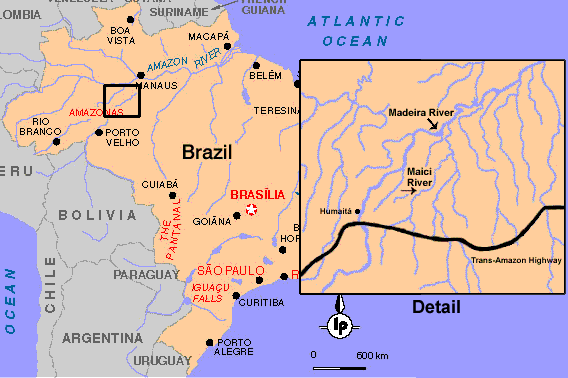
Language is a reflection of culture and in 1979 when Daniel Everett with his wife and three young kids went to Brazil to live among one of the most remote tribes in the world, Dan was forever discovering differences rather than similarities between the cultures. Initially, Dan went as a missionary to the Pirahã with intentions to convert the natives to Christianity, but living among the tribe that had no word or concept for war, shared equally with all members of the village, was non-materialistic, he began to see that his "lifestyle" was inferior to the one he sought to convert, so he gave up mission work and refocused his energies on learning the Pirahã language and culture, both of which were hugely different from his own or any other he had studied.

Even the name of his book Don't Sleep, There Are Snakes: Life and Language in the Amazonian Jungle is a reflection of that difference. The expression "Don't sleep, there are snakes" is actually a way of saying 'good night' but the difference comes with the intent in saying 'good night'. To the Pirahã, they believe that sound sleeping puts one in danger, drops one's defenses, and so they must "harden themselves" into nocturnal awareness to ward off predators. In fact, the Pirahã laugh and talk much of the night, and don't sleep much at any one time, perhaps 20 minutes to at most two hours at any time throughout each 24 hour period.


Euphemisms therefore seem common in the language. When visiting someone's house, the traditional way of approaching a house is to call out, "Hey, tell the dogs not to be mad at me!" Also, if someone gives you food, the person asks, "Do you already know how to eat this?" and if you want to politely refuse, you simply answer, "I already know how to eat this."

Similarly, phatic communication -- communication that primarily functions to maintain social and interpersonal channels like hello, goodbye, how are you?, I'm sorry, you're welcome and thank you -- do not exist as Pirahã sentences are either for requests for information (questions), assertions of new information (declarations), or for the most part commands. Their expressions are primarily limited to immediate experience, so they talk about what they have experienced or someone still living has experienced. Sentences are all simple sentences -- compound and complex sentences are structurally not possible and language structure is limited to simple present, past and future tenses; there are no perfect tenses, and certainly no embedded clauses. In application, translating the Bible, the Koran, or Buddhist Vedas would be impossible as these stories are outside of experienced immediacy and no eye witness could make assertions to their existence. Such stories would therefore, even if they could be translated, have no impact on the tribe. In fact, no known missionaries have had any impact on the Pirahãs for nearly 300 years.

The Pirahã's contact with the "outside" is virtually limited to the Caboclos, descendants of an Amazonian indigenous people living in close proximics to the Pirahã. The Pirahã call them xaobi-gii (authentic foreigners); Americans, Brazilians, etc are simply xaobi (foreigners), because the Pirahã view the Caboclos as more acceptable to interact with, partly because their two different tribes are still more alike than the Pirahã and "other" foreigners who the Pirahã have little social contact with and virtually no understanding of, which ultimately means no interest in.

The Pirahã have no counting system, no fixed expressions for color, no sense of tribal history, creation myth or folklore. Kinship terms are simple and limited to the lifespan, that is, with mortality at around 45, great-grandparents could not be known and so there is no term for such an imaginary relationship. There are no property terms and body-oriented directions are non-existent, e.g. 'turn left' or 'go straight ahead' are not spoken but rather directions for the Pirahã are focused on the directional path and flow of the river, which forces speakers to think of the overall world differently.

Their language has one of the smallest sets of speech sounds and phonemes in the world, with only three vowels (i, a, o) and just eight consonants (p, t, k, s, h, b, g, and the glottal stop x) for men and for women three vowels and seven consonants (women replace the masculine s sound with the h). Surprisingly the consonants are frequently interchangeable, but what is important is the tone, accent, and weight of the syllables which can ultimately be whistled, hummed, yelled or sung. Pirahã is very much a tonal language and cannot be whispered as voicing is necessary for completing communication. Pioneering work by the sociolinguist Dell Hymes noted that there are five pitch channels in Pirahã: whistle speech, hum speech, musical speech, yell speech, and normal speech, the latter using consonants and vowels.

One fascinating conversation Daniel had concerning food involved lettuce. A plane delivered lettuce, tomatoes and cabbage and Daniel was delighted to eat something besides rice, beans, fish and wild game smothered in tabasco sauce. A Pirahã was puzzled when he saw Daniel eating, and enjoying, the salad, and asked, "Why do you eat leaves? Don't you have any meat?" When assured that meat was available, the Pirahã made the "obvious" conclusion to the affair, "Pirahãs don't eat leaves. That is why you don't speak our language well. We Pirahãs speak our language well and we don't eat leaves." The statement confused Daniel but he was to finally come to the conclusion that to speak their language is to live their culture.


The Pirahãs were a hard to define tribe. Unlike other Amazonian groups, they did not wear feathers, enact elaborate rituals, paint their bodies, or have other outward exotic cultural manifestations. They don't display wealth because all Pirahã are equal, they don't need houses for privacy as privacy is not a strong value. They produce few tools, almost no art, and very few artifacts. Perhaps their most outstanding tools are their large, powerful bows (over two yards in length) and arrows (2-3 yards long). If a basket is needed, they quickly weave one on the spot out of wet palm leaves, of course not using the more durable wicker fibers but something for quickly completing what is immediately necessary. The women do wear necklaces made from seeds and homespun cotton string, decorated with feathers, beads, beer-tabs, and other objects, but their purpose is for warding off spirits, not to be artistic, show symmetry or reflect tribal colors or design, which don't exist. Neither do they have any method for food preservation. In death, Pirahã are buried in a prone position with their belongings alongside, but these amount to very little as Pirahã have relatively no material culture.

Marriage ties are for life but invariably men (maybe even women) cheat. The next day a woman will have the man with his head on her lap and she will be rapping his head repeatedly for hours. The woman can express her anger tangibly and the man by allowing her to rap expresses his remorse. The conflict is over by the end of the day, but this isn't to say that it won't happen again.

One anthropology student went to the Pirahã in order to collect data. Lacking Pirahã language, he attempted to conduct his research in Portuguese, which some the Pirahã had limited working knowledge of. When the Pirahã realized that the recording could go to their friend Daniel Everett (having long experienced tape recorders from Daniel's extended stays in the village), the researcher's questions were totally disregarded and they began talking about village affairs to Daniel. The researcher gave up trying, probably intuitively knowing that if he had been speaking "straight head" (Pirahã) instead of "crooked head" (Portuguese) his language constraints would have been lowered and his communication conventions would have been more in line with experiential immediacy.

Tuesday, June 7, 2016

The Corpse Walker: Glimpses of Society

Liao Yiwu—poet, novelist, screenwriter, free-lance journalist—published an epic poem “Massacre” that condemned the Tiananmen Square killings. He portrayed the stark reality of the killings of innocent students and residences by reciting “Massacre” using Chinese ritualistic chanting and howling to invoke the spirits of the dead. The audiotape widely circulated via underground channels in China, and eventually caught the attention of the Chinese security police. He spent four years in prison for “speaking out”.

Since his release, Liao has remained on a permanent government blacklist and most of his works are still banned in China, where he lives. Finding a job as a blacklisted person is very hard and he must remain mobile to escape the ever-watchful eye of the government. To do so and because his resident registration, which allows him to get legal work, has been cancelled, he is a street performer. He has been detained numerous times for conducting “illegal interviews” and exposing the dark-side of the communist society, particularly in his documentary-style book Interviews with People from the Bottom Rung of Society. The 27 chapters in his book The Corpse Walker are a collection of voices of people, who, like himself, were flung to the bottom rung of society resulting from the tumultuous changes and political purges of the Maoist era and the radically changing Chinese society.


Originally he compiled over 60 interviews with people who were flung to the diceng, “bottom rung of society”, a word he coined and which is an anathema notion to the supporters of Mao’s communistic movement, which is supposed to create an egalitarian society free of prostitutes, beggars, triad gangsters, drug abusers, homosexuals, street musicians and magicians, dissidents, and more. The displaced people—the marginalized—are mostly those who have been stripped of their residential registration and thus rendered unemployable and subject to expulsion to the countryside. Laio gives voice to the marginalized in his book The Corpse Walker: Real-Life Stories, China from the Bottom Up (2008). The book is a loud condemnation of the deprivation of people’s rights to speak out as well as being an excellent portrayal of a group of unique individuals that heavily populate China. The manuscript had to be smuggled out of China otherwise it would never have reached a reading public.

The 27 chapters in this book are on the voiceless and virtually “unseen” people of China, people that the government doesn’t acknowledge and does not want others to acknowledge as well. Laio as a flute street performer and as a marginalized was able to get their stories:


The professional murderer
The neighborhood committee director
The human trafficker
The former red guard
The public restroom manager
The counterrevolutionary
The corpse walkers
The Tiananmen father
The leper
The falun gong practitioner
The peasant emperor
The illegal border crosser
The feng shui master
The grave robber
The abbot
The safecracker
The composer
The blind erhu player
The rightist
The street singer
The retired official
The sleepwalker
The Yi district chief’s wife
The migrant worker
The village teacher
The survivor
The mortician

Literary expressions:

Many people use the phrase “covering the sky with one palm” to describe the government power over religion as the Communist-spawned Religious Affairs Bureau takes charge of all Buddhist, Taoist, Muslim temples as well as Christian churches. The abbot being interviewed astutely said, “Throughout ancient history, no matter how incompetent the emperors were, or how corrupt and decadent the royal courts became, one never heard about officials blackmailing and harassing monks.” [p87]

Liao described the safecracker with the Chinese cliché, the safecracker “had a tiger’s back and a bear’s waist” as apparently he was a strong man and even though it was a cold winter the man was wearing only a shirt and summer pants. [p267]

Street shoeshine women shoeshine “yellow shoes”, the code name for prostitution. When men stop and show interest, a shoeshine woman will start polishing his shoes first, reach up to fondle his ankle, while haggling over the price. 50 yuan [US$6.40] is a typical full service price. Full-breasted young women find transactions easier, while women almost 30 and with kids and sagging boobs might get lucky to get 20 yuan. “Smart” girls from the countryside get to the city, drop their accents, powder their faces and swing their butts, and even pay money to buy fake college degrees so they can hook the more educated guys by saying that after they earn more money, they can change to a new career to match their college degree. [p313-4]

Outcomes of the Great Leap Forward (1958-1961):

The Great Leap Forward resulted in ordering people in the Dongyang Commune to hasten farm production and discard traditional farming practices. Peasants of fertile fields famous for rice, wheat, corn, beans and sweet potatoes were instructed in the new farming method of “reasonable density” invented by Soviet scientists. That is, make deep furrows and plant seedlings densely. The Party claimed a 10-fold increase of crop production, so crops were duly planted with packed seedlings … which of course failed. The peasants knew better but dared not disobey or voice their more "educated opinion" in the matter. [p123]

Families were starving and couldn’t subsist on the poor communal food kitchens which had thin soups and no fat and no nutrition. Cannibalism became a terrible scandal, and of particular note in the Fifth Production Division which comprised 82 families and a population of 491. Between December 1959 and November 1960, parents there had killed and eaten 48 female children under age seven, which represented 90% of the female children in that age group. About 80% of the families were involved in cannibalism. [p127]

Doctors and nurses were allocated more food than ordinary peasants because there was a social need for them to perform in society. Yet, they too didn’t get meat and the sleepwalker’s wife who worked at the hospital was able to supplement her and her sick husband’s diet by picking up placenta—their only source of protein—from a hospital. Locals didn’t want to touch the stuff for superstitious reasons. [p305-6]

In the Dongyang Commune, a rural area of Sichuan, peasants ate a type of white clay called Guanyin Mud. The mud—mildly sweet and metallic—was considered precious because it helped soothe the sense of extreme hunger. Eating too much, a frequent problem, caused stomach cramps and extremely constipated the intestines. Raw veggies and castor oil would have relieved this but these were not to be found. [p130]

Teachers, as members of the educated class, were condemned as Rightists and if they didn’t lose their lives were sent to the countryside. One teacher of Chinese and math was soon only permitted, as all other teachers were permitted, to teach the chairman’s Little Red Book. Its quotes were treated like words from God. Three times a day people read from the book and all daily behavior was to be a reflection of its teachings. Math could not be taught from the "text" and was struck from the curriculum. Ironically, a well known general, who had written the essay “The Admiring Qualities of a Pine Tree”, also part of the carefully culled curriculum, lost favor with Mao, and teachers who had been ordered to teach his book were labeled as counterrevolutionary and were dealt with "appropriately". [p163]

The street singer came from a family of blind street musicians, a pre-Cultural Revolution trade open to the blind. His illiterate father took his stories from Chinese classical literature, such as “The Warrior Conquered the Tiger”, filling his stories with suspense, colorful description to the beat of his now extinct traditional instrument, the daoqin—a meter-long bamboo cylinder covered on one end with pigskin and much like a drum. With the start of the Cultural Revolution, the government banned him from performing his stories because they were considered feudalistic and anti-revolutionary, so he and his blind wife were assigned to work in a remote sausage factory for 27 yuan [$3.50] a month, barely enough to feed the family of five. After 1966, all street performances were declared illegal and local opera troupes were only allowed to stage the “Eight Revolutionary Model Operas” mandated by Mao’s wife. Apart from that, people spent their evenings attending communist meetings, witnessing public executions of counterrevolutionaries, murderers and rapists, and being bored to tears. [p285]

Social outcomes following the Great Leap Forward:

The neighborhood committee director was interviewed  in his tiny home and on the wall were big pictures of Karl Marx, Friedrich Engels, Vladimir Lenin, Joseph Stalin, and Mao Zedong—the world’s well-known communist leaders. When asked if the committee director worshiped the leaders, he replied, “Well, I can’t do that. If we want to set up an altar for them, there are specific rules. You cannot treat the pictures of these great men the same way you do pictures of movie stars. You cannot tilt them, or put them in separate places. There are five equally great men, and they have to line up on the same wall. Otherwise it would be a political mistake.” [p191]

Falun Gong practitioners in 1999 stages a silent protest in Beijing against unfair treatment. The communist party leadership saw the group suddenly as a threat to communistic rule, declared it an evil cult, and launched a massive campaign to eliminate Falun Gong in China. [The on-going campaign against Falun Gong practitioners is unclear as the “cult” seems harmless enough: Falun Gong combines Buddhist and Taoist meditation and exercises and was founded by Li Hongzhi, referred to as Teacher Li by practitioners. Teacher Li’s book is said to cultivate the mind and teach a person to be a good person, and teaches the principles of truth, benevolence and tolerance.] [p230]


In recent years, millions of peasants have migrated from the poverty-stricken rural areas to big cities in search of better job opportunities. Many end up working on construction sites or at clothing and toy factories. According to a Chinese government statistic, about 114 million rural laborers—known as min gong, “peasant workers”—swarmed into China’s major cities in 2003. [p308]

The American version of The Corpse Walker:

The United States has a similar book of lesser-known voices, those on the lives of ordinary Americans in the States. The book by Studs Terkel Working: People Talk about What They Do All Day and How They Feel about What They Do (1997) is a book filled with colloquial American English. It is also a book used as a textbook in China with the Chinese translated version being Americans Talk about Lives in America.

Sunday, May 8, 2016

Amitav Ghoush: The Hungry Tide

The story unfolds in an immense archipelago of islands, the Sundarbans, between the sea and the plains of Bengal on the easternmost coast of India. Without clear borders to divide salt and fresh waters and with islands criss-crossed with man-eating tigers and huge crocodiles, in decades past a visionary Scotsman founded a utopian settlement where people of all races, classes and religions could live together. However, with the arrival of the good-intentioned Piyali Roy of Indian descent but still stubbornly American, and her scholarly pursuit of the rare river dolphins, the ecobalance of quiet community begins to fragment.

As as cetologist seeking the rare and elusive river dolphins, Piya hires Fokir, an illiterate peasant man, to guide her through the backwaters to map out the dolphin's territory, while Kanai, an older businessman with some infatuation with Piya's youth and drive becomes her translator and mentor of sorts, and so the tides of life begin to turn.


The women in the fishing village where Piya ended up were unusual in that during the day they were devoid of marital reds. Because fishing took the lives of many men, women in their twenties and more fortunately in their thirties would become widows, and so as soon as their men left to go fishing (what other livelihood could there be in this remote island region?), the women changed to saris of white mourning, removed the bangles from their wrists and washed the vermilion from their hair as if to ward off the evil eye and hold misfortune at bay. Shedding the symbols of marriage would have been unthinkable in other parts of India, but here it was done with hopes of preventing bad luck.

It was the freshwater Gangetic dolphins, discovered by William Roxburgh, that were said to explicitly delight in the freshwaters of the Ganges and cavort in the labyrinth of rivers and creeks in the South and Southeast of Calcutta that drew Piya to the backwaters. Once in contact with Fokir who knew the tide waters intimately and had an immediate connection to Piya, she was taken to see the rare elusive dolphins. Orcaella were of two kinds: one liked the salt waters of the coast while the other preferred the rivers and fresh water. There seemed to be no biological difference but rather a choice based on habitat selection, and while the numbers of salt-water preferring dolphins were in the thousands, those preferring the fresh waters were in the mere hundreds and were a fast dwindling breed.

Before coming to these tide waters, Piya had already spent three years working as an Orcaella specialist. She had worked everywhere the Irrawaddy dolphins were found - Burma, northern Australia, the Philippines, coastal Thailand, everywhere in fact except where the first entered the record-book of zoological reckoning: India. Now she was here.

Piya learns more about herself and her choice in studying cetology as she encounters the strangely remote island world of ebbing salt waters. Born in July, her zodiac sign is the crab and she had always wondered why, of all the many interesting animals in the world, a society would choose to honor a crab every twelve years, but in the coastal labyrinth of islands she begins to understand. Crabs are launderers of the mud, scrubbing it grain by grain. Their feet and sides are lined with hairs forming microscopic brushes and spoons. They are a sanitation department and a janitorial team rolled into one - they keep the mangroves alive by removing leaves and litter, and without them the mangroves would choke in their own debris. In fact, they comprise a fantastically large portion of the coastal waters biomass. They likely outweigh the trees and the leaves. They are keystone builders and caretakers of the biomass and should therefore have more recognition than crocodiles, tigers and dolphins who seem to get by far the largest portion of research attention. Ah, and if Fokir hadn't been in pursuit of crabs, she wouldn't even be aware of the vicinity of the dolphins. Maybe the ancients had gotten it right after all - perhaps it was the crabs that rule the tide of her destiny.

Ah, but tigers played a big role to in the balance of the ecosystem. The Sundarbans were remote and official research was sketchy but the wife of the Scotsman who had initially established the utopia had been keeping records for years on tiger killings and it was her guess that among the network of islands, one person a day was killed by tigers. Though the number was shocking, the woman referenced 4,218 humans killed by tigers in lower Bengal between 1860 and 1866. The number was compiled by J. Fayrer, the English naturalist who coined the phrase "Royal Bengal Tiger".

The story ends with the death of Fokir, the mourning of Piya, her departure and finally her return "home", the surprising term she used for the Indian backwaters where she had so recently been emotionally traumatized in. But in her defense, she says she came "home" because to her home was where the dolphins were. The tides had gone out, and yet there should be no surprise that they have returned.

Monday, April 11, 2016

Decorative Hanji Paper Olive Oil Bottle

Transforming hanji -- handmade Korean mulberry paper -- into something both useful and beautiful is truly a Korean traditional art. For centuries Koreans have fashioned all sorts of beautiful and exotic-looking boxes and even furniture by simply using the hanji to cover layers of dense cardboard and then applying several coats of glue. The end result is a beautiful box or piece of furniture that is quite hard and durable, except being made of paper, it can't withstand much moisture.  

I have many colors of hanji. Some are definitely more textured than others, and not all are hand-dipped. The bright colors to the right (below) are machine manufactured "hanji" -- much cheaper, not so easy to work with and hard to obscure layers, but for some artwork like papering glass bottles, this bright cheaper stuff worked great! I just cut out little squares and rectangles of varying sizes and glued them on using the hanji-style painting method, which is much like decoupage! 


For making the the butterflies I just folded a somewhat stiff piece of black paper in half and cut out a butterfly. Very easy and quite classy to look at. One side of the bottle has two larger butterflies while the opposite side has three. Below is the finished decorative product. To its left is a hanji craft tissue box a friend made and gave me. It's the box that really inspired me to take a hanji craft class and learn the art form for myself.


Tuesday, March 15, 2016

11 Endangered Traditions from Around the World

The sum total of all ideas, dreams, legends, rituals brought into the world by the mankind since the dawn of our time—this is our ‘ethnosphere’. This is humanity’s great legacy.

As Wade Davis, author of Dreams from Endangered Cultures and National Geographic explorer, describes, some of this legacy is expressed in physical objects or impressive constructions, for example the man-made wonders of the world. However, other aspects can be less tangible living cultural expressions that have been passed down through generations and contribute to our collective sense of identity and community. Whether these expressions take the form of rituals, festivities, skills, dance or knowledge—they elicit certain emotions within us or make us feel a sense of belonging. It is an unavoidable truth of modernity that, along with many of the benefits that globalization has brought to society, it is also causing some of our gloriously diverse cultural heritage to be lost.

The legendary anthropologist Margaret Mead said before she passed away that her greatest fear was that as we headed towards this blandly amorphous generic worldview, not only would we see the entire range of the human imagination reduced to a more narrow modality of thought, but that we would wake from a dream one day having forgotten there were even other possibilities.
“In the end, then, it really comes down to a choice: do we want to live in a monochromatic world of monotony or do we want to embrace a polychromatic world of diversity?— Wade Davis
UNESCO is currently safeguarding and attempting to preserve 298 traditions that the organization has listed as ‘intangible cultural heritage’. Below are eleven illustrations of very intriguing and delightful traditions from this endangered extravagant ethnographic record. Illustrating them here is a gentle reminder that there are an infinite number of ways of thinking and orientating one's self on this pale blue dot we call home.

1 | Vanuatu Sand Drawing


Long before Snapchat existed, the artists from the Vanuatu archipelago in the South Pacific were creating ephemeral messages—traced by a single finger along a continuous meandering line of an imagined grid to produce a graceful set of geometric patterns in the cooled ash of cooking fires over the volcanic black soil. Not only are they beautiful, these sand drawings possess several layers of meaning: they can be repositories of information, illustrations for stories, signatures, or simply messages and objects of contemplation. (source)


2 | Generational Vietnamese Gongs

Originating from the appropriately named ancient ‘Dong Son’ civilization, the belief systems of the communities form a mystical world where gongs produce a privileged language between men, gods and the supernatural world. Behind every gong there is a god or goddess, that grows more powerful as the gong ages. In the central Vietnamese highlands, gongs are a symbol of a family’s wealth and prestige; every family owns at least one to pass down through generations. In fact, no rite of passage in their lives, from sacrificing bullocks to victory celebrations, is complete without them. (source)


3 | The Hopping Procession of Echternach

If hopping alongside 13,000 people sounds like fun, head down to the medieval town of Echternach in Luxembourg on the Tuesday of Pentecost (a Christian religious festival) and join in the fun! It is a thoroughly light-hearted occasion, yet also served as a gesture of defiance in days gone by when foreigners threatened Luxembourg’s survival as a country. The secret to the harmonious hopping lies in the folded cloth held by the dancers in each row. Watch closely to notice subtle differences in the dancing styles, German pilgrims being more energetic in contrast to the relaxed steps of the Belgians. (source)


4 | Chinese Shadow Puppetry

A form of theatre in which the colorful silhouette figures, many of which have between 12-24 movable joints, are manipulated by puppeteers who are often also masters of improv singing and falsetto. The puppetry show isn’t purely for entertainment either, since it passes on cultural history, social beliefs and unique local customs. (source)


5 | Chinese Wooden Movable-Type Printing

One of the world’s oldest printing techniques, wooden movable-type printing, takes place in Rui’an County, Zhejiang Province. The men who draw and hand-engrave the characters by hand require intensive training—at present only 11 people over 50 years of age have mastered all of the techniques. (source)


6 | Croatian Gingerbread Making

Gingerbread has become a symbol of Croatian identity—not only is the process of making the gingerbread difficult, each craftsman will also decorate the gingerbread in a specific way with small pictures, messages, motifs and mirrors—no Croatian festival or wedding is complete without an ample supply of gingery deliciousness. (source)

7 | Turkish Oil Wrestling Festival

Since 1346, that is, for the past seven centuries (making it the longest-standing annual sporting event in the history of the world) ‘pehlivan’ wrestlers have travelled to Edirne in Turkey for Kirkpinar—a competitive oil wrestling festival. Each one-on-one oily battle is decided by the ‘pehlivan’ who can pin the other for long enough. When this happens, the winner will kiss the defeated as is the custom, and not unlike in a gladiator’s ring in ancient Spartacus, the testosterone-fuelled audience goes wild. (source)


8 | Tsiattista Poetic Duelling

Picture an epic rap battle... now imagine it’s in Greek-Cypriot poetry and performed with violin or lute in the background. The ‘Tsiattista’ performers improvise rhyming couplets on specific themes within strict time constraints and attempt to outwit their opponents to win over the crowd. (source)


9 | Tibetan Opera

Tibetan Opera has roots in Tibet’s pre-Buddhist era (the Bön religion), which in turn goes back even longer and incorporates elements from the pre-Bön era—when a shamanistic, animist-oriented religion was practiced. For this reason Tibetan Opera has been dubbed a ‘living fossil of traditional Tibetan culture’ and remains an integral part of the cultural identity of the Tibetan people. The opera itself requires a skillful combination of martial arts, singing, dancing, comedy and precise elocution, woven gracefully together into a story that shares everyday scenes from daily lives of ordinary people, all of which transform into nothing less than a universal statement about people's hopes, aspirations and the human condition. (source)
“Today, we are going through a critical period in time… protecting an ancient culture like this is the responsibility not only of the concerned nation, but also of the world community as a whole.— His Holiness the 14th Dalai Lama

10 | Yamahoko Moving Museums

On July 17 every year, the Gion Festival in Kyoto in central Japan culminates with a grand procession of yamahoko—floats known as ‘moving museums’, with gorgeous drape decorations. The floats are paraded through the main streets of central Kyoto, and were originally intended to summon the plague god, so that he could be transformed into a protective spirit through music, dance, and worship. (source)


11 | Catalonian Human Towers

Every year in Catalonia, Spain, there are festivals in which people come together to build colorful—and ridiculously tall—human towers called castells, meaning ‘castles’ in Catalan. These castells can be anywhere between six to ten levels high and consist of about 100-500 men, women and children—supported by nothing other than sheer strength and courage. (source)


Local Catalan photographer David Oliete is fascinated by these human towers and their capacity for evoking human emotion. He begun photographing the castells eight years ago and hasn’t stopped since. Explore the gloriously kaleidoscopic shots of human towers in David’s Maptia story: ‘The Human Towers of Catalunya’.

The above document is borrowed from 11 Endangered Traditions from 
Around the World as compiled by the Maptia team.