Friday, September 11, 2015

King Peggy: From Secretary to King

August - September 2008:

Peggielene Bartels, secretary to Ambassador Kwame Bawuah-Edusei and divorcee of a ex-husband she was still in love with, worked virtually from sun-up to sundown as a secretary at the Ghanian embassy. She had no personal life; she dedicated it to her office job at the embassy, making sure that behind the scenes, the embassy was well-oiled and efficient. For 29 years she had worked in administrative positions in Washington DC, meeting African heads of state and US senators and planning glittering parties. Born in Ghana, she had been something of an anomaly, a female with a mouth, spirit and an attitude in the male-dominated society that just didn't fit. And then she got the strange 4 a.m. call, the call that transformed her from mere secretary to king of a city in Ghana ... if she would accept. She thought and thought and the spirits told her to accept. She knew if she did, finally her strong male-like outspoken qualities could be put to use in her home country of Ghana.

She had been raised a Christian, or at least having Christian principles, but she never totally turned her back on the spirits of her homeland for to do so would be disastrous. She poured water for her mother's spirit every night and schnapps every morning for everyone knew that the spirits were always thirsty. In the same way, Peggielene had been "chosen" to be the next king by the pouring of schnapps and the schnapps bubbling over when her name was intoned, thus the spirits informing the elders that Peggielene, the only woman on the list of 25 people suggested to be king, should be the one chosen and crowned.

Peggielene thought about the proposition but didn't readily accept. There were too many big considerations, and the biggest was that Otuam, the city she was to govern, was flat broke, the palace in total disrepair and the infrastructure for water and education almost non-existent. The task would be momentous, not to mention that she couldn't become king until the previous king, who was in refrigeration and incurring daily costs by being there, was properly buried with a big sendoff and that could only be done in the right setting - a totally refurbished palace. Where would she get that kind of money?!

After careful deliberation and the spirits seeming to speak to her constantly about accepting, she did. She flew to Otuam, Ghana and immediately missed her air-conditioned apartment, especially when she discovered that five people would be sharing her simple little hot room, because she was king and her relatives spirits would be needed in the room to protect her. She didn't think a slumber party at her age was fitting, but what could she do? She went to take a shower, and the bucket on the bathroom floor reminded her that there was no running water in Otuam. She bucket bathed.

The next day Peggy went to meet her elders, old, crafty and dishonest ... as she somewhat suspected and soon found out just how sneaky and snaky they were, for whatever money was collected in taxes went into their pockets and whatever money she gave for the restoration of her palace or anything else, never got beyond their pockets. And it was dishonorable to fire them ... they were men, and her elders and had been elders to her uncle the previous king. In time, she learned and on her second visit to Otuam, she began confronting them and voicing her strong opinion. Her favorite roar to a couple of her elders was, "You have elected a man with breasts! Maybe I don't have balls, but for all that, I am a king and I am a man! ... I am going to squeeze your balls so hard your eyes pop out!" But that was later.

On her first visit to Otuam, Peggielene evaluated what must be done to bury the king, prepare the palace for the burial ceremony and for her acceptance and crowning as king, in which her "stool" would be venerated and libations of schnapps poured daily to it. The stool in Ghana is like the metaphysical chair of enthronement. It is a decorated stool of some material that takes on spiritual qualities once a king is crowned, or rather "enstooled". And henceforth, the new king and all the king predecessors would have libations poured to them on the daily basis, and the elder pouring the libations would discuss spiritual matters with the stool ... or perhaps it would be better to say, the stools conveyed spiritual matters to the pourer of the libations and he in turn would pass the matters along to the enstooled king.

As a woman with strong opinions and which had been furthered sharpened in her years in the UK and the US, she had big ideals for her little Otuam village. She intended to end wife-beating, a chronic problem; she planned on getting medical aid for people and a midwifery clinic; the town desperately needed running water, and of course better education was a priority too. Of course getting a decent road to Accra would be needed, and then more people and statement would be inclined to visit. She continually added to the list of "needs" for her Otuam. And as a barren woman who could never have children, thus the reason for her divorce, she now had 7,000 children ... and she intended to take care of them. She might have been useless as a wife who was incapable of bearing children children, but she didn't intend to be useless as king who takes charge over "his" children.

She scrimped and scraped money, confronting dishonest elders to get money; she revised the board of elders to create a more honest arrangement, putting hard-working fishermen and even sharp-meeting women on the board, she suddenly the village started paying attention to her as king, and the money that had previously been given to the elders was now transferred to the proper hands, and thus to the coffers of the town, and so progress could start to be made!

On the day of her "enstoolment" she ate her anti-urinary breakfast of boiled yams, palm oil and hard-boiled eggs (for a king must never be seen doing the basic functions of a man while holding court, which by the way could be every day). And sitting behind the Soul, a young vestal virgin girl whose own spirit would buffer that of the king's, Peggielene became king of Otuam, and finally a king-mother to 7,000.
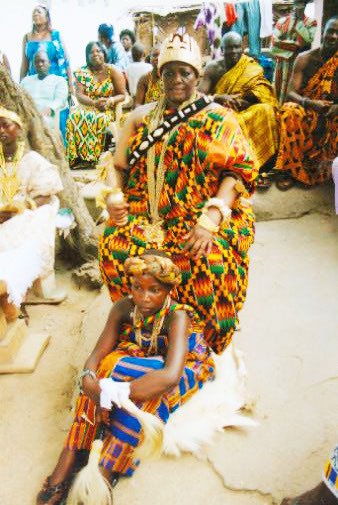
Coronation day:  King Nana Amuah-Afenyi VI  of the Otuam people, sitting in state with her "soul," Nana Ama, twelve, the little girl whose innocence shields the new king from jealous evil spirits. Source

November 2010 - early 2011 (The book King Peggy: An American Secretary, Her Royal Destiny, and the Inspiring Story of How She Changed an African Village was published in 2012.)

After making wife-beating a punishable crime in Otuam and sinking two wells for public use and arranging for a Baptist school to be opened, King Peggy gained the respect of her people in the down-trodden poor town where the elders stole the town's tax money and spent it for themselves. Since becoming king, Peggy has been saving fishing fess and land sales to build a public latrine and create a library with Internet access for Otuam's kids. Nearby towns and city of Accra recognizes that King Peggy is building Otuam into a modern city and connecting roads are being repaired, resulting in investments in the town and the opening of shops, gas stations and other conveniences.

In October 2011, Pastor Colleton and members of Shiloh Baptist Church traveled once again to Otuam to submit a letter of intent for building a high school and meet with parents and kids to decide on scholarship awards and register them for scholarship programs. Furthermore, King Peggy and Pastor Colleton visited hospitals in Accra to determine the equipment and training needed for Otuam's nurses in order to open a medical center. Ambulances were also looked at for purchase.

The demands of Otuam are great and the income is small. All charitable efforts for the development of Otuam are to be directed through the Shiloh Baptist Church (on Facebook). Meanwhile, King Peggy continues her work as a secretary back at the Ghanian embassy in Washington DC. She is proud of her career, and the income, especially as being a king requires more income than her town at present can generate ... and she has such big goals for her town ... and so she continues to work for her 7,000 children.


Wednesday, August 26, 2015

The Flipped Classroom

The Flipped Classroom is one of the latest buzz phrases in education. The teaching style involves more preparation by the teacher and, ironically, more participation and hands-on involvement with the students. The preparation and learning how to adjust the teaching from a teacher-centered classroom to a more facilitator-guide in the classroom are two of the hardest obstacles in making the flip. FLIP, by the way, is an acronym for:
F - Flexible learning environment
L - Learning culture
I - Intentional content
P - Professional educator
It in no way replaces the teacher but makes the teacher a guide in a flexible learning environment where students are learning the culture of the topic and of sharing their opinions, which can be valued when their opinions are supported as taught in the more learner-friendly environment. The content is intentionally prepared for the learners so that they might attain a larger grasp of the topic than if they had just been lectured to, and of course the teacher who in effect becomes a guide-on-the-side is still the one in charge of the classroom and is constantly moving around and seeing that students are on target, focused and are making progress in their learning. This last point is something which is rather hard when the teacher is just lecturing - not much checking of individual comprehension and their application of the "taught" knowledge can be done with the teacher simply in front of the classroom giving top-down information.


3 apps that I would recommend as being very helpful in the flipped classroom. 

Slide organization prepared by Cheryl Magnant, MA, MA
The basis and foundation ideas of this PPT originated from a Fulbright lecture,
given by Quan Quan Nyugen at the end of last year.

Wednesday, July 15, 2015

Slow Dancing with a Stranger: Alzheimer's

Meryl Comer wrote her personal 20-year experience of caring for her husband in her book “Slow Dancing with a Stranger: Lost and Found in the Age of Alzheimer’s” (2014). Her husband Harvey had early onset Alzheimer’s at the age of 58. For 20 years, and still as the book concluded, she cared for her husband, and in the latter years she was also caring for her own mother, another victim of Alzheimer’s. How she held up and endured is beyond me. She states time and again, “The man I live with is not the man I fell in love with and married.”


The book is a dedication to what stay-at-home care entails. She would know. She lived it. And in the latter years when she juggled care for two Alzheimer’s loved ones, she also juggled the demanding new position of President and CEO of the Geoffrey Beene Foundation Alzheimer’s Initiative, a position that she was qualified to hold after her years of dedicating her own life for the round-the-clock care of a high-demand husband-patient (and also mother) who could no longer return her love, affection or, even in the latter seven years, words.

Her husband was slowly robbed of something we all take for granted: the ability to navigate the mundane activities of daily living—bathing, shaving, dressing, feeding, and using the bathroom. His inner clock was confused and couldn’t be reset. His eyes were vacant and unaware—as if an internal window shade veiled access.

Neither a scientist nor a neurologist, Meryl spent close to two decades trying to decipher what was going on in her husband’s head and to grasp how hard and unfair it was for such a highly educated and acclaimed scientist to lose pieces of his intellect and independence as the circuitry of his brain misfired and corroded. No new short-term memories stuck: his internal navigational compass shut down. His disease became Meryl’s crossword puzzle.

Meryl was long forgotten by Harvey, yet she became his constant companion, his copilot, his guardian. She bore all the burdens for his care, made all the decisions for them both, the demons and terror of Harvey’s world became hers. As a caregiver, she took the brunt of the disease. She became the knowing victim, the mental survivor of the disease, and the one who struggled to find hope amid the black shadows of the disease.

To find hope and search for answers, Meryl lined her bookshelf with tomes on dementia care. She came to know that the disease affects a reported 5.4 million people in the United States and 44 million worldwide. Like a stealth invader, it quietly dements aging populations globally while quickly pushing past cancer and HIV/AIDS as the most critical public health problem of our time. Yet, an estimated fifty percent of those with dementia never get diagnosed.


These are horrendously high numbers, and they are rocketing more and more rapidly. What is not typically figured in the statistics is the vast number of Alzheimer caregivers, like Meryl. More that 15 million caregivers are the unintended victims of Alzheimer’s, and add that number to legions caring for loved one—young and old—with diseases of the brain, traumatic brain injuries, and other chronic diseases complicated by a memory disorder. Caregivers like those and Meryl speak the same language, and so she became the president and CEO of the organization that reaches out to Alzheimer caregivers. She with her experience and her 20-years of continuous devotion and dedication gives insight and understanding to the legitimacy of life behind the devastation of Alzheimer’s she has experienced firsthand. So with Harvey's slow decline—both mental and physical—Meryl realized that she knew Harvey better as a non-reciprocating individual, better as an individual who became personality-less and virtually unresponsive. Indeed, her life with 24/7 care became a slow dance and her husband became a stranger. They both were robbed of their relationship, their emotions and their shared joys, and even after 20 years the dance is still continuing.


Thursday, June 4, 2015

Somaly Mam, from Cambodian Prostitute to Activist

Somaly Mam was not her original name. Like many people, she's had many names, but Somaly was in a position to choose a name and she embraced the name that would give her the most freedom of identity. As a child she was called Ya, and sometimes just Non, or "Little One". When she was taken by a old man as a child and became his slave, she was called Aya, and upon occasion Viriya. Years later a man who said he was her uncle, and who became a father-figure to the young unloved girl, gave her the name Somaly, meaning "the necklace of flowers lost in the virgin forest". She never knew what her own parents had called her, being an orphan from a young age, but she knew the love steeped in this name and the bequeathal of acceptance for her pure soul, and so she claimed this name. Typical Khmer advice is never to find out about your past, and her "uncle" told her to look toward the future. He gave her a future with his love, and as her parent-figure and adoptive siblings, she had the foundation of her success in escaping prostitution later on.

When she was quite young, the old man came to her village and took her away with promises of reuniting her with her parents. No one cared for the small orphan, and very likely no believed his promises, but no one interfered. She was taken away and became the slave of the old man, whom she was to respectfully call grandfather. He was an inveterate gambler, a wastrel and young Somaly had to work hard carrying morning wash water and doing other tasks to earns coinage to feed "her" grandfather, who never worked. When Somaly became a teenager, and started growing breasts, the old man began touching her and Somaly did all she could to escape his attentions by quickly doing her household duties and then fleeing the tiny hut. One day grandfather sent her to a merchant to buy some oil, but in hindsight she realized that she was to repay her grandfather's gambling debts by giving the merchant her virginity. This was the first rape of many, and she was only about twelve.

She had no one to really turn to, because her "maternal uncle" was trumped by the "grandfather". Her "uncle" who she now calls "father" explained to her that there is much suffering in life, and no matter how much life hurts, one must remain silent. This seems to be strong Khmer philosophy.  His advice was, "If you want to stay alive, grow a dam kor tree in front of your house." The dam kor is the silk-cotton tree, but the word, kor, also means mute. To survive, you must remain silent.


When she was about 14, she was married by her grandfather to a soldier in his mid-20s, a surly aggressive man who raped her violently multiple times on their wedding night and every night afterwards when he wasn't fighting. She hated marriage. Marriage put women in a prison. Her husband was particularly violent, slamming her head again and again against the hut structure, gashing her face with a fingernail kept intentionally long, abusing her in any way if the food she prepared wasn't to his liking or anything at all didn't strike him like he wanted. He started taking shots at her with his military rifle, but in all this, she learned that to the Khmer you must not let the fire that is outside come inside your house, and the hearth fire must not be allowed outside. You don't talk about what happens in your household.

When her husband was away, she worked at a clinic to bring in some coins. She worked at night for 30 pounds of rice every month, a high wage. All she wanted was work, she wasn't frightened of the dead, she lived with a husband who was worse. The hospitals were notorious for "killing" people. No one was a proper nurse or a trained doctor; treatments were on trial and error basis and washing hands was not a habit. Treatments were based on traditional belief: young mothers hemorrhaged on the inside and developed fever (puerperal fever) but this was interpreted as a dead person has used the labor to enter the body and perform a dance. If the young mothers survived, custom dictated that they drink a glass of a boy's urine and lay a coal fire under their beds as well as eat a lot of pepper to regain their energy and lighten their skin.

When she was fifteen she got her period for the first time. Another "nurse" explained to her what this meant. Her husband was away fighting but the doctors at the clinic preyed on the young women and there was nothing they could do but submit. Again, though being raped was not her fault, she lived in fear of her husband finding out because in Cambodia, if a married woman has sex with another man, it is believed she should kill herself. Somaly did try. She swallowed a lot of Russian sleeping drops but only woke the next day stunned and bleary.

She only remained married a few months and then her husband no longer returned from fighting. Her grandfather however came for her and took her to Phnom Penh where he sold her into prostitution to feed his gambling habit. The first day when she refused to service a patron, she was raped by the owner's husband and beaten violently with his crutch and then raped by both of the brothel guards. The next day she didn't refuse a patron ... there was just no choice.

Many parents or relatives sell their daughters to a brothel and the price depends on their freshness and beauty, their cleverness and their connection to the seller. Today some girls are kidnapped into prostitution, but that didn't happen so much when Somaly was young. The girls in the brothels were bought on a kind of downpayment and once the girls worked it off, they could go free. Often however parents would continue to take out new debts on their "working girls" keeping their daughters in perpetual servitude. Even if the girls did work off their debt, the word for prostitute in Cambodia is srey kouc, "broken woman", and broken things cannot be mended and nobody wants people to know they have a prostitute in their family. The girl can never return home. Prostitution is their lot for life.

Somaly was often beaten by the customers, beaten by the owner's husband and the guards, put into the punishment room and while tied covered with snakes and left overnight. Cuts and welts were common things. But what Somaly suffered in prostitution and what young girls suffer now is vastly different. Now, girls have nails driven into their heads, girls are beaten with chains and electric cables, and girls are violenced in ways supposedly inconceivable but in ways which are influenced by the popular Chinese films full of torture scenes, movies favored by pimps nowadays.

Nowadays also the girl are taken at much earlier ages because in Cambodia men will pay thousands of dollars to rape a virgin for a week. Always a virgin because sex with a virgin is supposed to give a man strength, to lengthen a man's life span and even lighten his skin. Brothels, to ensure bona fide virgins, even sell girls as young as five and six years old. But after the first week is over, they sew the girl inside (without anesthetic) and quickly sell her again. A virgin is supposed to scream and bleed, and this way the girl will scream and bleed. They do this maybe three or four times. Another reason the virgin market in prostitution has taken off is that people believe that sex with a virgin will protect against illness, or even be a cure for AIDS. The little girls tear much more easily than women, likewise they get AIDS more easily too, but men are to be served; girls are to be obedient and subservient in all things.

After a time, Somaly paid off her debt and, because she didn't know anything else, she continued servicing men as a prostitute. However, she began servicing foreign expats, and eventually married one and moved to Paris. The year in Paris was difficult for both her husband and herself, and after a year they returned to Cambodia, but Somaly returned as a Cambodian married to a foreigner, who had foreign living experiences, was viewed as having improved herself, and indeed she had. She returned matured and having a new sense of confidence, and her heart bled for the girls trapped like she had been in prostitution, and so she began encouraging girls to leave, finding places where they could be trained as seamstresses for $100/mth, and finding medical aid for the girls who were sick and unable to get treatment. Her husband Pierre never complained about the expenses she incurred with her rescue attempts and eventually they opened a tiny home for prostitutes to run to and get shelter. Until that time her home was opened to these girls.

Near her home was a center for brothels called the "Broken Coconut", and "coconut" in Khmer is another word for a woman's secret place. Because of her home's position, she was easily able to help fleeing and desperate girls, but she was also an easy target for the growing power of the prosittution rings, which was quietly supported by many policemen. There were some big-hearted policemen but they were hard to find, and her home was stormed one night, making her flee for her life.

Early in 1996 Somaly and Pierre started a charity to fund a proper center to help prostitutes. They chose the name AFESIP which translates from French as Acting for Women in Distressing Situations, a name that carried no label of prostitution. Getting recognized was a struggle but in August 1996, a big conference on the sexual exploitation of children took place in Sweden, and several journalists wrote about Cambodia. After that, large international agencies seemed more interested in AFESIP and a big UN agency promised funds.

Over time, Somaly expanded the center in size and in skills taught. Her "mother" had joined her as a type of housemother to the prostitutes to love them and nurse them and teach them skills before finding them suitable jobs so more girls could be taken in. While her mother stayed at the center, Somaly could expand her work and she approached the Ministry of Defense and made it clear that the country needed sex education and girls needed to be given something beyond shame and ignorance of their bodies. She explained why it was important to discuss rape, and respect of women, the true circumstances of AIDS, and how it is most easily contracted, and therefore the need for the use of condoms. Since AIDS was epidemic, her proposal was accepted and she began sex education lectures in police stations, military camps and other places.

Over the years (book written in 2008) AFESIP has helped more than 5,000 victims of prostitution to get back on their feet. In Thailand, Laos and Vietnam AFESIP has helped an additional 1,000 victims. But reintegration is a long process. Some girls can be self-sufficient after only 10 months, but others that have been gravely psychologically damaged take months to build up trust and confidence before they can even be taught a skill, and it takes 1 1/2 years to train a woman to take the test for the government's hairdressing certificate. Therefore, AFESIP needs on-going donations, government support, government delegation, police protection, and volunteers to help these girls become confident, self-sufficient women. The prostitution business is worth $500 million/yr, almost as much as the annual budget for the government, so there is much resistance against AFESIP and Somaly herself.

Somaly says that even this many years away from being a prostitute and being repetitively raped day after day, she still suffers. After 15 years she still feels dirty. So she washes like a madwoman, puts cream on and covers herself in eau de toilette to mask the stench that pursues her. At home she has a cupboard full of perfume. She spends money to blot out a smell that only exists in her imagination. And she seeks to purge the stench of prostitution by her undying efforts in saving as many as she can. She is seeking to change the misguided thinking placed in the saying "Don't try to bend the sroleuw tree, don't try to change a whore" based on the belief that all whores are deceitful and dishonest, hard and intractable, when in fact they are often honest girls from the countryside, who have suffered and cannot express their suffering and anger and people interpret their anger and suffering emotions incorrectly. She seeks change.

Somaly has visited many countries as a speaker and advocate for the women of Cambodia, and worldwide, trapped in the machinations of prostitution. In Sweden she was awarded the World Children's Prize for the Rights of the Child. In Germany AFESIP was awarded he Roland Berger Award for Human Dignity. In Washington D.C. she was honored at the Vital Voices 2009 Global Leadership Awards, but no matter the awards and distinctions for her human rights work, dignity lost is hard to recapture. Somaly still works to regain her dignity and the dignity of those she represents.

Friday, May 15, 2015

B.B. King, Blues Master and Icon

Yesterday B.B. King, rock-the-world blues guitarist, died at the age of 89. His death was from complications from high blood pressure and diabetes. His life was an on-going splash of color and life and an on-going contribution to the music world, not just to blues but how his blues influenced even the early days of jazz and rock, the radio and the road show. He is a king in the music world!

I had just finished reading his book Blues All Around Me: The Autobiography of B.B. King when he died. I never heard of him before but after reading the book, I could so easily understand the throb of pain and reaction in the media caused by his passing. He wasn't an articulate man. Rather, he was quiet and as a child, he had a stutter and was painfully shy. Music unlocked his soul and gave him expression. For a man who wasn't articulate, he painted beautiful imagery in his autobiography with his simple sentences:
"Great Grandma spoke with quiet authority. She'd put me on her lap and, up close, I'd notice wrinkles around her mouth and over her lips. Her eyes would twinkle and her voice was steady. I believed her every word. Unlike some of the men, she didn't exaggerate or fib to build herself up. She was sincere. She told me a story about Houston, Mississippi, where a black boy fell in love with the master's daughter. When the moon was slim and the night was dark, they'd meet undercover and steal a kiss..." 
He grew up milking cows, driving tractors, picking cotton and at night or on free weekends he would walk several miles to town with his guitar and strum a bit, picking up coins on the corners of sidewalks, and then walking back home the several miles late at night to save those coins. Though tired, he had a smile on his face and energy to continue the manual labor because his soul was fed with the music he created and shared.


In school in those few years when he attended, he learned of Booker T. Washington, Frederick Douglass, Mary McLeod Bethune, and how hard work, tenacity, and faith were the keys to accomplishment. He following the fights of Joe Louis like he was fighting for the Black's freedom. But his bigger heroes were the musicians that his Aunt Mima had on records. Men like Blind Lemon Johnson who sang "Rabbit Foot Blues", "Shuckin' Sugar Blues" and "That Crawlin' Baby Blues" and "Mosquito Moon". But while Blind Lemon was raw, Lonnie Johnson was gentle and had a dreamy quality of singing and a lyrical way with the guitar. Blues were about feeling, and these two guitarists were the ones who hit young Riley, latter B.B., hard.

Riley moved to Arkansas because the picking of cotton paid better, $1 per one-hundred pounds versus the 35¢ he got in Mississippi. So after madly picking cotton from early morning to about noon, he would wait around WDIA had see if he could substitute for Maurice "Hot Rod" Hulbert, a deejay with a program called Sepia Swing Club. He was getting his plucking fingers in the door of blues music. It was rough but he had passion for the picking' - the picking' of the guitar, not so much of the cotton, but a man did what a man had to do, and he was a workaholic anyway. So by 4pm he'd be back in the field for another couple of hours picking that cotton and dreaming of picking his guitar for wider and larger audiences. It was at the WDIA that he got his nickname Beale Street Blues Boy shortened to B.B. although for a time he had the longer shortening of Blues Boy.

Well, B.B. also had a name for his guitar - she was curvy and sexy and the passion of his life. The name came about while he was pickin' in a club one night and the club caught on fire. No way was he leaving without his precious guitar that he had saved and saved for, so fighting his way through the blazes, he grabbed his guitar and barely escaped the building, cradling his guitar in his arms. He was burned on his legs but his guitar was fine, so he caught his breath and thanked the Lord. Then overhearing a patron say, "Damn, you wouldn't think two guys would kill each other over a gal like Lucille" and B.B. realized the blaze was from a fight over a woman he never met, but it was a memorable night, a memorable name, and right then and there he christened his guitar Lucille. He liked seeing his guitar as a woman, as someone worth fighting for and even dying for. Over the years he's had seventeen guitars, but all of them have been named Lucille.

In 1952, when B.B. was 26, his "Three O'clock Blues" reached and remained #1 on the Billboard's rhythm and blues chat for three months. This breakthrough changed his life. He didn't become rich and he didn't become famous, but in the world of black music, he became a national name, and just like that, his territory spread beyond Tennessee, Mississippi, Arkansas and Alabama. He states very clearly that he was listened to by blacks and not selling to whites, that wouldn't happen until some 20 years later, but he was now on the slow ladder climb to nationwide fame.

Blues is typically associated with drugs and B.B. did some experimenting too, but after one naive sexy evening with a hot woman who gave him drugs, he bumped into Tiny Kennedy, a pal who set him straight by yelling at him "You the damnedest fool I ever did see. That shit will kill you. And if it don't kill you, it'll turn you into a raggedy-ass junkie like her. You better check your rings and watch ..." B.B. did and sure enough the hot, sexy junkie girl had stolen his goods. He never did drugs again, and if he found out guys in his band were using dope, he'd fire 'em on the spot.

That didn't stop him from having more hot and sexy nights with hot and sexy women. He slept his way across the country, before he was married, when he was married, afterwards, between marriages, and to his knowledge he fathered 15 children, all of whom he acknowledged and all of whom he gave allowances to of some kind. He says he was like a foreigner to his children with his life on the road, but he still had the best of intentions and he still sent money to support them, something he could do because he loved to work.

He loved women of all kinds -- sweet women, women with compassion and inner beauty -- but one time when he had a hard time dealing with a woman was when the new trend in the hippie movement was to send a naked young lady to attend to him, not to offer sex but to welcome him, sort of in the spirit of the flower children. Well, it was Georgia and the lady was young, nubile and white. He wanted to accept the gesture and show his appreciation but he couldn't figure out quite how, and he also just wanted to stare, but then that would be rude and show just how nervous he was. Well, he got through the experience but he could hear the men around him laughing.

He grew in the world of black music and whites started listened, reinterpreting the blues and expanding on his style. B.B. believed in always doing his best, always evolving his style, and he was known for his workaholic passion for sharing his interpretation of the blues. In his early 70s, he was included in The Ed Sullivan Show, and through that experience he got on The Tonight Show. And in these later years, he finally reached worldwide acceptance. There are franchised B.B. King nightclubs in Memphis, L.A., Nashville and Orlando. Gibson started a line of B.B. King guitar strings made of Swedish steel. There are B.B. King casual clothing and B.B. King food products (B.B. King barbecue sauce, B.B. King salad dressing, B.B. King salsa and B.B. King bean spreads). There was even discussion of B.B. King catfish although ironically by that time B.B. had already been a vegetarian for 10 years after watching a TV show on the slaughter of chickens and cows.

With international acceptance came social invitations. B.B. was invited for the first time to the White House by President Bush, and he received the Presidential Medal of the Arts, one of the highest awards the US can bestow on a private citizen. He ate lunch with Vice President Quayle and the presidents in both Turkey and Latvia, because as they said, they wanted to get to know B.B. And Queen Elizabeth and Prince Philip of England invited him to a garden party being thrown in Washington D.C. He even took his band to Beijing, China where he opened the Hard Rock Cafe.

The little boy Riley who lost his beloved mother and grandmother at a very early age and struggled to live, having little to no time or interest in book learning, became a household icon and monument in the world of music. He wrote his poignant autobiography humbly, sharing his foibles and weaknesses much more easily than tooting his horn on his many successes. But his sharing made the reader realize that his life was a struggle, not one he was ashamed of but one that he embraced so that his utmost purpose of "feel the music" and share what he felt could be achieved. He wasn't a businessman; he was an extreme artist, placing value on the intrinsic rather than the material gain.

Friday, April 10, 2015

Words Lost in Translation

When translating from one language to another, inevitably you will come across a word that just can't be translated directly into the other language and you must resort to description and explanation of the concept. This is true because language reflects culture and vice versa, culture reflects language, so our cultures like our languages are different and therefore result in different ways of looking at the world. Many cultures in fact have totally different world experiences from other cultures preventing full understanding between the cultures because they just can't quite identify with one another. 

Many people already are aware that the Inuit have a large number of words for "snow" that just don't translate into English. This is because when the Inuit talk about the snow, they are including references to how cold it is and therefore how fluffy, crisp, hard, blowy, etc and the snow is that is falling, the snow that is on the ground, e.g. in hard packed coverage or deep fluffy coverage that doesn't support a dogsled. In English we resort to description if we think the kind of snow on the ground or falling is important. That would take a long, long time in the Inuit language because about nine months of the year the Arctic has some kind of snow.

If you'll recall, the movie "The King and I" was about a missionary who went to Siam (Thailand) in the 1800s and had the palace concubines and children put on a play. In the play about Harriet Beecher Stowe's book "Uncle Tom's Cabin", the miracle of snow was introduced. The concubines and others didn't believe that anything cold could fall from the sky; it was outside of their world experience and so at first they didn't believe anything like that could exist, then they played with the word "snow" and the mysterious idea of a cold world and marveled that such a thing could exist. They were able to step outside their culture via literature and broaden their world concept.

Well, a rather new and interesting book on the shelf is "Lost in Translation: An Illustrated Compendium of Untranslatable Words from Around the World". The book has pages of illustrated words from other languages that just can't be translated easily or directly into English, but if they were, could be an asset to the ever-growing English language. Following are several of the entries with some charming illustrations:

Suadade (noun)

Probably one of the most famous (are beautiful) Portuguese words is "saudade" which refers to the feeling of longing for something or someone you love or have lost. Fado music, a form of music characterized by mournful tunes and lyrics, relates to saudade.

Saudade is not just a feeling but something you can literally "have". In Portuguese, you could say "Tenho saudades," which translates as "I have saudade."

This kind of reminds me of a Spanish expression, "No tengo ganas", with ganas being another word that doesn't translate. Ganas kind of means desire, will or energy, so "No tengo ganas" kind of means "I don't have the desire/will/inclination/energy to do that."


Cacimbo (noun)


This Kimbundu word, used in Angola, refers to a heavy mist or drizzle that occurs in the Congo basin area and which is often accompanied by onshore winds. It is synonymous for the cool season, and apparently there is no translation possible. Upon hearing the word, Angolans think about the fresh air, the summer, the cool weather and the very cold water.

This word reminds me of "siwonhada", a Korean word with perhaps more meanings on cool, refreshing, invigorating ideas. It seems to similarly be used for a breath of fresh air after the summer heat or the icy coldness of the air conditioner after the burning heat outside. It has no specific temperature range but often reflects the change in coolness after the hotness. Actually, siwonhada is an idiom with many more meanings, but this one on coolness is probably the most commonly used one.

Extrawunch (noun)


This useful German word is used to denote someone who is slowing things down by being fussy. It means an additional request which turns a simple delivery/operation/undertaking into a complicated one, often with only a marginal benefit and a sense of it being an unnecessary complication.

Hiraeth (noun)


Hiraeth is Welsh and refers to a particular type of longing for the homeland or the romanticized past. The Japanese word "natsukashii" means something similar. It sometimes has connotations of nostalgia for an idealized past that never was.

Somewhat similarly is the Korean word "han", which is in fact a cultural disease of the Koreans before Korea became a democratic country (in the late 1980s - early 1990s). Han means a rancor, bitterness or inability to express one's feelings of turmoil or resentment, kind of like a bitterness that could not be expressed (because of the military government) and an eating away of bottled up pain, anger and frustration. The oldest generation may still have the cultural disease of Han but the younger generations, experiencing freedom of speech and action, certainly do not.

Korembi (noun)


A beautiful Japanese word that refers to the sunlight that filters through the leaves of trees. Taking pictures of korembi is popular with photographers and this word seriously needs to be added to the English language!


Mokita (noun)


The word "mokita" comes from the Kivila language in Papua New Guinea. It translates loosely as "the truth we all know but agree not to talk about". Another necessary word addition for English!

Dapjeongneo (noun?)


The next time your girlfriend asks you, "Don't you think I'm pretty in my new dress?" you'll get an instinctive feel for the meaning of this word. Dapjeongneo (답정너) is a recently created Korean word used when somebody (usually, you may have guessed, a woman) has already decided the answer you want to hear, and all is left for you to do is to utter the answer.

Waldeinsamkeit (noun)


Waldeinsamkeit is German for "a feeling of solitude, being alone in the woods and a connectedness to nature." Perhaps not the most useful word out there, and to be fair, it's a fairly old term that nobody uses nowadays, but it's still pretty cool and would make you look very smart if you were to throw it in  a discussion, and mention that Ralph Waldo Emerson even wrote a whole poem about it.

Depaysement (noun)


A word that is in every French-speaking traveler's vocabulary. It doesn't translate to "homesick" but rather to the feeling that comes from not being in one's home country, of being a foreigner or immigrant or displaced from your place of origin. Literally translated in English, it would be something like "unlandscaped" (Italian has an exact translation, "spaesamento".)

The word can also have a positive connotation, a "change of scene" that is experienced in a completely new place. Therefore, in using and understanding the exact meaning of the word, one must pay attention to context and tone.

Iktsuarpok (noun)


Iktsuarpok is Inuit for the feeling of anticipation that leads you to go outside and check if anyone is coming. It also denotes impatience. Imagine living in an igloo in the middle of the northern tundra where not a single living soul lives within 100 square kilometers, then you can quickly get the sense of the meaning of the word for expectancy. The environment certainly has shaped the creation and use of this word.


Jayus (noun or adjective?)


A very useful word if you have friends with a bad sense of humor. Jayus is Indonesian for "a joke so poorly told and so unfunny that one cannot help but to laugh." English has the expression of "corny" and Koreans can use the above word "siwonhada" (cold) in this situation, but neither English nor Korean have a word for the embarrassed laughter following such a joke. Both languages could benefit by this word!


Mamihlapinatapei (noun)


Mamihlapinatapei is an amazing word in Yagan, an indigenous language of Tierra del Fuego (an archipelago off the southernmost tip of the South American mainland, across the Strait of Magellan). It means the wordless yet meaningful look shared by two people who both desire to initiate something but are both reluctant to start. Yeah, this word could seriously work in English! "The look", the closest translation is English, just has too many possible meanings.

Verschlimmbessern (verb)


Another German word, a verb in fact, means "to make something worse when trying to improve it," something we've all experienced but now we have a word for it. Somehow if this word gets borrowed into English, I do believe it'll have to be introduced as a contraction, maybe something like "The boss versched the reconstruction." It does sound appropriately negative so maybe this shortening will find its way into English ... eventually.

Eomchina (noun)


Eomchina (엄친아) is a hilarious Korean contraction of the phrase "Mom's friend's son" (엄마친구아들). Korean mothers are often very competitive and compare their children against the offspring of their friends. This word is used to describe a person who is more successful or skilled than you - the kind of person your mother would compare you to in a negative light so as to motivate you to study harder. Wow, yes, Korea is so competitive that I bet my students hear this word a LOT!

Schadenfreude (noun)


This German word literally translates as "harm-joy" and refers to the feeling of joy or pleasure when one sees another fail or suffer misfortune. The philosopher Arthur Schopenhauer mentioned schadenfreude as "the most evil sin of human feeling." A number of interesting scientific studies of schadenfreude were undertaken in recent years.


Following are some more culture revealing words, for as Virginia Wolf said in the only surviving recording of her voice, "Words belong to each other". Words are indeed a magnificent meditation and cultural reflection on the beauty of language. Language is what makes us human; it defines us, our essence, our souls.

Gurfa - Arabic (noun)


The amount of water that can be held in one hand. (I'm wondering how this word became popularized in Arabic and in what context it is really used.)


Tsundoku - Japanese (noun)


Leaving a book unread after buying it, typically piled up together with other unread books. Hmmm, I think I need this word.

Palegg - Norwegian (noun)


Anything and everything you can put in a slice of bread. Well, why not? A sandwich connotes two pieces of bread with a filling and people describe the filling via language, cheese-lettuce-and-tomato sandwich, PBJ sandwich. Why not put anything between bread, I mean, food is food, right?


Forelsket - Norwegian (noun)


The indescribable euphoria experienced as you being to fall in love. Useful indeed!


Trepverter - Yiddish (noun)


A witty riposte or comeback you think of only when it is too late to use. Literally, "staircase words."


Wabi-sabi - Japanese (noun)


Finding beauty in the imperfections; an acceptance of the cycle of life and death.


Jugaad - Hindi (noun)


Ensuring that things happen even with minimal resources, even if they happen "by hook or by crook." Oh, yes, English needs this!


Komorebi - Japanese (noun)


The sunlight that filters through the leaves of the trees. Komorebi is just plain word poetry!


Kilig - Tagalog (noun)


The feeling of butterflies in your stomach, usually when something romantic or cute takes place.


Fika - Swedish (verb)


Gathering together to talk and take a break from everyday routines, usually drinking coffee and eating pastries (either at a cafe or at home) and often for hours on end.


Commuovere - Italian (verb)


Often taken to mean "heartmoving" but directly relates to a story that moved you to tears. Guess this means something different from tear-jerking, but they seem quite similar to me.


Luftmensch - Yiddish (noun)


Refers to someone who is a bit of a dreamer and literally means "air person". The closest English I can think of is the person has his head in the clouds, but a one-word descriptor is so much more culturally powerful.


Tretar - Swedish (noun)


On its own, "tar" means a cup of coffee and "pelar" is the refill of said coffee. A "tretar" is therefore a second refill, or a "three-fill".


References:


15 Untranslatable Words You Wish Existed in English - Lingholic

Lost in Translation: An Illustrated Catalog of Beautiful Untranslatable Words from Around the World - Brain Pickings


Tuesday, March 10, 2015

Baltic Plywood Horses

Browsing the web I stumbled across a pattern for making cardboard horses. Ann Wood, the craftsy designer, drew up three patterns (about 6-inch sized horses) and made a stampede of 100 cardboard horses. Her horses have been widely posted on the web and so creative that I took a closer look at her website. Very creative and suitable for almost all ages! But it kind of amazed me that so much effort would be put into cardboard horses rather than more enduring wooden horses ... that's a lot of work for just a cardboard frame, so I thought I would make some wooden ones.

Baltic pine plywood is the way to go. It cuts easily, shapes easily, doesn't break down like other plywood that has poor wood-fill composition, and it also takes paint well. I bought a 4'x2' sheet and proceeded to trace out the horses via carbon paper. OK, that took a looooong time. Actually I'm glad I didn't count the hours that went into making these, but once I got started, I wanted to do quality work so paid a little more attention to detail than if I were making something out of cardboard.


Tools needed:
  • carbon paper
  • needle-nose pliers
  • buttons -- four for each horse
  • twisty-ties (free from the produce section at the store)
  • water colors
  • paint brushes
  • markers (optional)
  • paper cups and paper towels
  • Baltic pine plywood
  • sandpaper
  • drill
  • scroll-saw
  • optional: lace, yarn, ribbon, etc for manes and tails (hot-glue gun)
Here is the step-by-step process:
  • traced out the three different patterns of horses (carbon paper)
  • with a scroll-saw cut the horses out piece by little piece (I didn't follow the tracings because I wanted personality and not clone horses; that made the cutting a lot faster and involved a little creativity)
  • sanded each little piece by hand
  • drilled holes for fastening on the legs
  • painted the pieces with water colors (touch up with markers)
  • fastened the pieces together with wire (twisty-ties from the store -- free), buttons and a needle-nose pliers


Now what to do with them? I made 39 horses out of the 4'x2' sheet of Baltic pine plywood. I've given a few away but the rest, not sure. My younger bro piped up that they would make a really cool Christmas tree, and I think he's right, so the horses are packed away for Christmas.  Think I might get some more Baltic pine plywood and make a lot of white stars to balance out the color on the tree.

And now for niece (10) and nephew's (6 1/2) contribution. They had so much fun creating their horses. Now they're requesting snowflakes and stars. Hmm, we'll see.