Tuesday, May 6, 2014

Skeletons Yield Secrets of the Black Plague

Skeletons Yield Secrets of the Black Plague —— (Huffington Post)

LONDON (AP) — You can learn a lot from a tooth.
Molars taken from skeletons unearthed by work on a new London railway line are revealing secrets of the medieval Black Death — and of its victims.
This week, Don Walker, an osteologist with the Museum of London, outlined the biography of one man whose ancient bones were found by construction workers under London's Charterhouse Square: He was breast-fed as a baby, moved to London from another part of England, had bad tooth decay in childhood, grew up to work as a laborer, and died in early adulthood from the bubonic plague that ravaged Europe in the 14th century.
Source
Source
The poor man's life was nasty, brutish and short, but his afterlife is long and illuminating.
"It's fantastic we can look in such detail at an individual who died 600 years ago," Walker said. "It's incredible, really."
Source
The 25 skeletons were uncovered last year during work on Crossrail, a new rail line that's boring 13 miles (21 kilometers) of tunnels under the heart of the city. Archaeologists immediately suspected the bones came from a cemetery for plague victims. The location, outside the walls of the medieval city, chimes with historical accounts. The square, once home to a monastery, is one of the few spots in the city to stay undisturbed for centuries.
To test their theory, scientists took one tooth from each of 12 skeletons, then extracted DNA from the teeth. They announced Sunday that tests had found the presence of the plague bacterium, Yersinia pestis, in several of the teeth, meaning the individuals had been exposed to — and likely died from — the Black Death.
The findings didn't stop there. Archaeologists, historians, microbiologists and physicists worked together to apply techniques from several scientific disciplines to the discovery.
Radiocarbon dating and analysis of pottery shards helped determine when the burials took place. Forensic geophysics — more commonly used in murder and war-crimes investigations — helped locate more graves under the square. Studying oxygen and strontium isotopes in the bones revealed details of diet and health.
These were, by and large, poor people. Many of the skeletons showed signs of malnutrition consistent with the "Great Famine" that struck Europe 30 years before the Black Death. Many had back injuries suggesting lives of hard labor. One man became a vegetarian late in life, indicating he may have entered an order of monks.
Archaeologists were surprised to discover that the skeletons lay in layers and appeared to come from three different periods: the original Black Death epidemic in 1348-1350, and later outbreaks in 1361 and the early 15th century.
"It suggests that the burial ground was used again and again for the burial of plague victims," said Jay Carver, Crossrail's lead archaeologist.
The Black Death is thought to have killed at least 75 million people, including more than half of Britain's population, yet the burials suggest a surprisingly high degree of social order — at first. As the plague ravaged continental Europe — borne westward by fleas on rats — city fathers leased land for an emergency burial ground. The burials were simple but orderly, the bodies wrapped in shrouds and laid out in neat rows, sealed with a layer of clay.
The later skeletons, however, show more signs of upper-body injuries, consistent with a period of lawlessness and social breakdown.
Archaeologists are planning a new dig this summer to learn how many bodies lie under the square. Carver says the number appears to be in the "low thousands."
And the teeth may not have yielded all their secrets. Experts in ancient DNA at McMaster University in Canada are working to sequence the plague genome found in the teeth, in order to learn more about a disease that still infects several thousand people a year around the world. Most patients recover if treated early with antibiotics.
Scientists want to know if the 14th-century disease is the same as the modern version, or whether the disease has evolved. Study of DNA from the teeth of skeletons discovered in the 1980s at another London plague cemetery suggested the bug was largely unchanged, but the scientific jury is still out.
Brendan Wren, a professor of molecular biology at the London School of Hygiene and Tropical Medicine, said the new information could help scientists "understand how the plague bacillus — and other nasty bugs — become so virulent to humans."
"It is useful information that could warn and avert potential epidemics and pandemics," he said.
Jill Lawless can be reached at https://twitter.com/JillLawless

Monday, April 21, 2014

Are All Calories Created Equally?

The following is an eye-opening article by Mark Hyman, MD on calories consumed. Of particular interest is the listing of detrimental effects from insulin on the body, one of which is infertility, a very conceivable correlation considering that obesity is rising as is infertility. Here's the article.


The vast majority of conventional nutritionists and doctors have it mostly wrong when it comes to weight loss. Let's face it: If their advice were good and doable, we would all be thin and healthy by now. But as a general rule, it's not. And the mainstream media messages often confuse things even more. It is based on many "food lies."

And the biggest lie of them all is this: All calories are created equal.

Is this really true? Not really. Let us explore why.

Take a class of sixth graders. Show them a picture of 1,000 calories of broccoli and 1,000 calories of soda. Ask them if they have the same effect on our bodies. Their unanimous response will be "NO!" We all intuitively know that equal caloric amounts of soda and broccoli can't be the same nutritionally. But as Mark Twain said, "The problem with common sense is that it is not too common."

I guess that is why the medical profession, nutritionists, our government, the food industry, and the media are all still actively promoting the outdated, scientifically disproven idea that all calories are created equal. Yes, that well-worn notion—that as long as you burn more calories than you consume, you will lose weight—is simply dead wrong.

Newton's first law of thermodynamics states that the energy of an isolated system is constant. In other words, in a laboratory, or "isolated system," 1,000 calories of broccoli and 1,000 calories of soda are, in fact, the same. I'm not saying Newton was wrong about that. It's true that when burned in a laboratory setting, 1,000 calories of broccoli and 1,000 calories of soda would indeed release the same amount of energy.

But sorry, Mr. Newton, your law of thermodynamics doesn't apply in living, breathing, digesting systems. When you eat food, the "isolated system" part of the equation goes out the window. The food interacts with your biology, a complex adaptive system that instantly transforms every bite.

To illustrate how this works, let's follow 750 calories of soda and 750 calories of broccoli once they enter your body. First, soda: 750 calories is the amount in a Double Gulp from 7-Eleven, which is 100 percent sugar and contains 186 grams, or 46 teaspoons, of sugar. Many people actually do consume this amount of soda. They are considered the "heavy users."

[Double Gulp—750 calories, 46 teaspoons of sugar] Your gut quickly absorbs the fiber-free sugars in the soda, fructose, and glucose. The glucose spikes your blood sugar, starting a domino effect of high insulin and a cascade of hormonal responses that kicks bad biochemistry into gear. The high insulin increases storage of belly fat, increases inflammation, raises triglycerides and lowers HDL, raises blood pressure, lowers testosterone in men, and contributes to infertility in women.

Your appetite is increased because of insulin's effect on your brain chemistry. The insulin blocks your appetite-control hormone leptin. You become more leptin resistant, so the brain never gets the "I'm full" signal. Instead, it thinks you are starving. Your pleasure-based reward center is triggered, driving you to consume more sugar and fueling your addiction.

The fructose makes things worse. It goes right to your liver, where it starts manufacturing fat, which triggers more insulin resistance and causes chronically elevated blood insulin levels, driving your body to store everything you eat as dangerous belly fat. You also get a fatty liver, which generates more inflammation. Chronic inflammation causes more weight gain and diabesity. Anything that causes inflammation will worsen insulin resistance. Another problem with fructose is that it doesn't send informational feedback to the brain, signaling that a load of calories just hit the body. Nor does it reduce ghrelin, the appetite hormone that is usually reduced when you eat real food.

Now you can see just how easily 750 calories of soda can create biochemical chaos. In addition, the soda contains no fiber, vitamins, minerals, or phytonutrients to help you process the calories you are consuming. These are "empty" calories devoid of any nutritional value. But they are "full" of trouble. Your body doesn't register soda as food, so you eat more all day long. Plus, your taste buds get hijacked, so anything that is not super-sweet doesn't taste very good to you.

Think I'm exaggerating? Cut out all sugar for a week, then have a cup of blueberries. Super-sweet. But eat those same blueberries after binging on soda and they will taste bland and boring.


Now let's look at the 750 calories of broccoli. As with the soda, these calories are made up primarily (although not entirely) of carbohydrates—but let's clarify just what that means, because the varying characteristics of carbs will factor significantly into the contrast I'm about to illustrate.

Carbohydrates are plant-based compounds comprised of carbon, hydrogen, and oxygen. They come in many varieties, but they are all technically sugars or starches, which convert to sugar in the body. The important difference is in how they affect your blood sugar. High-fiber, low-sugar carbohydrates such as broccoli are slowly digested and don't lead to blood sugar and insulin spikes, while table sugar and bread are quickly digested carbs that spike your blood sugar. Therein lies the difference. Slow carbs like broccoli heal rather than harm.

Those 750 calories of broccoli make up 21 cups and contain 67 grams of fiber (the average American consumes 10 to 15 grams of fiber a day). Broccoli is 23 percent protein, 9 percent fat, and 68 percent carbohydrate, or 510 calories from carbs. The "sugar" in 21 cups of broccoli is the equivalent of only 1.5 teaspoons; the rest of the carbohydrates are the low-glycemic type found in all non-starchy vegetables, which are very slowly absorbed.

Still, are the 750 calories in broccoli really the same as the 750 calories in soda? Kindergarten class response: "No way!" So why do we all think that's true, and why has every major governmental and independent organization bought into this nonsense?

Let's take a closer look at just how different these two sets of calories really are.

First, you wouldn't be able to eat 21 cups of broccoli, because it wouldn't fit in your stomach. But assuming you could, what would happen? They contain so much fiber that very few of the calories would actually get absorbed. Those that did would get absorbed very slowly. There'd be no blood sugar or insulin spike, no fatty liver, no hormonal chaos. Your stomach would distend (which it doesn't with soda; bloat from carbonation doesn't count!), sending signals to your brain that you were full. There would be no triggering of the addiction reward center in the brain. You'd also get many extra benefits that optimize metabolism, lower cholesterol, reduce inflammation, and boost detoxification. The phytonutrients in broccoli (glucosinolates) boost your liver's ability to detoxify environmental chemicals, and the flavonoid kaempferol is a powerful anti-inflammatory. Broccoli also contains high levels of vitamin C and folate, which protect against cancer and heart disease. The glucosinolates and sulphorophanes in broccoli change the expression of your genes to help balance your sex hormones, reducing breast and other cancers.

What I'm trying to illustrate here (and this is probably the single most important idea in this book) is that all calories are NOT created equal. The same number of calories from different types of food can have very different biological effects.

If you still think a calorie is just a calorie, maybe this study will convince you otherwise. In a study of 154 countries that looked at the correlation of calories, sugar, and diabetes, scientists found that adding 150 calories a day to the diet barely raised the risk of diabetes in the population, but if those 150 calories came from soda, the risk of diabetes went up by 700 percent.

Some calories are addictive, others healing, some fattening, some metabolism-boosting. That's because food doesn't just contain calories, it contains information. Every bite of food you eat broadcasts a set of coded instructions to your body—instructions that can create either health or disease.

So what will it be, a Double Gulp or a big bunch of broccoli?

Monday, March 31, 2014

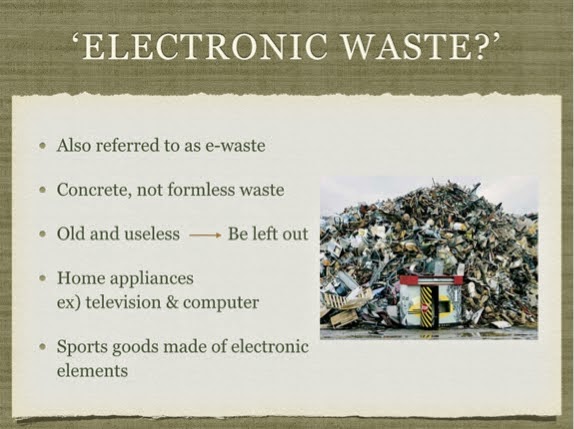
Accumulation of Electronic Waste

Three of my students put together a phenomenal presentation on the accumulation of electronic waste and what happens to a vast amount of it after it is tossed out of the user's home, never to be seen by them again, but to be affected by it again is another story. With permission of Dongjune Lee, Jeongsoo Yoo and Seulki Lee I am able to publish with presentation here. I sincerely thank my students for their great effort in making the presentation and for allowing me to share it!


Usable parts are manually disassembled and separated by metals for recycling. 
Workers in Guiyu work without gloves or any protective clothing. When tested, workers had 82% higher than average levels of lead in their blood. Not only are workers affected, but local water is contaminated and cannot be purified for safe consumption. So why do workers recycle when they know of the risks? A worker gets approximately $8/day for his/her work which is about five times higher than what would be received as a regular farmer or laborer.


Leaders of developing countries must use foresight, but this is hard when economics drive politics
and ready revenue promises quicker development.
Leaders of developed countries as a whole are driven by maintaining momentum for more economic development and expansionism of technology, resulting in economic development overshadowing social welfare. Leaders of developed countries must take a step back and consider the consequences outside of their own country that their push for more technological and economic development are causing. In short, they should act more responsibly for the welfare of the entire planet and not the welfare of the national budget.


Sunday, February 16, 2014

Dogsledding at Wiggi's Mountainside Huskies, MI

Jack London popularized the idea of a dog and/or wolf in both The Call of the Wild and White Fang as powerful friend and means of transport in fiercely cold weather. The Dane, Knud Rasmussen, arctic explorer and Inuit anthropologist, was the first European to cross the Northwest Passage via dogsled. Every year the Iditarod is run, a dogsled challenge of officially 1,049 miles (1688 km). Friends went dogsledding last year and have since talked excitedly about it. I had to give it a try!

There are many sites in Michigan where a person can go dogsledding ... costs fluctuate a bit but weight restrictions pretty much max out at 300 pounds. My friends who went last year sat on a frame of webbing and the two of them were draw-stringed in a sack to keep flying snow off. That didn't sound like much of an authentic dogsled experience to me - sitting in a sack on a webbing with the potential of hitting a stump and getting a permanent implant. So did a little sleuthing online. Most of the sites offer rides for 30 minutes, 1 hour, and custom rides. Almost always, however, there is a weight cut-off of 300 pounds, of course this limit is to protect the dogs from over-exertion. The problem with the weight cut-off would force my brother and I to go in separate sleds at double the expense. Looking further, we found one place that was more rustic than others (perfect - not so commercial!), was three-generation family operated (a family passion and tradition), and way-lah, had a weight limit of 350 pounds. Yeah, a shared experience is so much more fun than going separate ways. We booked!

Guest riders are encouraged to pet and greet the dogs. Wiggi's had 14 dogs and 16 maturing pups. This year three litters had been born and each of the litters had been exceptionally large; I think they originally had 20 or 21 pups before selling some. The first dog we met was three-legged and she had the heart of a runner. A male dog had bit off her leg when she was a rowdy pup, but she had the pluck of a champion and could keep up with the other dogs, but the owners just didn't have the heart to hook her to a sled no matter how much she begged and positioned herself to be hooked up and run. She had the run of both the house and the woods as a much-loved member of the family. The other huskies were friendly, and wow did they get excited when the home-constructed light-framed sleds were dragged out. The dogs seemed to be vying for attention and getting chosen to run, otherwise I can imagine being chained in the long dog-line-up waiting for their turn made the day drag. The young man who took us out was telling us that animal rightists sometimes came by and threatened reporting them for making their dogs "work". Those animal rightists don't seem to understand that some dogs, like huskies, are "work" dogs and die inside without stimulation.


The dogs in line-up ... when the dogsled is positioned for going somewhere, then the dogs really come alive!
Hooking the dogs up. The back left dog is actually a pup in training. In his excitement to run he kept jumping the traces and getting himself tangled. Once out on the trail though he got right in with the concept of RUNNING :)
For the "Kodak moment" I started out sitting, but once a few shots were taken I got on one runner, my bro on another with the musher behind on both runners and controlling the kick-brake and off we went. From our runners we kicked going uphill to help the dogs and maintain speed and, going down, the musher applied the brake as necessary to keep from plowing over the dogs. 
The weather was perfect out! This winter 2013-2014 has been awesomely beautiful ... if one likes snow. Up until today when we went out dogsledding, Michigan has already gotten 88 inches of snow. Of course that all depends on where in Michigan a person is looking at accumulation. Anyway, the day before we went, another several inches fell and we were worried about driving on the back roads north of Cadillac because those roads can't be kept clear fast enough. Had to leave my bro's car, which is rear-wheel drive, behind and use mom's front-wheel drive vehicle. Wouldn't have made it otherwise!


Couldn't have asked for a more picturesque setting!
The snow was perfect for dogsledding though. And with the recent blanket of whiteness, also perfect for pictures. On the dogsledding route weaving through a large wooded expanse, we passed a horse pasture. The poor horses weren't enjoying the snow so much, and just a few days before one of the horses had lain down in the snow evidently to roll but then couldn't get up. Took a couple of hours to dig the poor horse out. Nope, the horses weren't enjoying their little confining trod-down area much.

Well, we did very much enjoy the snowy day. I wouldn't call what we did as an adrenaline-spiking adventure but it sure was a novelty and a wonderful winter-weather experience. Have to say, though, after the 30 minutes of virtually no hand movement on the back of the sled, my front paws were cold. The dogs, on the other hand, were blazing hot ... and were rewarded with venison to say "thank you" for their great effort. 


From my research on what's available for dogsledding in Michigan's lower peninsula, this seems to be the most authentic and uncommercialized. Wiggi's Mountain-side Huskies: wwhuskies@netscape.net and 231-362-2651. They're on FB too.

Dogsledding at Wiggi's Mountainside Huskies, a family-owned business. Have to say, this 30 minute new experience - and in such a fantastically clean pastoral setting - was the highlight of my winter vacation!

Sunday, January 19, 2014

Portrait of an Unknown Woman

The inside of the dust cover reads: Author of Portrait of an Unknown Woman, Vanora Bennett, "was born and brought up in London. She has spent several years working abroad, covering political, military and religious conflicts in unstable countries from Angola to Cambodia to Russia to Zimbabwe. She is a writer and a freelance journalist, writing a weekly column for The Times website, TimesOnline, on the unexpected side of London. She lives in North London with her husband and two children. Portrait of an Unknown Woman is her first novel." It is an masterful weaving of romance, intrigue and art history.
The book centralizes around the artistic family portrait "First Portrait of the More Family" by Hans Holbein the Younger, painted at Chelsea in 1527-28 but destroyed by fire in the 18th century. Bennet depicts Holbein as being intuitive about personalities resulting in paintings that are character studies. Thomas More (1478-1535), author of Utopia, philosopher and lawyer, commissioned Hans Holbein to paint his family picture, and of course Holbein lived in More's home and was sponsored by him during the months of his artist endeavors. As such Holbein got to know the family, their relationships, joys, foibles and tensions, and his painting reflected his perceptions.

More's father and son (both John), his three daughters - Elizabeth (Daucey), Cecily (Heron), and Margaret (Roper) - his two adopted daughters - Margaret Griggs and Anne Cresacre, his second wife Alice, and his attendant Henry Pattinson who represented the fool were included in the family portrait.

The "unknown woman" the book centralizes around is Margaret Griggs, one of the wards who Bennet unveiled at the end of the book as the biological daughter of Thomas More's first love. It was common back in the middle ages to adopt a son or daughter with an inheritance and raise him or her in one's household and marry the adoptee off to one's own biological children, extending the family wealth. Margaret Griggs was a ward but Thomas More only had one son and he was several years younger than Margaret, and Anne Cresacre, another ward, was his intended anyway. Margaret Griggs was the eldest of all the daughters by one to four years and yet the younger daughters were married off but no husband was found for Margaret.

However, unbeknownst to Margaret the family tutor who was hired right after her adoption at twelve or so was to be her intended ... but this was not revealed until the end of the book. Her intended was actually the forcefully disinherited Crown Prince, one of the two princes who were held in the tower of London. Both boys had escaped and Richard, the younger brother, became the tutor for More's children, although Richard had taken on the alias John Clement, a character Thomas More had referred to in one of his books as "my good boy Clement".

Bennet weaves a tale of court intrigue and John Clement, actually the disinherited Crown Prince, recreates himself as a court physician and during a masked ball unknowingly meets his former pupil, Elizabeth Daucey, who is just but unhappily married and masked at the ball but coquettishly entices him to sleep with her. Unfortunately, she is impregnated. Soon after John Clement and Margaret Griggs are married.

"First Portrait of the More Family" by Hans Holbein the Younger,
painted at Chelsea in 1527-28 but destroyed by fire in the 18th century
The second family portrait by Hans Holbein the Younger ...
a family portrait of secrets for family viewing only
A few years pass and Thomas More once again commissions Hans Holbein to paint a family portrait. Holbein comes and is delightfully welcomed by the family, but Holbein, an empathetic character uncovers the family tensions and instead of painting the family in the same position and with the same characters as in the former painting, he switches Elizabeth Dauncey and Margaret Griggs Clement around, altering their focus and tension to John Clement, the only additional person to the painting, and imbalancing the harmony that was felt in the earlier painting. Other tensions are apparent - furrowed brows, taught jaws - hints of something imminent to happen to the family for indeed it was. Thomas More was feeling the pressure of Thomas Cromwell's militant presence and most family members reflected the imminence of the inevitable arrest. Subtle hints of their political persuasions are revealed to the discerning eye.

Supposedly the second painting was never finished, but in its unfinished state was framed and hung in Cecily Heron's home for private family viewing only. No one was to see and infer the heavy tensions and family secrets suggested at by the portrait. Though loved almost like family, Holbein was handsomely paid and sent on his way and the key player who painted and therefore was not in the portrait was evicted far from further family secrets. Thomas More was soon afterwards arrested, sentenced and beheaded. John Clement - the disinherited Crown Prince, now court physician - was also arrested but released. As his older brother Edward had recently died, Richard aka John Clement could have fought for the throne but his fire for revenge had dissipated and would have gone unsupported. He chose to live - he and is wife and son - and only the secrets are alluded to in the second painting by Hans Holbein the Younger.

Monday, December 30, 2013

Despite Alzheimer's, She Is "Still Alice"

"Still Alice", a novel by Lisa Genova is "a poignant portrait of Alzheimer's ... Not a book you will forget." USA Today.
The book starts out with Alice Howland as a fifty-year-old cognitive psychology professor at Harvard. She is a world-renowned expert in linguistics with a likewise successful husband and three grown children. Unfortunately, she suddenly begins to become radically disoriented, forgetful, tongue-tied and is soon diagnosed with early onset Alzheimers. Her career, her family, her very world are rocked! The book is an astute psychological study of an Alzheimer-victim's perspective of what the disease is and how it shakes the very core of her existence. Brilliantly written!


September 2003

Alice is dumbfounded. She has always had near-perfect recall of scientific articles she has read. She has performed with excellence as a dynamic speaker, giving in-depth analytical comments in forums, raising mind-boggling questions and dispelling disputes. She has thrived on a brisk jog after work to maintain her physical capabilities. In September, however, Alice no longer has perfect recall ... she can no longer remember favorite scientific authors, she forgets specific psychological jargon and hears herself using the empty word "things" in her presentations and classes, she even becomes so disoriented while jogging a few blocks from home that she struggles to find her own way home. She is of course stressed and goes in for testing.

As a psychologist she is well aware of why certain neurological tests are given ... the Stroop, Raven's Colored Progressive Matrices, Luria Mental Rotation, Boston Naming, WAIS-R Picture Arrangement, Benton Visual Retention, NYU Story Recall ... all designed to tease out any subtle weakness in integrity of language fluency, recent memory, and reasoning processes. She had given many of the tests before to her students, when she was in control. But today, she is no longer in control. She is the subject being tested.

The outcome ... Alzheimer's .... brain atrophy!

With her surface knowledge of Alzheimer's, she knows that the brain of an Alzheimer's patient has reduced levels of acetylcholine, a neurotransmitter important in memory and learning. She likewise knows the hippocampus, a seahorse-shaped structure in the brain critical for information of new memories, becomes mired in plaques and tangles, and that anomia, a pathological tip of the tongue, is another hallmark symptom. And she knows that someday, she will look at her husband and her children, her colleagues, and faces she's known and loved for forever, and she won't recognize them. And she knows that before that time comes she can expect delusions, hallucinations, agitation, depression, anxiety, euphoria, apathy, disinhibition, irritability, repetitive motor disturbances, sleep disruptions, changes in eating habits to name but a few. Alice chooses denial, denial that she has any problem and doubles her efforts in her work.

June 2004

Alice is back in a tiny testing room with Sarah Something. Oops, she has promptly forgotten the name after being introduced. In the Memory Disorders Unit at Mass General Hospital she is asked many questions about her present circumstances, her family, her visual orientation, words that begin with particular letters, and more. After a bit she is given a paper with an NYU story, a test of declarative memory performance:
"On Tuesday, July second, in Santa Ana, California, a wildfire shut down John Wayne Airport, stranding thirty travelers, including six children and two firemen."
She is asked to repeat the key details of the NYU story, which she does, and the testing continues. On to a Boston Naming Exam. She is asked to name a four-legged animal. "Racquet." And her stumbling of word recall becomes noticeable with the progression of pictures shown. "Oh, wait, I know what it is, it's a ladder for plants, a lattice? No. A trellis!" "Accordion, pretzel, rattle." "Oh, wait again. We have one in our yard at the Cape. It's between the trees, you lie on it. It's not a hangar. It's a ... halyard? No. Oh, god, it begins with H, but I can't get it." Sarah Something makes a notation on her score sheet. She sails through the WAIS-R Picture Arrangement test, Raven's Colored Progressive Matrices, the Luria Mental Rotation test, the Stroop test, and copying and remembering geometric figures. She has been in the testing room for over an hour, and then Sarah Something drops the bomb and asks her about the short story she read earlier.

Oops! "I don't really remember that much."
"That's okay. Tell me what you remember."
"Well, it was about an airport, I think."
"Did the story take place on a Sunday, Monday, Tuesday, or Wednesday?"
"I don't remember."
"Just take a guess then."
"Monday."
"Was there a hurricane, a flood, a wildfire, or an avalanche?"
"A wildfire."
"Did the story take place in April, May, June or July?"
"July."
"Which airport was shut down: John Wayne, Dulles, or LAX?"
"LAX."
"How many travelers were stranded: 30, 40, 50, or 60?"
"I don't know, 60."
"How many children were stranded: 2, 4, 6, or 8?"
"8."
"Who else became stranded: 2 firemen, 2 policemen, 2 businessmen, or 2 teachers?"
"2 firemen."
"Great, you're all done here. I'll walk you over to Dr. Davis."
Great? Was it possible that she remembered the story but didn't know she knew it?

October 2004

After jogging one day she enters her house. Her house? The refrigerator is in a different place. Well, maybe not, but it does seem different. The microwave? Hmm, some other things seem a bit odd, and then there is Lauren her next door neighbor suddenly standing behind her politely asking why she is in her kitchen. HER kitchen? Just whose kitchen is this? After that, whenever she returns from jogging she makes sure that she has the right house, the one with the note in bold black letters on the fridge saying:
ALICE,
DO NOT GO RUNNING WITHOUT ME.
MY CELL: 617-555-1122
ANNA: 617-555-1123
TOM: 617-555-1124
John made her promise not to go running without him. Recently her spatial perception has been off. Objects sometimes frequently appear closer or farther away than they actually are. She's had her eyes checked. They are fine. The problem isn't corneas, lenses or retina. The glitch is somewhere in the processing of visual information, somewhere in her occipital cortex. She evidently has the eyes of a college student but the occipital cortex of an octogenarian. She calls John in her impatience and anger at her life changes. John is in a meeting, but answers the phone anyway. He can't promise when or if they can jog today. He is busy, he has to go. Blazing anger overtakes her! Each time he doesn't take her she is consumed with the thought of losing more invaluable and irreplaceable neurons. She calls him back.

"I need to run today."
"I don't know yet when my day's going to end."
"So?"
"This is why I think we should get you a treadmill."
"Oh, fuck you," she said, hanging up.

She supposes that wasn't very understanding. She's had a lot of anger lately, but she couldn't say if this was a symptom of her disease advancing.

Summer 2005

She sat in a white wooden chair on a deck drinking tea when the man of the house [John] approaches her with a butterfly necklace [hers].
"That's not my necklace, that's my mother's. And it's special, so you'd better put it back, we're not supposed to play with it."
"I talked to your mom, and she said you could have it."
She studied his eyes and mouth for motive, but before she could decipher his sincerity, the beauty of the sparkling blue butterfly seduced her, overriding her concerns. "She said I could have it?"
"Uh-huh."
............................................

She sat on the floor in front of the full-length mirror in the bedroom she slept in and examines her reflection. The girl in the mirror has sunken, darkened circles under her eyes. Her skin looks loose and spotty all over and wrinkled at the corners of her eyes. Thick scraggly eyebrows need to be tweezed. Her curly black hair, wait, the girl's hair isn't black but is very shot with gray. The girl in the mirror looks ugly and old. Running her hands along her own cheeks and forehead she comes to a startling realization, "That can't be me. What's wrong with my face?" The girl in the mirror sickens her. "What's wrong with these mirrors?" The bathroom doesn't smell right either. There is a bucket on the floor offending her nose. She pries off the lid. Something white and sticky. She dips a brush in, and watches a creamy white paint dribble down. She knows each of the mirrors is defective, the one in the bathroom, the one in the bedroom where she slept. She found four more before she finished and had painted them all white.
............................................

She sat in a big white chair, and the man of the house [John] is in another one. He is reading a thick book and drinking a drink that is yellowish brown with ice in it. She picks up an even bigger book and thumbs through it. Her eyes pause on diagrams of words and letters. Her eyes land on individual words ... disinhibition, phosphorylation, genes, acetylcholine, priming, transience, demons, morphemes, phonological.
"I think I've read this book before."
The man looks over and nods. "You've done more than that. You wrote it. You and I wrote that book together."
Hesitant to take his word, she closes the book and reads the shiny blue cover, "From Molecules to Mind" by John Howland, PhD and Alice Howland, PhD. She looks up at the man. He's John. "John..."
"Yes." He draws closer.
"I wrote this book with you."
"Yes."
"I remember. I remember you. I remember I used to be very smart."
"Yes, you were, you were the smartest person I've ever known."

Tuesday, November 26, 2013

Useful Internet Sites for Teaching

This collection of Internet sites was gathered at one of our teaching seminars at Korea University. I have my colleagues to thank for such a great list of teaching resources to escape the monotony of the traditional textbook!

Voxopop:    
(Username: XXXXX             Password: XXXXX)
  • Use this site to create a class group to store all recorded files in one place.
  • Useful for speeches, anecdotes or speaking practice for individuals.

Wordpress:
http://wordpress.com/               
(Username: XXXXX             Password: XXXXX)
  • Use this site to create a class blog for social or academic purposes.
  • Can also be used to post entries on a forum.

Moodle:       
Usename: XXXXX                Password: XXXXX)
  • Create an e-learning platform (similar to EKU or an educational portal)
  • Use for discussion forums, assignment submission, projects and chats

Wikispaces:
(Username: XXXXX             Password: XXXXX)
  • Create an e-learning platform with a focus on writing and assessment
  • Create spaces for social writing, project submissions and grading

Check My Words:
  • A useful site for students to use with Microsoft Word
  • Users download a toolbar which explains common errors, reads the words written and links to online dictionaries.

Mark My Words:    
  • A useful site for teachers to use with Microsoft Word.
  • Using documents online, insert automatic comments onto work
  • Link essay points to suggested links for research

The Corpus of Contemporary American English:
  • A free corpus with a variety of search options
  • Shows different genres of words
  • Users can also be sent a new academic word list

FLAX Interactive Language Learning:
  • Written texts and tools to work with them
  • Contains a collection of essays written by university students in English universities from BAWE collection (British Academic Written English Collections)
  • Essays classified by subject or genre


Citation Machine:
  • Quick and easy citation generator for APA, MLA, Chicago and Turabian documentation
  • Gives properly formatted citations for references pages and in-text citations for a variety of print and virtually all non-print options
  • Fill-in-the blank and copy and paste

Google Drive for Making Surveys:
  • The YouTube video explains how to create a survey with GoogleDrive
Purpose of Class
  • To teach students to become independent learners by using online resources
  • To provide students with a method to attain primary sources

Ted Ed:
  • Use this site to create your own ready-to-use TED class lessons.
  • Can also use lessons created by other educators.

World Teacher:
  • Though primarily an ELT site, she has some great ideas for academic class projects and also gives comprehensive links to other educational aspects.

Learning English Online:
  • Extremely useful site for specific vocabulary-related and grammar-related points.
  • Has a host of cultural information useful for various aspects of teaching.
  • Can also be used as a good point of reference for students wishing to do self-study.
 
Tumblr:
  • Using a very simple blog interface to host files, use for in-class lessons, and post homework assignments

 
English Central:
  • Use this site to allow your students to learn the 570 most common Academic English words.