Tuesday, January 3, 2017

Getting Old, Being Mortal

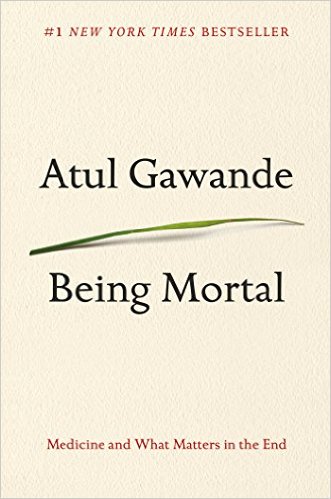
Atul Gawande's 4th book!
Atul Gawande — author (of three best-selling books - Complications, Better and The Checklist Manifesto), surgeon at Brigham and Women's Hospital in Boston, staff writer for The New Yorkers, professor at Harvard Medical School and Harvard School of Public Heath— is one of my favorite authors. Despite being a physician himself, he is forthright in saying that doctor's are not gods and astute in analyzing the odd triangular relationship of doctors, patients and medicine in general. His book Being Mortal is even more of an eye-opening analysis of the "problem" of aging, for that is how society now views it ... not aging as inevitable but more as a problem. He looks at the history of aging, perceptions of aging and how advanced medicine has changed those perceptions. This book must be read, shared, concepts discussed must become more than just concepts but must enter mainstream dialog, for by talking through our aging processes, Dr Gawande is showing that people are more accepting of the inevitable rather than undergoing massive amounts of medical treatments for extended life, but at what cost, longer life but one that has little value.

Points of awareness I want to retain:

The elderly in the US are classed by health care professionals as to what functions they can perform: 
  • The 8 "Activities of Daily Living" - If you are incapable of doing without assistance — use the toilet, eat, dress, bathe, groom, get out of bed, get out of a chair, walk — you lack the capacity for basic physical independence ... therefore nursing home care is required.
  • The 8 "Independent Activities of Daily Living: - If you cannot— shop for yourself, prepare own food, maintain housekeeping, do your laundry, manage your meds, make phone calls, travel alone, handle your finances— you lack capacity to safely live on your own ... therefore, assisted living is required.
The teeth tell the aging story— experts say they can gauge a person's age to within five years by the examination of a single tooth (if the person has any teeth left). How? Teeth are the hardest substance in the human body, but with age the white enamel wears away exposing the softer, darker layers. Meanwhile, the blood supply to the pulp and roots atrophies and saliva flow diminishes. The gums become inflamed and pull away from the teeth, elongating the appearance, esp the lower ones.

To really know how an elder person is, always examine the feet! (p 40) Elderly can look dapper and fit but the feet tell the truth. Clipped toenails? Fungus? Bunions? Problems that cause poor fitting shoes, or shoes that are incorrect for posture, or injuries that affect walking ... which in turn affects hips and back being thrown out of alignment, or broken by pending falls. Can in fact the person touch his/her feet? 

A geriatrician should realize that aging of the body and the mind cannot be stopped; therefore, he/she should look at what functions the elderly have (like good shoes and proper foot care, and prescription medicines that don't, in combination, cause dizziness) and focus on prevention (like falls from floor mats and floppy shoes) rather than only giving prescriptions. 

Swallowing becomes a problem as people age. The lordosis of the spine tips the head forward, so when he/she looks straight ahead, it's like looking up at the ceiling for the non-aged. Therefore, for the elderly trying to swallow while looking up is a recipe for choking. The elderly might therefore need to eat while looking down.

Keren Brown Wilson, one of the originators for the concept of assisted living, built her first assisted living home for the aged in Oregon in the 1980s. In doing so, she was trying to eliminate nursing homes for the elderly and give them a home where they could age with autonomy, in other words, give them a "home". (In mind, she had her own mother who had suffered a debilitating stroke at the age of 55.) From there, the concept of "independent living" took off, but lacking Keren Wilson's vision for living with autonomy, assisted living residences only became an intermediate step before going to the nursing home.
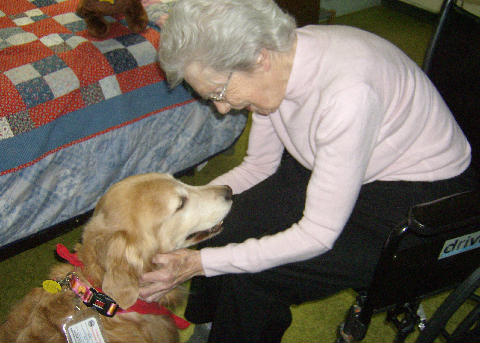
(blog link - excellent read on Bill Thomas's audacious conversation to get the dogs, cats and birds)

Bill Thomas, of upstate New York, was a young physician that performed a radical experiment. In school he was "a pain", never studying, always questioning, and if the term had existed then, he would have been labeled as ODD - Oppositional Defiant Disorder. Ultimately, he connected to the idea of being a physician and did an about-face from not studying to studying and gaining entrance to Harvard Medical School. After graduation, he moved back to quiet upstate New York, eventually accepting a job at a nursing home, and with his glib tongue, wrangled the counsel members to allow him to bring in animals into the nursing home to give the residents, who had no inertia or desire to live, something to focus on. Not just a dog or a cat, but he started with 2 dogs, 4 cats and 100 parakeets. Residents were asked if they wanted a cage with parakeets in their rooms ... and the place came alive. People who didn't talk, took interest, named their birds, gave directions on the care of their birds, one man even came out of despondency, gained health again and returned back to his home to live by himself. The place was an utter success! According to research on the outcome, drug costs (mostly drugs for psychotropic agitation) dropped to just 38% and death fell 15%. Dr. Thomas writes about his experiment: Life Worth Living ... the Eden Alternative in Action.

The national Coping with Cancer project published a study that showed that caregivers of terminally ill patients who spent their last days in ICU were three times more likely to suffer major depression. In short, spending one's final days in ICU is like failure, failure to live life and pass with dignity as they are attached to ventilators, in delirium and permanently beyond realizing that they will ever return home.

People in the past died quickly, but in the present people don't want to accept death, and so extend life with medical "advancement", often compromising the quality just to obtain quantity. Examples of US presidents who died quickly:
  • George Washington - throat infection one evening and died the next
  • John Quincy Adams, Millard Fillmore, Andrew Johnson - had strokes and died within 2 days
  • Rutherford Hayes - heart attack and died 3 days later
Not passing quite so quickly:
  • James Monroe, Andrew Jackson - died from long-lasting tubercular consumption
  • Ulysses Grant - oral cancer, died after 1 year
Mistakes doctors make are often conceptual. No one wants to admit that death comes. No one wants to sit down and talk directly about whether they want chemo or not, to be resuscitated or not, hospice or not. Basically, there's little to no discussion about facts and options. Doctors see themselves as prolonging life, and that image is often forced onto the patients and their families.

To discuss mortality with someone can be approached responsibly. According to palliative specialists, no one should say, "I'm sorry things turned out this way," which is distancing, but a preferably approach could be, "I wish things were different". And instead of asking, "What do you want when you are dying?" could be rephrased as "If time becomes short, what is most important to you?"

Sunday, December 11, 2016

Silk Riders: On the Trail of Marco Polo

Silk Riders: Jo and Gareth Morgan's Incredible Journey on the Trail of Marco Polo was an interesting read. Jo and Gareth were avid motorbikers, and as they were finishing a ride high in the Indian Himalaya they started thinking of their future tours. A fellow rider tossed out the silk road and Jo and Gareth really liked the idea. The trip took two years to organize. In that time they had to figure out political details, travel logistics, cultural awareness issues, get and curry sponsorship, and of course figure out who among their friends could join them on their trip. BMW only provided at large discount 7 bikes and so the trip was limited to 7. 

The 7 were kiwis, but their trip would begin at the BMW factory in Munich where the new bikes recently broken in in the Australian outback and imported into Germany to begin the trip would get a total tuning in readiness for the multi-thousand-kilometer journey.


Then in 2005 the trip began. They were waved off in Munich by a single person, an English motorcyclist who journeyed from Yorkshire to Bavaria to see them off, and off they went through the lower reaches of Germany, into Austria, to the foothills of the Alps, and onward to Venice, the family home of Marco Polo. Despite the Polo family being one of the most prominent families of Venice and despite the since fame of the explorer, the 7 were surprised at the few memorials commemorating one of the city's most famous past residents. There is a library where Marco's last will and testament is held and the San Lorenzo church, in the yard of which he was buried in 1324. Near the site of his homestead is an area of little courts called 'Il Milione', which was Marco's nickname, 'the teller of a million tales'. 

Then off to the Balkans they sped. Few people are aware that Marco Polo was not a Venetian by birth but rather a Croatian. Marco was born on Korcula, an island of what is now Croatia. Of course the 7 had to go to the island, ferrying one of the bikes over for a picture with the iconic bike in front of what is said to be the house of Marco Polo's birth. 

To Serbia, Bulgaria, then Gallipolli, Turkey, which was very significant to the Kiwis as they recalled the Kiwis who died trying to claim the cliffs of Gallipolli. Onward to Istanbul where Jo started to having trouble as women were not to be seen in public, certainly not on a motorbike, and even though as she progressed further into Iran, the chador she wore just wasn't quite enough because it outlined her provocative bottom as she sped along. 

A disappointment to me in the book was the little attention given to following the trail of Marco Polo, as far as information on what they discovered in relation to Marco. Instead, the intent of the book was just to skim over the countries the 7 sped through and give mostly motorcycle commentation on the road conditions or visa issues. There were tidbits on culture but obviously the book was about a mad dash across Asia following a trail and not really picking up that many culturally rich experiences. 

That said, the highlight of the Iranian segment of the trip was the visit to the Valley of the Assassins, of which Marco wrote. The fortress of Alamut still remains, and as legend goes, an 11th century Hashish-iyun sect, basically an Islamic mercenary group led by a fanatical imam, had an unusual method for training young men to fight unconditionally. He would dose them with hashish and then turn them loose in a five-star pleasure garden stocked with milk and honey and virgins--all accouterments of paradise. After a couple of weeks, he removed them and cut off their narcotic supply. Finding themselves in a military camp they were told that they had been to paradise and if they hoped to live again in the style they had experienced in paradise, they would need to distinguish themselves in battle, and the imam of course provided that. These feared, driven warriors were known as Hashish-iyun, and the word 'assassin' derives from this group.


The Silk Riders only did the overland route from Venice to Xanadu (now Yuanshangdu) and down to Beijing. They didn't even attempt to follow Marco's route of 20+ years. 

To Tehran (the city that couldn't possibly have worse traffic, and motorcycles were forbidden in them for fear of drive-by motorcycle gunners) so their motorcycles were transported via truck. Lots of problems but eventually they were allowed to proceed onward to Turkmenistan, perched on the edge of the Karakum Desert across which they would have to travel. 

Then to Uzbekistan, the country that is the world's largest silk producer, and the country that was the half-way point of the 7 bikers' trip. Onward to Kyrgyzstan and most notably to Kara-Kul in the northwest where there are soaring mountains, alpine meadows and cooler temperatures. Close is the beautiful Lade Issyk-Kul, the second highest navigable alpine lake in the world after Lake Titicaca in Peru. Jo had swum in Lake Titicaca two years previous on another tour, and she attempted to take a dip in Lake Issyk-Kul in memory of her previous swim.

Of course they had chances to try the many exotic foods on the regions they passed through. In Kyrgyzstan is was the kumys, the fermented mare's milk popular among the nomads and which Marco had reported favorably that the drink tasted like white wine. The 7 heartily disagreed!

To China. One of the most amazing highlight in China was in Dunhuang, known for the famous Mogao Grottoes, or the Caves of 1000 Buddhas, which is a structure carved into a rocky cliff-face at the edge of the Lop Nor Desert. The Buddhas trace back to the first which was carved in AD366 when a Buddhist monk carved one Buddha figure into a rock. Over the ensuing 1500 years, more Buddhas were added, but not only Buddhas as the name suggests, but also the life of the local people. In the 20th century a chamber was discovered containing thousands of manuscripts which had been sealed since the 11th century. Unfortunately, explorers from England, Germany, Russia and more countries pillaged the place, dispersing artifacts around the globe but leaving the caves as empty shells, but ones which continue to whisper the reminders of great secrets from Chinese antiquity.

Continuing onward out of the desert great mounds of packed earth started appearing ... remnants of the ancient Great Wall which ended in the desert and which in their entirety were built over a period of 1500 years. This amazing wall eventually was over 10,000 kilometers in distance, but despite the great expanse, the beacon towers could relay a message of attack, fire, emergency from the furthest-most tower in the desert back to Peking in less than 30 minutes! 

Of course they cycled to Xian, the capital of China until Kubla Khan (Marco's Great Khan), the man who shifted the reins of command to Peking in the 14th century. They viewed the 2000-year-old, life-sized warriors guarding the royal tomb that was discovered in 1974 by a farmer digging a well. The 7 reckoned 300,000 workers were needed in this construction that took over 35 years to build.

From Xian to Mongolia, the end of the road. They headed to Shangdu, known to Marco as Xanadu and which, according to Samuel Taylor Coleridge, Kubla Khan had his stately pleasure-dome. Once they got there, they were in trouble with the authorities as to their purpose in that town. And then they came to realize that Shangdu was not the old Xanadu but Yuanshangdu, 200 kilometers away, was. And off they sped to Yuanshangdu, where in 1275 Kublai Khan had received Niccolo and Maffeo Polo and Niccolo's boy, Marco. This was the town that marked the eastern limit of Kublai Khan's empire, which stretched right back the way they had come, to Hungary. This was the end of the Silk Riders enterprise. Since April, they had covered almost 20,000 kilometers, crossed two major deserts, dodged through a war zone, visited the three inland oceans of the Black Sea, the Caspian Sea and the Aral Sea, and traversed the entire distance from west to east of the Great Wall.

They saddled up and set off for Beijing, the city known as Khan-Balik, "the Lord's City", in Kublai Khan's day. Their journey culminated with a ceremonial banquet at the New Zealand embassy and well attended by members of the BMW owners' club. would be held in their honor for the completion of their journey.

For a 52:30 minute YouTube clip on their journey, watch "Silk Riders - Motorcycling tour in the footsteps of Marco Polo",  and their blog on their journey.

Sunday, November 27, 2016

Mongolian Dzud

A group of my clever students not only put together a very well organized presentation on a current environmental issue, but they also introduced one that no one in the class had heard of before, including myself. Great job on all accounts! Requirements were to give a team presentation with each team member building on the previous person's data and each person using only 4-5 slides. All content was to have basic referencing and then after presenting, members were to have a Q&A on their presentation. Very impressive on all accounts. Thank you You Seung, Jae Min, Yu Jin and Eun Ji for allowing me to publish your work here. I love it!  ♥ ♥ ♥ ♥