Thursday, November 13, 2014

20 Favorite Tiny Houses

Living most of the year in South Korea but in the future needing a "place" to call my own in the States when I'm visiting, I happened across a tiny house .... and fell in love! My current apartment is 10'3"W x 21"L with perhaps a 10' ceiling. It's a professor dorm room and I get so irritated that I have to use the university furniture and not my own. The furniture they offer is bulky and not space-saving, and in some instances, not useful at all. I wanted to chuck the bulky TV stand out with its ice-age monstrosity of a TV, a useless space-consuming night stand, and a 21" wide wardrobe that not much fits in (I had a 36" one which I would have donated upon leaving the dorm but that was NOT to be discussed). No, no, no, I must keep every ice-age artifact no matter that none were designed for limited space. Irritating, especially when I plan to be here a few years.

Max dimensions of a tiny house if one wishes to pull it without hiring assistance is: 8'4"W x 13'4"H x 40'L (and the max of the truck pulling the house along with the house is 65') I don't know if the the 40'L tiny house requires a special license for towing, but it would seem likely. The width of 8'4" is inclusive of the eaves!
Anyway, when I saw the layouts of the tiny houses, I thought, "Wow, I can live in less space but have all the conveniences I want if I design my own space!" And from there, I went nuts on design. Ideally for parking, the 8'x28' trailer rocks, but it's a bugger to haul around. The 8'x20', however, is both OK for some traveling and can hold all I need to hold. So, I went to all my favorite tiny houses and gleaned ideas to maximize my space!

The big points that I most want to focus on when personalizing my own tiny house are:
  • kitchen (I have food sensitivities and eat tons of veggies so I also need a sizable fridge; oven not an essential as I hardly use flour, but I want lots of cabinet space for high speed blender, crockpot, and rice cooker as I use them so regularly)
  • lots of desk space and of course bookcases!
  • good space for a hot shower and maybe a hot soak in winter
  • hanging storage for clothes (I hate drawers)
I've designed my personal 8'x20' tiny house but won't put it here. The loft isn't too creative, but the rest is totally unique. And someday when I finally get around to building, as each tiny house is uniquely different than others, mine will be a new model altogether. Ah, free thinking here. But then, possibilities are only limited by one's imagination ... or lack of.


8'x20" options:


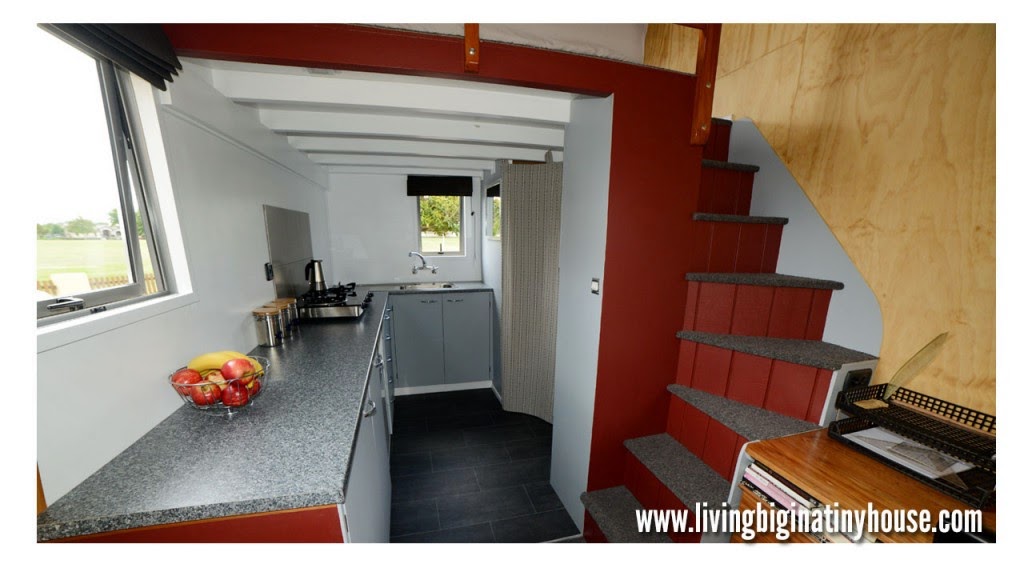
My all-time favorite! I love the slight slant of the ceiling to maximize on loft space and the color scheme with white walls. In fact, this is the loft and wood-and-white appearance I'd like in my tiny house. Built on a 8'x20' but the total dimensions are: 8'6"x20x13'4" (so technically it exceeds the road width dimensions by 2" ... and yet it was hauled across country to California).


Designed by web designer - cost $30,000
Another link of picts
Blueprints

Another favorite because of the very utilitarian space and the large loft is "Cypress 24". The tiny house looks like a behemoth with its wheel base and long body on each side, I'm really struggling to believe this measures out at 7'4"x20". [Maybe it's the Cypress 20 that is 20' long - that makes sense.]

Cypress 24

Next, with solar panels! Also nice wood interior, couch converts to fold-out bed, and other great space savers. I like being off-grid, but even after several tutorials on setting up electricity-less heating and the use of solar panels, I'm not confident that I could set it all up correctly, especially as nitrogen gas is emitted with solar batteries and one must take counter measures ... or just plan on being on grid. Oh, and must not forget the cat! A lot of tiny house owners have cats ... and no house is complete without one. Must therefore think about a ladder structure other than very space-saving upright ones so that the cat can have access to the loft. (7'x20")


Off-grid with fine wooden interior

Vina's tiny house has amazing aesthetics! Neat, clean, homey, inviting! And French doors (although even with a magnetic netting, I'll bet mosquitoes find a way in ... so no beloved French doors for me). I love the near white walls with light wood. The light colors give an amazing spaciousness that isn't in the all-wood interiors (I feel heavy and depressed in those environments). The inside measures slightly more than 7'x19' even though the house is built on a 8'x20' trailer. Figuring in the wall measurements is an essential before building, otherwise the tiny house won't be allowed on the road if it exceeds 8'4"Wx13'4"H.


Vina's tiny house - gorgeous!

April's tiny house - April, a grad student built this home ... using the wood colors that I absolutely love! It's simple and gorgeous. In fact, the half-moon window is what really makes this tiny house transform into a spectacular masterpiece! (7'4"x18'7")


April's tiny house

The Bayside Bungalow - the linked site has a photo diary of how the tiny house was constructed. Again, this tiny house has light wood and white to make the space seem larger than reality. What I really like, however, is the front door with its large glass inset. Brittany Yunker, the designer and builder, was so proud to find the door after ages of looking. She says that the door is what makes the statement for the house ... and I will agree with her ... along with the spectacular half-moon window like in April's tiny house!  (8'x19' but 8'5" with eaves x 19')


Bayside Bungalow for rent

8'x16' options:

Sweet Pea tiny house, or Gina's tiny house. There's an amazing lot in this tiny house - French doors, a spacious living room feeling with tons of book shelving, and yes, a bathtub (probably a RV size bathtub but this is very uncommon in tiny houses. RV bathtubs come in 36", 38" and 40" sizes. Nice!)   On a 8'x16' trailer.


Sweet Pea tiny house or Gina's tiny house

A custom-created tiny house. The woman who ordered the house designed it herself, and she had some very good space-saving ideas. One I particularly like is the escape door through the bathroom. This door is kind of essential as a 4' gate can be accidentally pinned in the travel position, trapping anyone left inside. Instructional video is attached. (8'x16')

Lots of interesting features for its size ... with a "back door"

Another custom-created house (Mendy's tiny house), also with a folding-down 4' back porch. I like this added "free" spaces it really extends one's personally defined space. On the other hand, I very much dislike the stark black-and-white interior but the lighting and usage of windows is really well done. The outside dark framing of windows and doors with black gives it an Asian feeling ... this is just begging to be emulated. Very good for dimensions of 8'x16'.


Mendy's tiny house built custom at Tennessee Homes

8'x22' options:


Elaine's portable cabin by Rich Daniels is gorgeous also with what appears to be sliding glass doors, two sets of them!!! I love the sliding glass door concept, but the minimum width I'm finding is 5' wide - 60"Wx80"H or 5'Wx6'8"H. French doors can be as narrow as 4' wide ... but they let in a lot of mosquitoes and they require space to swing outward or inward. Definitely sliding doors are on my list ... but finding 4' doors is looking to be an impossibility (custom made with its sky-high expense is not an option). This model has no loft, yet is 176 sq ft and really uses the space and light well.


Elaine's tiny house

8'x24' options:


Music city tiny house is another of my favorites. It really comes across as very spacious and very well laid out with two lofts and a kitchen with a lot of counter-tops and full-sized kitchen appliances! However, I do think there's a lot of wasted space in this place but it is only a vacation home or rental and therefore doesn't need to utilize every nook and cranny and also doesn't need closet or storage space, which it definitely lacks. Another downside is the French windows; while beautiful, they open inward and so need a lot of inside space without obstructions. Beautiful overall though and this design is definitely influencing how I design my home, esp with the great use of high windows! (8'x24'x13')


Music city tiny house

Brevard tiny house also has a nice layout built by two sons for their mother. There's even a built-in staircase because she isn't comfortable on a ladder. What I really like though are the pull-out drawers with kitchen appliances. When not in use, they just tuck away without mess or fuss in the cupboard! (8'x24')


Brevard tiny house built by two sons

Little Beach cottage on wheels is very cute! It features full-sized kitchen appliances, an excellent living room space in front of French doors and even has a little cute porch ... which is really weird because to get to the porch, a person must go outside and then climb on the porch, not just step out of their door and sit down. Quite spacious though. (8'x24')


Little beach cottage on wheels

8'x28' options:


This was the first tiny house I saw ... and it is the inspiration behind me wanting to live tiny. It wouldn't be much of a downsize in such a huge space though. I LOVE LOVE LOVE the big kitchen! But even though I'm a minimalist, I don't have just four pair of pants and four shirts like the couple do. I want some closet space, eliminate some of the boxy cupboards and put in a bathtub ... some other changes, but yes, I do very much like this space. (221 sq. ft. 8'x28' - actually 8'6"x28').


Fantabulistic tiny house (8'x28')

The Bohemian based on the online blueprints of the above tiny house. And here is a tiny house that was custom-made for a couple using the blueprints. The staircase and boxy cupboards were eliminated which really opened the floor plan up a lot!


The Bohemian (8'x28')

Minnesota tiny house or Kasl family tiny house. Oh, I so love the pale lime with white interior! The interior in total is really fantastic. I'm still not sure of the dimensions of this tiny house but it looks pretty long to me so I'm guessing it's 8'x28'. [Kim Kasl saw this blog and corrected the dimension - 8'x24' but in reality is only about 22'L inside. Thanks, Kim!]


Minnesota tiny house or Kasl family house

Other "largish" tiny houses"


Smart student units, 10 sq meters, Sweden. Seems to be an early prototype for future housing for students. Not large by any means, but very well organized ... and utterly cute!


Smart student units - Sweden

Brett's tiny house. Living off the grid in Australia in 2m x 7m x 4.17m. This is completely self-sufficient living. The roof has built-in water collection which empties in a massive holding tank in his living "couch", there're solar panels, and a video tour is available. The video tour is especially interesting as it introduces some of the setup needed for a technical closet for controlling the heat, cooling, solar battery reception and charge, etc. 

Brett's tiny house - Australia

Luxury Japanese-influenced living! This 10'?x20' tiny house has no wheels, but it is a beauty! Wow, I could really do a lot of borrowing of ideas out of this house if I could find some unique round and moon-shaped windows cheap enough! I love the RV-size bathtub arrangement too. Overall, this is quite the efficient space saver and extremely attractive at the same time. I love Asian ... hence living in Asia, so my tiny house will certainly reflect my foster country of choice.


Japanese-influenced tiny house

The "Minim" probably a shortening of minimum. The tiny house has solar panels and an energy-saving electric panel (burns the same energy as 4 incandescent lightbulbs) to supplement with heating, and a beautiful floor plan with tons of unique space-saving ideas. The kitchen setup is phenomenal, and the video covers many of the space-saving ideas employed in creating this very versatile living space. (10'x21')


The "Minim"

Other Tiny House Resources:


Monday, October 13, 2014

Stunning Rice Paddies in Japan

The fields in some locations in Japan at first look ordinary enough ... until the rice begins to grow!


Stunning crop art has sprung up across rice fields in Japan, but this is no alien creation. The designs have been cleverly PLANTED!

 Farmers creating the huge displays use no ink or dye. Instead, different colored rice plants have been precisely and strategically arranged and grown in the paddy fields. 

As summer progresses and the plants shoot up, the detailed artwork begins to emerge.


A Sengoku warrior on horseback has been created from hundreds of thousands of rice plants. The colors are created by using different varieties of rice plants, whose leaves grow in certain colors. This photo was taken in Inakadate, Japan.


Napoleon on horseback can be seen from the skies. This was created by precision planting and months of planning by villagers and farmers located in Inakadate, Japan.


Fictional warrior Naoe Kanetsugu and his wife, Osen, whose lives are featured on the television series "Tenchijin" appear in fields in the town of Yonezawa in the Yamagata prefecture of Japan.


This year (2010 or before - I received these phenomenal pictures via email in July 2010), various artwork or smaller kinds of "crop art" has popped up in other rice-farming areas of Japan, including this image of Doraemon and deer dancers. 

The farmers create the murals by planting little purple and yellow-leafed Kodaimai rice along with their local green-leafed Tsugaru, a Roman variety, to create the colored patterns in the time between planting and harvesting in September.
 The murals in Inakadate cover 15,000 square meters of paddy fields.


From ground level, the designs are invisible, and viewers have to climb the mock castle tower of the village office to get a glimpse of the work.

Closer to the image, the careful placement of the thousands of rice plants in the paddy fields can be seen. Rice-paddy art was started there in 1993 as a local revitalization project, an idea that grew from meetings of the village committees. The different varieties of rice plants grow alongside each other to create the masterpieces.


In the first nine years, the village office workers and local farmers grew a simple design of Mount Iwaki every year. But their ideas grew more complicated and attracted more attention. In 2005, agreements between landowners allowed the creation of enormous rice paddy art.
 A year later, organizers used computers to precisely plot the planting of four differently colored rice varieties that bring the images to life!

The new revitalization project designs in Japan are truly works of art!!!

Friday, September 26, 2014

"Princess" of Saudi Arabia

The book Princess by Jean P. Sasson is "an appalling indictment of the treatment of women in Saudi Arabia" and an "unforgettable ... fascinating book to move you to tears". The book is about one of over a hundred-plus princesses, the granddaughters of Abdul Asis ibn Sa'ud, who speaks out to Jean Sasson to write the conditions of women forced to hide behind the abaaya, the black veil. Women are not owners of their own bodies, their own destinies, or their even their own children. They are chattel to men, passed off after menses at early ages to become wives, sometimes second, third or fourth wives, and quite frequently these husbands are as old, if not older, than their own fathers. The women must obey their husbands implicitly, prepare their bodies to be used by their husbands upon demand, be ordered to appear or not appear, be escorted by men wherever they go. When their sons become older and the husbands cannot provide escort, then the sons are the escorts.
Sultana, the princess in the book, is fiery and wants the world to hear the conditions of the Saudi Arabian women to give the world understanding and not be afraid of the only visible parts of women - the blackness of their eyes and the blackness of their robes - and to judge that limited dark view of women. Sultana cannot escapes her gilded princess cage in Saudi Arabia. She remains the property of her husband, and sees her daughters grow up to become property themselves. Yet, to speak out even slightly would mean to denounce Saudi Arabia, the Koran, and/or her own husband, and any insult to any of them would mean her being sentenced to some punishment away from her children, and so she continued to silently exist in her gilded cage ... but with the knowledge that the book Princess would be published and begin to let the Western world have some understanding about the "freedom", or lack of it, of the Saudi Arabian women.

The Laws of Saudi Arabia


The criminal laws of Saudi Arabia adhere to strict Islamic precepts. The word Islam means "surrender to the will of God". The most important concept of Islam is the Shari'a, or the "path", which embraces the total way of life ordained by God. All peoples of the Islamic religion are expected to conduct their lives by the traditional values set by Muhammad, the Prophet of God, who was born in AD 570 and died in AD 632.

It is difficult for most Westerners to understand the complete and total submission of Muslims to the laws of the Korean in every aspect of their daily life. The Koran, along with traditions set by Muhammad, is the law of the land in Saudi Arabia.

While Jean Sasson was living in Saudi Arabia, she once asked a noted scholar of Islam who made his living as a lawyer, to describe the Saudi Arabian application of justice that stems from the teachings of the Prophet. His explanations helped dispel her misunderstandings of Saudi law.

  1. There are four main sources of the Shari'a: the Koran, which is compiled from thousands of religious verses revealed by God through his Prophet, Muhammad; the Sunna, which are the traditions the Prophet addressed that are not recorded in the Koran; the Ijma, which are the perceptions of the Ulema, or religious scholars; and the Qiyas, which is a method whereby known jurists agree upon new legal principles.
  2. The king of Saudi Arabia is not exempt from the regulations set forth by the Shari'a.
  3. The court system itself is complicated, but if a judgement is taken to appeal it is reviewed by the court of appeals. This court, usually consisting of three members, increases to five members if the sentence imposes death or mutilation. The king is the final arbitrator who serves as a final court of appeal and as a source of pardon.
  4. Crimes are classified into three divisions: Hudud, Tazir, and Qisas. Crimes of Hudud are crimes that are denounced by God; the punishment is made known in the Koran. Crimes of Tazir are given to the appropriate authority to determine punishment. Crimes of Qisas give the victim the right to retaliate.


CRIMES OF HUDUD

Crimes of Hudud included theft, drinking of alcohol, defamation of Islam, fornication and adultery.

Persons found guilty of theft are punished by payment of fines, imprisonment, or amputation of the right hand. (The left hand is amputated if the right hand has already been amputated.)

Persons found guilty of drinking, selling or buying alcohol, sniffing drugs, taking injections of drugs or stirring drugs into dough are punished by a sentence of eighty lashes.

Persons found guilty of defamation of Islam are sentences according to the circumstances. The harshness of the sentence varies depending on whether the person is a Muslim or a non-Muslim. Flogging is the general punishment for Muslims.

Persons found guilty of fornication are flogged. Men are flogged while standing and women while sitting. The faces, heads and vital organs of the guilty are protected. The usual number is forty lashes, but this number may vary according to the circumstances.

Adultery is the most serious of crimes. If the guilty party is married, her or she is sentenced to death by stoning, beheading or shooting. Stoning is the usual method of punishment. Proof of the crime must be established by confession or by four witnesses to the act.

CRIMES OF TAZIR

The crimes of Tazir are similar to misdemeanor crimes in America. There is not set punishment, but each person is judged on an individual basis, according to the seriousness of the crime and the sorrow shown by the criminal.

CRIMES OF QISAS

If a person is found guilty of crimes against an individual or a family, the aggrieved family has the right to retaliate. The sentence is decided in private by the family, and the actual punishment is carried out in private.

If murder has been committed, the family has the right to kill the murderer in the same method their loved one was murdered, or in any method they choose.

If a member of a family was accidentally killed (such as a road accident), the family of the deceased may collect "blood money". In the past, camels were used as pay for blood money; today the rate of exchange is in currency. There are set damaged according to the various circumstances: the payment can be anywhere from 120,000 to 300,000 Saudi riyals ($45,000 - $80,000). If a woman is killed, the payment is half that of a man.

If a person cuts off another person's body part, the family or the victim may commit the same act upon the guilty party.
Who may testify in criminal proceedings: 
The witness must be deemed sane, the age of an adult, and a Muslim. Non-Muslims may not testify in criminal court. Women may not testify unless it is a personal matter that did not occur in the sight of men. Actually, the testimony of a woman is not regarded  as fact but rather as presumption. The court may decide whether the testimony is valid according to the circumstances.  
Why women are forbidden to testify in criminal proceedings: 
There are four reasons given why women's testimony is not valid in a Saudi court.
  1. Women are much more emotional than men and will, as a result of their emotions, distort their testimony.
  2. Women do not participate in public life, so they will not be capable of understanding what they observe.
  3. Women are dominated completely by men, who by the grace of God are deemed superior; therefore, women will give testimony according to what the last man told them.
  4. Women are forgetful, and their testimony cannot be considered reliable.

Chronology of the book:

570         Prophet Muhammad is born in Makkah, Saudi Arabia
610         Prophet Muhammad sees a vision from God proclaiming him to be the messenger of God. Islam is born.
622         Prophet Muhammad flees an angry mob in Makkah and escapes to Madinah. This flight is forever after known as “the Hegira”, the great crisis of Muhammad’s mission on earth. The Muslim calendar begins on that date and is called Hegira in honor of the journey.
632         Prophet Muhammad died in Madinah
650         The sayings of Prophet Muhammad are collected and written down. Known as the Koran, this book, which recorded the word of God as told by Muhammad, became the holy book of Muslims.
1446       The first documented Al Sa’ud, ancestor of Sultana, leaves the nomadic life of the desert and settles in Dar’iyah (old Riyadh).
1744       Muhammad Al Sa’ud establishes a partnership with Muhammad Al Wahhab, a teacher who believes in the strictest interpretation of the Koran. Combined forces of a warrior and a teacher unleash a rigid system of punishment upon the people.
1802-6    Sons of Muhammad Al Sa’ud and Muhammad Al Wahhab, inspired by the teachings of the Koran, attack and capture Makkah and Madinah. They are ruthless, massacring the entire male population of Taif, a settlement above Makkah. With this victory, most of Arabia unites under one authority.
1846-65  The Sa’uds extend authority southwards to Oman.
1876       Sultana’s grandfather, Abdul Aziz ibn Sa’ud, founder of the kingdom, is born.
1887       The city of Riyadh is captured by the Rasheeds
1891       The Al Sa’ud clan flees Riyadh into the Empty Quarter.
1893-4    The Al Sa’ud clan marches across the desert to Kuwait.
1901       September. Abdul Aziz, now twenty-five years old, along with his warriors leaves Kuwait for Riyadh.
1902       January. Abdul Aziz and his men capture Riyadh. The new Al Sa’ud dynasty begins.
1915       Abdul Aziz Al Sa’ud enters into an agreement with the British government to receive £5,000 per month to fight the Turks.
1926       Sultana’s father is born.
1932       Unification of the dual kingdoms of Hijaz and Najd. Named the Kingdom of Saudi Arabia, it becomes the twelfth-largest country in the world.
1933       Sultana’s mother, Fadeela, is born.
1934       Saudi Arabia goes to war against Yemen; peace is established one month later. 15 May. In revenge for the Yemen war, King Abdul Aziz is attacked at the holy mosque in Makkah by three knife-wielding Yemenis. His eldest son, Sa’ud, flings himself in front of his father and is wounded instead.
1938       20 March. Oil is discovered in Dammam, Saudi Arabia.
1939       War in Europe halts oil production.
1944       Oil production in the kingdom rises to 8 million barrels a year.
1945       14 February. President Roosevelt meets King Abdul Aziz aboard USS Quincy. 17 February. Britain’s prime minister, Winston Churchill, meets King Abdul Aziz aboard USS Quincy.
1946       Oil production soars to 60 million barrels a year. December. Sultana’s parents marry in Riyadh, Saudi Arabia.
1948       Radio Makkah, the first radio station in the kingdom, is opened despite fierce opposition from the Ulema (religious men). 14 May. The state of Israel is established. The first Arab-Israeli war begins.
1952       King Abdul Aziz bans alcohol imports for non-believers.
1953       9 November. King Abdul Aziz, Sultana’s grandfather, dies at the age of seventy-seven. His eldest son, fifty-one-year-old Sa’ud, becomes king. His half-brother Faisal becomes crown prince.
1956       Sultana is born into the family of Al Sa’ud, the tenth daughter of her parents.
1958       March. With the kingdom in financial turmoil, Crown Prince Faisal takes administrative control of the government.
1960       December. King Sa’ud dismisses his brother from administrative duties and assumes control of the government.
1962       Slavery is abolished in the Kingdom of Saudi Arabia. Most slaves continue to live with the families that owned them.
1963       The first girls’ school opens; religious factions riot.
1964       3 November. King Sa’ud abdicates and leaves the kingdom for Beirut. Faisal is declared king, and his half-brother Khalid crown prince.
1965       Despite protests, the first television station is opened in Riyadh. September. Prince Khalid ibn Musa’id, nephew of King Faisal, is killed as he leads an armed protest against the opening of the television station.
1967       June. The Six-Day War begins between Israel and her Arab neighbors. Saudi Arabia sends forces.
1969       February. Deposed ex-king Sa’ud ibn Abdul Aziz dies in Athens after spending more than $15 million each year of his exile.
1973       6 October. The October 1973 war begins between Israel and her Arab neighbors. Saudi Arabia sends troops. 20 October. Furious at America’s military assistance to Israel, King Faisal announces a holy war and oil embargo against America.
1975       25 March. King Faisal is assassinated by his nephew Prince Faisal ibn Musa’id, brother of the prince who was shot and killed during a riot in 1965. Crown Prince Khalid is declared king. His half-brother Fahd is named new crown prince.
1977       King Khalid issues a government decree that forbids women from traveling outside their homes unless accompanied by a male family member. A second order follows that forbids women from traveling abroad to study. Both decrees resulted from an international incident involving Princess Misha’il, who was publicly after meeting and falling in love with another Saudi student in the American University in Lebanon. Her lover was beheaded.
1979       November. The Grand Mosque in Makkah is attacked. Protestors complain of women working outside the home in the kingdom. In the months to follow, women’s freedom is curtailed in response to government fear of increased fundamentalist unrest.
1982       June. King Khalid dies of a heart attack. Fahd, his half-brother, is declared king; his half-brother Abdullah is named new crown prince.
1990       5 August. Kuwait is invaded by Iraq. Western Allied forces gather in Saudi Arabia to join Arab armies in repelling Saddam’s army.

1991       Mutawas – the moral police of Islam – react with fear and hostility to the presence of the foreign female soldiers. Pressure increases to force the Saudi government to tighten restrictions on the female population of all nationalities as religious factions return to strict interpretation of the Koran.

Tuesday, September 9, 2014

Noah's Ark in Hong Kong

An incredible tourist attraction is in Hong Kong. Unfortunately, I didn’t take these pictures but received them along with the following information via email. Sad, but one day I will make a point of visiting the incredible modern-day version of Noah’s Ark.

The Noah's Ark Theme Park, complete with fiberglass animals exiting two-by-two, sits in front of the Tsing Ma Bridge in Hong Kong. The Ark in Hong Kong measures 450ft long and 75ft wide and is built according to Biblical specifications.


The Ark also boasts less authentic Biblical touches such as double-glazed windows and a fine dining restaurant.

The billionaire brothers who built the Ark in Hong Kong claim it is the only full-scale version in the world, and the imaginative trio even attempted to give the giant boat an air of authenticity by placing 67 pairs of animals at the entrance, just like the pairs of creatures saved from the Great Flood by Noah in the Bible tale. The creationist-inspired vessel forms part of a theme park near Hong Kong, which was inspired by a young girl's scrawled drawing of the mammoth boat. Architects appear to have used some artistic license in parts of the Ark—for instance, including double-glazed windows, a fine dining restaurant and luxurious bedrooms.
 Also inside, real-life exotic animals live—including a nautilus, a toucan and reams of fish—giving the Ark credibility and some life-like authenticity.

The Noah's Ark Theme Park is now run by Christian organizations, who use it to promote peace and unity. Matthew Pine, manager of Noah's Ark Theme Park, said: “They had a vision to do something remarkable, something outstanding. They came up with many ideas. Some of them were really outrageous. But then they came across this girl's drawing, and knew it would be something do-able that captured imaginations. So they hired architects and engineers to create the replica Noah's Ark.” 

The Ark also includes a sophisticated-looking restaurant as one of its on-board attractions. Guests on board Noah's Ark can also stay on the Biblical vessel in one of its luxurious hotel-style rooms.


The Hong Kong-based Noah's Ark theme park was completed in 2009, 17 years after plans were made for the enormous structure, and it is popular among tourists. “The reason that particular moment of the Flood story was chosen from the Bible's story is," says Matthew Pine, "because this is the message
 we want to bring to Hong Kong, to China, to the world. 'In our lives we always face floods, we will face trials, we will face difficulties.
 Hopefully Noah's Ark will inspire people to pass
 through those troubles as Noah did in his day.'” 


Friday, August 8, 2014

A Fictionalized Monograph of an Aztec

The dust cover of Azteca by Gary Jennings reads:
"Once in a great while appears a book that combines the drama and immediacy of fiction with a deep knowledge and understanding of an exotic place and time — a book that excites and expands the imagination. In the last three decades, readers have been enthralled by Mika Waltari's splendid The Egyptian, Mary Renault's The King Must Die and James Clavell's Shogun. Now comes Azteca!" 
I've read Clavell's Shogun trilogy and now Jennings' Azteca, both of which were phenomenally researched and crafted with creative ethnology, so now I must go for Waltari's The Egyptian and Renault's The King Must Die, neither of which I'd ever heard of until picking up this book. When great literature is compared with other literary pieces and called similarly brilliant, the reader must listen to the erudite muse of print and ... read on!

The monograph 

And so begins the narrative of a quarrier's son, Mixtli, who was granted an ironic education, became a courier, a renowned warrior, a nobleman, an outcast, a wanderer, and a tradesman, but who ultimately died ignominiously at the hands of the "Christian" invaders who denied Mixtli his own Aztec spirituality and his own authenticity as the last keeper of ancient Aztec records. The narrative begins with him as an old gnarled and twisted man captured by the Conquistadores who want to hear and record a history of the Aztec people they have conquered and are decimating ... and who deny that Mixtli could possibly be telling the truth as Aztecs have no honor, no morals, and are on a ethnic hierarchy far below they themselves who are bringing Christianity to this uncivilized nation ... albeit in a violent bloodbath of deceit, treachery, and mercenary zeal that allows for no spiritual clemency or humanitarian act.


Mixtli, born with the Mexicatl dark spot like a bruise in the small of his back, begins his narrative by relating his abrupt entrance into the world in the Conquistadore year 1466, whereupon he was immediately plunged into a welcoming cold jar of water after which his severed navel string was wrapped around a little wooden war shield and given to the first Mexicatl warrior passing and who
was commissioned to plant the object somewhere on the next battlefield to better the boy's fate, destiny, fortune.

As a babe, his mother daily bathed his face in scalding hot lime water, as was the custom, to discourage the emergence of a beard throughout his adult life.

Mixtli tells of growing up and that lying, "speaking spittle and phlegm," was a grievous sin and punished by lower lip piercing of a thorn to curb such untoward behavior. He told of flags and tapestries made of fine feathers minus their quills — egrets for white, macaws and cardinals and parakeets for various reds, jays and herons for blue, toucans and tanagers for yellows. The colors and iridescence fluttered lively even in the softest breezes. But Mixtli intoned that the know-how for weaving these glorious flags died in the tumultuous years following the arrival of the Conquistadores and the passing of their virulent diseases (which he later related was ultimately what massacred the nation and not really the Conquistadores themselves).


He recalls wars and the need for wars even in peace time to feed the gods and keep them content. In times of peace when pestilence or a drought struck, the gods were thought to be angry and a war between alliances was arranged — not to kill on the battlefield but to take prisoners for sacrifice on temple altars. Warriors who died on the battlefield or as a temple sacrifice had a Flowery Death, that is, a death honorable to one's self and satisfying to the gods. To most effectively please the gods, alliances during the peace-time "wars" would sacrifice their captives on the same day and same hour. The god-nourishing blood of thousands of captives being sacrifices on the same day was thought to gorge the gods and make them replete so they would release their starvation caused by many (perhaps even as many as 20 or 30) warless years.

Using the term "flowers" to describe highly evocative situations was a literary motif of the Aztec. For instance, to give someone a "flower garland" was to kill them in sacrifice to the gods, "to destroy with flowers" was to seek retribution which almost certainly involved death, to have a "war of flowers" was to have a war among alliances for the purpose of taking prisoner-sacrifices to offer to the gods, and more benignly from a male's perspective, "to caress someone with flowers" was to seduce a woman.

Mixtli related that virginity of unmarried girls was required, and girls who went "astraddle the road" (prostituting) were deplored. However, some Aztec girls knew ways of proving their "virginity" on their wedding night. Pigeons fed with dark red seed of some flowers lay red-yolked eggs, so young virgins-to-be would secret an egg inside of them and would "prove" their virginity by the undetectable egg. The egg was used in conjunction with an astringent of buckthorn that would pucker the orifice to adolescent tightness. The Christian Conquistadore scribes were repulsed, insulted yet fascinated by the telling of Mixtli's tales of sexuality and war. The stories were duly documented but, though a baptized Christian of many years and his tales were of his culture or before his days as a Christian, Mixtli was thought to be repulsive to even speak such tales of blood, war and sexual appetites of himself, his people or his culture.

He told of the 5, not 4, directions of the compass — east, north, west and south, represented by the colors red, black, white and blue respectively. But green was the color to mark the center of where a person was at as well as all the space above as far as the sky and all the space below as far as the Mictlan underworld. Green, therefore, was a very important color for the Aztec, as for instance, only a child of a noble lineage could have a name reflecting a name with green in it, e.g. Jadestone Doll.

Mixtli spoke of Aztec medicine taken to the battlefield — salted honey or a healing salve of beeswax mixed with egg yolks, the juice of both adder bark and barbasco root as infection fighters. Soldiers, allies and enemies, too seriously injured in battle were knifed to death and all soldiers, friend or foe, were burned communally but each with a chip of jadestone in hand or mouth to honor their blood shed in battle and as symbols for their acceptance in the afterworld.

Just a cultural aside, the Conquistadores were culturally confused by the crosses found in the Aztec empire. To them, the crosses referenced a Christian burial, but to the Aztec the cross was a wayfarer symbol not for "reverence" but for "gladness" as it marked the presence of clear fresh water nearby.

Azteca as narrated my Mixtli tells of a nation at the height of its culture but in the depths of sacrificial depravity. He tells of the comings of the Conquistadores in the middle of his life, the deaths of all his family and friends, even his second wife who is dying of the disease "Being Eaten by the Gods" (leprosy). Finally, he tells of the overthrow of the Reverend Speaker (king) Montecuzoma and how Cortes, Alvarado and Narvaez lost the entire treasure of the dead king when they fled an uprising of the angry Mexicatl. And thus was lost the treasure now referenced as "the lost treasure of the Aztecs".


So Mixtli "kisses the earth" (swears or pledges honor) that he, as the last Rememberer of the Aztecs, has told his life tale with care and honor so that his history may be known to the conquerors, and yet he knows that before they strike him the last Rememberer down in cold-blood that the great Aztec history will similarly be chopped apart ... as the history of the Mexicatl / Aztecs is now in the hands of those who have no memories but are the usurpers of the nation.

AR (Accelerated Reading) score:   74 points, a very high score

Friday, July 25, 2014

Zip-lining "The Gorge", North Carolina

Zip-lining "The Gorge" in Salina, North Carolina was quite the rush (although I have to say I was expecting a little more of an adrenaline charge, probably because during the whole experience we were surrounded by deep lush forest and felt cocooned and safe by the "soft" foliage. I think with all that luxurious greenness around, we didn't really get a chance to actually conceptualize just how high up among the treetops we were). Not scary at all, but the guides did say that every day there is probably at least one person who just can't do it, either at the beginning or along the way, and has to be carefully assisted down and escorted safely back to base. Not scary! It was enervating! 11 zip lines rapidly descending 1,100 feet in elevation over an expanse of 125 acres of old growth and protected forest. The 11 zip lines were rigged on fat cables that had been bore-holed through massive trees. A lot of oaks, maples, tulip trees, cucumber magnolias amongst others were in the forest. One guide to liven up the group asked people if they'd ever seen a cactus oak. Thought I was going to bust out laughing ... but have to say, he did have me guessing for a second! Our guides were quite the naturalists, so we were constantly entertained with outdoor lore while we waiting our turns to zip.

The night before my sister-in-law and I zipped, a violent thunder and lightning storm had crashed through the forest and toppled some massive trees. One of our guides had a tour in progress when the lightning started (zip-line tours last 3 1/2 - 4 hours, depending). Officially when that happens, the zip-lines are closed and everyone repels down and walks out of the forest. Our guide was walking his guests out when a tree came crashing down about 20 feet away from him. Everyone had taken off their helmets. Well, they put them right back on and scurried out of there quick! But to our advantage the next day, there was a huge gap in the foliage and we could see down into the valley - 14,000 acres of Green River Gamelands wilderness - as we zipped along to the next platform. Three of the eleven zip-lines have particularly awesome valley and undulating mountain views from the line, fantastic for getting a perspective of the immensity of the mountains, but the majority just offer flashing glimpses through the heavy leaf canopy. "The Gorge" isn't kidding when they advertise themselves as being a Zipline Canopy Adventure!


Amongst the 11 zip lines were three repels. I think the highest repel was 84 feet. This was my first time repelling too, if a person doesn't count top-lining a sheer cliff face and being lowered down. I had no control on how quickly I descended ... but then I didn't this time either since we were using a weighted pulley system which controlled the speed of descent.


Also a sky-bridge had recently been completed. It was a fun walk across, didn't sway that much, but was great for making a memorable photo of the whole zip lining-under-a-canopy experience.


In our group of eight, which is pretty much the maximum to expedite groups maintaining the zip lining schedule, three of our group were small 70-pound kids, the lowest weight a person can have in order to zip. Actually, because three of our members were of minimum weight, our group probably took a whole hour longer to go through the lines because light-weights zip at much lower velocity and stop well short of the next platform so have to work their little arms a lot to pull themselves along. The next group was constantly waiting for us to clear a platform so they could zip in. I sure hope their guides were as knowledgeable about the forest and nature as ours were, because we were certainly entertained the whole time we were waiting on our platforms.


A video clip of one of the spectacular lines was filmed. The clip absolutely does not do justice to the glory of the view, but the singing of the line on the clip sure is memorable! Found a better clip on YouTube of zipping in Saluda. Just one comment, the video only shows one (very limited) perspective of zipping through the canopy and always carefully holding on with both hands on impact. The potential is so much more ... just make sure when hitting the slowing device, to face forward or a whiplash or cable smack could result. Letting go before hitting is ... PERFECTLY SAFE!